Many electric utilities are not prepared for the “unique challenge” presented by the expected rapid growth of data centers and large loads on the grid, and the ERO must support the industry through multiple measures including new reliability standards, according to a report released by NERC.
The new report, published March 17, reviews the responses by registered entities to a Level 2 alert sent in September 2025. That alert provided 105 questions for respondents to answer according to their functions: 44 applied to transmission owners and distribution providers; 23 to transmission planners and planning coordinators; 28 to reliability coordinators, balancing authorities and transmission operators; and 10 to resource planners.
Entities’ responses to the Level 2 alert revealed that utilities expect major changes in the composition of large loads on their systems in the next five years.
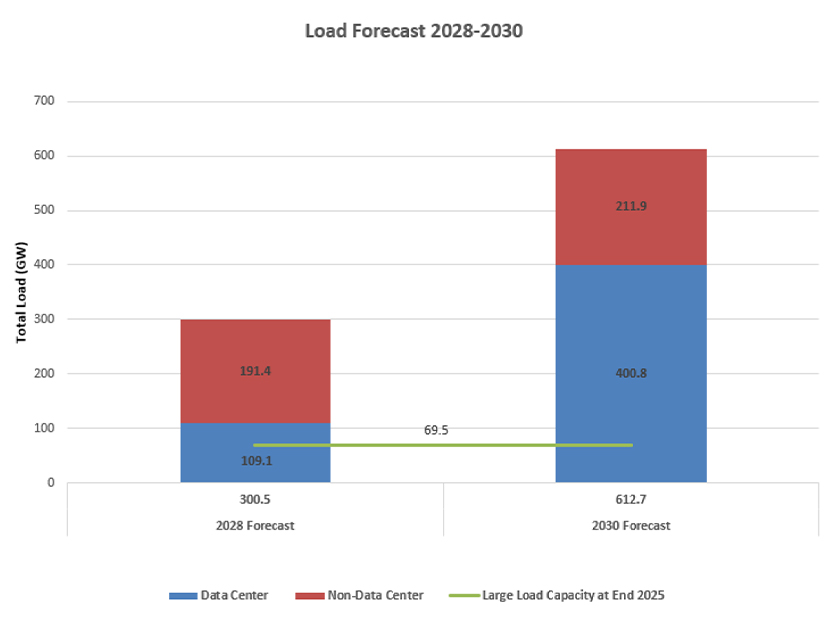
In one chart, NERC aggregated entities’ predictions for the demand associated with large loads in 2028 and 2030 as 300.5 GW and 612.7 GW, respectively — significantly more than the 69.5 GW recorded at the end of 2025. About one-third of the demand in 2028, 109.1 GW, is expected to consist of data centers. That share is expected to more than double two years later to 400.8 GW. However, NERC cautioned its confidence in these figures is “questionable due to the differences associated with entity interpretations on the word ‘forecast.’”
NERC also found that “entities largely did not have a formalized definition of ‘large load.’” Those that did revealed a wide range of thresholds, ranging from 100 kW to 400 MW. The greatest number of respondents to this question, which was directed to TOs and DPs, indicated their cutoff was either 50 or 75 MW. About 50 respondents each chose one of these options.
Other popular selections were 10, 20 and 25 MW, each of which was chosen by about 20 utilities. NERC indicated that DPs tended to report thresholds below 20 MW, while all TO respondents reported thresholds above this level.
Recommendations Unfulfilled
The Level 2 alert listed five recommendations related to maintaining reliability with large loads:
-
- TOs should create clear facility design and performance criteria in their interconnection requirements for large loads;
- TPs and PCs should establish a comprehensive interconnection and systemwide study process to assess the reliability impacts of large loads;
- TOs need a comprehensive load commissioning process that ensures operational readiness for large loads;
- TOs should establish operating protocols and communication infrastructure to support reliable ongoing operations after large load facilities enter commercial operations; and
- TPs, RPs and PCs should identify and implement a process to include large loads in their near-term and long-term planning horizon demand forecasts.
Responses to the questions showed many utilities have not taken steps to meet these recommendations, NERC wrote, indicating “that additional steps are needed to reliably integrate computational loads.” The ERO is working on several follow-up actions.
First, NERC plans to issue a Level 3 alert on computational large loads by May. Unlike Level 2, a Level 3 alert identifies specific actions deemed essential for certain stakeholders to maintain grid reliability. NERC’s Board of Trustees must approve the issuance of a Level 3 alert.
Second, the ERO expects to draft registry criteria updates to address the integration of computational loads, along with updating reliability standards as needed. These efforts are scheduled to begin in the second quarter of 2026. NERC’s third planned action is to release a reliability guideline in mid-2026 that will “immediately share best practices to improve reliability.”
NERC encouraged registered entities to stay up to date on the initiatives by following its Large Loads Action Plan webpage.