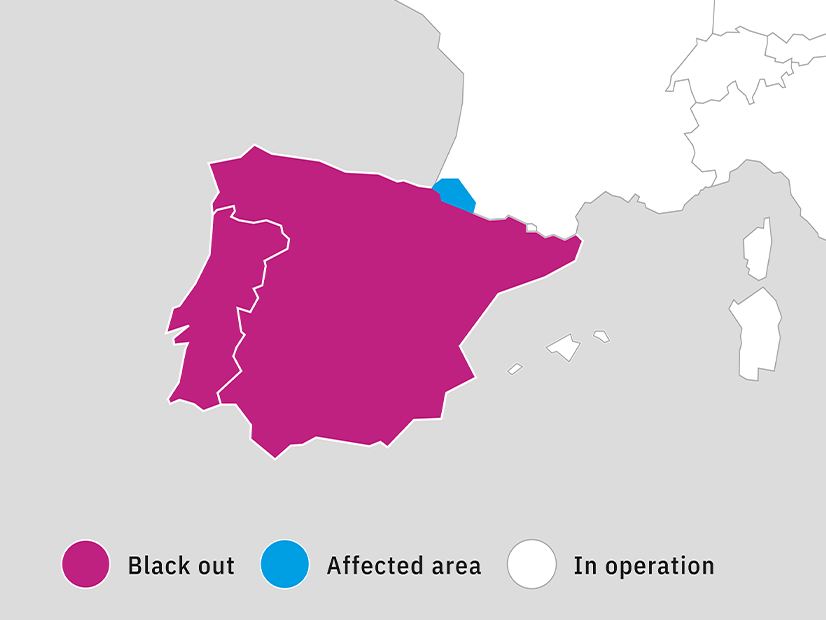
The European Network of Transmission System Operators’ (ENTSO-E) final report on the Iberian Peninsula blackout of April 2025 lays out the root causes and chain of events that led to the collapse of the grid, providing critiques of the numerous points of failure.
Much of 472-page document, released March 20, consists of the organization’s factual report, released in October 2025, but it also includes a detailed root-cause analysis and recommendations for preventing future outages, as well as additional data that were not previously available. (See European Regulator Issues ‘Factual Report’ on Iberian Outages.)
The report’s findings largely align with those of the Spanish government and grid operator, which concluded the blackout occurred because traditional synchronous generation could not provide adequate control of high voltage resulting from frequency oscillations, exacerbated by a faulty power plant controller.
To submit a commentary on this topic, email forum@rtoinsider.com.
ENTSO-E stresses throughout the report that no single factor led to the collapse and that any one of the factors by itself would not have been a problem. Instead, it created a large root-cause tree displaying the multiple factors that led to a very fast voltage increase (page 332).
The roots of the tree include:
-
- no explicit criteria concerning dynamic behavior for conventional generators’ reactive power;
- no economic consequences for generators if their voltage-control requirements were not met;
- renewable resources operate in fixed power factor mode; and
- the design of voltage control of local generation networks not aligned with system needs.
The report separates its recommendations based on whether they are related to the root causes and gives each a priority label. ENTSO-E said generators should operate in voltage-control mode whenever possible and that transmission system operators (TSOs) should ensure there are enough voltage-control and monitoring equipment on the grid.
It also said TSOs need to enforce Europe’s harmonized voltage operating range: Spain allows its grid to operate up to 435 kV, while the rest of the continent allows up to 420 kV.
Finally, ENTSO-E said a common procedure should be established to create a snapshot after a significant event, allowing for accurate simulations of the system under similar conditions to those of the event. It noted that it had to rely on incomplete data, particularly from Spanish TSOs.
“This blackout highlights how developments at the local level can have systemwide implications and underlines the importance of maintaining strong links between local and European system behavior and coordination, while ensuring that market mechanisms, regulatory frameworks and energy policies remain aligned with the physical limits of the system,” ENTSO-E said.