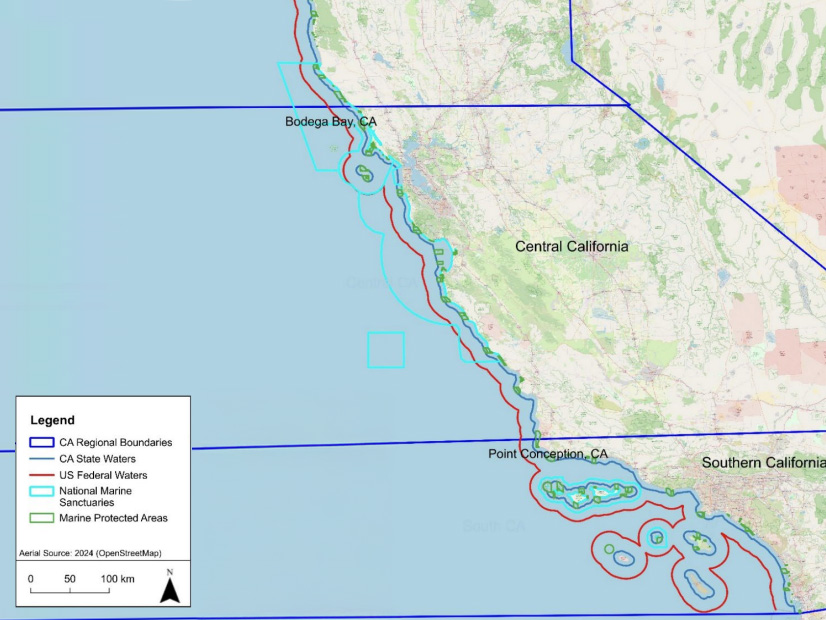
California has a significant amount of marine energy potential in the northern part of the state but much less in the south, a new California Energy Commission report has found.
The report, a requirement of California Senate Bill 605, evaluated two forms of ocean energy: wave and tidal energy. Both are renewable energy resources that could provide support for intermittent renewable resources like wind and solar power, CEC staff said in an April 2 workshop on the subject.
The report separated the state into three regions: Northern, Central and Southern California.
Northern California, defined as the region from Bodega Bay north to the Oregon border, contains substantial areas of moderate to high wave energy within 6 miles of shore. But the region has a lower population than other parts of the California coast.
Central California has a medium level of wave energy potential and the highest tidal energy potential, due to the large tidal inlets in the region, such as the San Francisco Bay and the San Pablo Bay. But the region has many constraints and conflicts to access its marine energy due to higher populations and ports.
Southern California has low to no tidal energy potential due to the lack of large tidal inlets, yet has high energy demand and substantial energy infrastructure, the report says.
Each of the three regions contains constraints, such as already being assigned as U.S. Bureau of Ocean Energy Management wind lease areas or oil and gas planning and lease areas, or being far from onshore electrical infrastructure.
Due to these constraints, a more realistic use of ocean energy could be for non-grid-connected applications, such as equipment in ports and harbors, marine aquaculture and scientific research equipment, the report says. The economic and societal barriers to entry are much lower in these application areas than on commercial-scale sites where developments must reach a certain size to compete economically with alternative power generation methods, the report says.
Another possible approach to kickstarting ocean energy projects in California could be building them with offshore wind projects. The land and nearshore components of marine energy and wind energy operations could be used together, potentially reducing the overall spatial and visual impact of that supporting infrastructure, the report says.
The report also outlined some other, more unusual, ways to use wave energy. One of those is to power underwater charging stations for autonomous vehicles.
Next, the CEC will submit a summary report of these findings to the California legislature and Gov. Gavin Newsom. The agency also plans to engage more key stakeholders in the process because the marine renewable energy industry “is still emerging with few commercial-scale projects in operation, so the public’s knowledge on these topics is limited,” the report says.