Continued growth of blockchain and crypto mining operations in the Texas Interconnection could “threaten the reliability of the interconnection” through indirect load loss effects, according to a report recently published by NERC.
The Considering Voltage-Sensitive Crypto Load Reductions report, published Jan. 7, is NERC’s first incident review of 2026. The ERO produced the document to highlight the unique characteristics of crypto mining facilities and how they differ from other emerging large electronic loads such as cloud computing and artificial intelligence data centers.
“As these facilities rely heavily on constant-power electronic supplies, cooling equipment and single-phase devices that respond to normally cleared transmission faults, they experience load drops within milliseconds of a voltage sag,” the report’s authors wrote. “Restoration times vary widely depending on equipment configuration and the level of manual intervention required. Understanding these behaviors is essential for assessing grid impacts, interpreting event data, and developing appropriate ride-through expectations and mitigation strategies.”
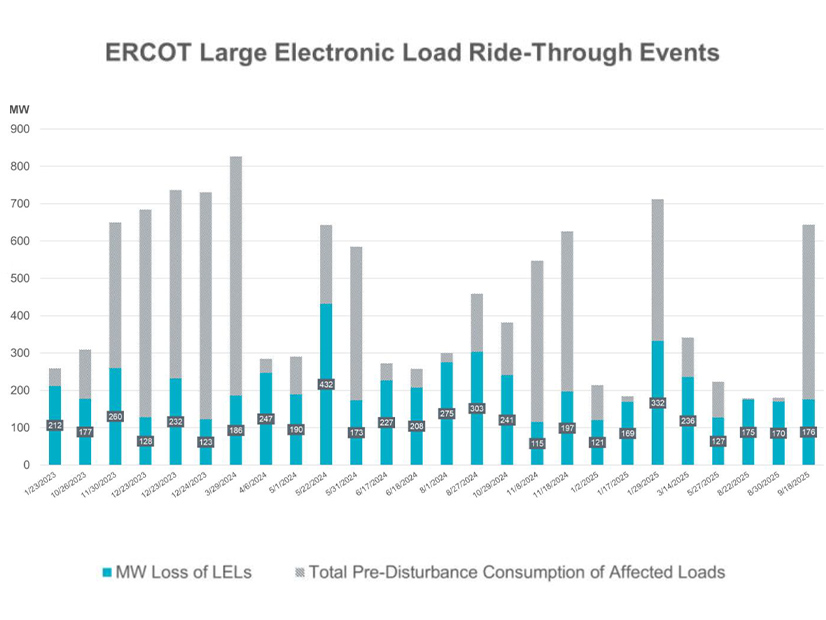
Between January 2023 and September 2025, ERCOT has experienced 26 large electronic load ride-through events involving one or more crypto facilities with indirect load loss of at least 100 MW, according to the report. The incidents “primarily occurred in central Texas, far west Texas, the Panhandle and the North Zone,” with impacts ranging from 17 to 95% of pre-disturbance consumption.
NERC staff emphasized that the load loss attributed to crypto facilities is indirect, meaning that it arises “from system or grid effects” rather than line outages. The events “verified that crypto facilities exhibit sensitive ride-through behavior, reducing consumption rapidly in response to voltage dips, particularly when single-phase voltage falls below approximately 0.7 p.u. [per unit].”
This behavior deviates from that suggested by the Information Technology Industry Council, which created the ITIC curve to illustrate the “AC voltage limits that most information technology equipment (ITE) can endure without experiencing unexpected shutdowns or malfunctions,” the authors wrote.
According to the ITIC curve, “voltage sags down to 70% of the root mean square nominal voltage are acceptable if the duration does not exceed 0.5 seconds.” Voltage sags below 70% of the RMS nominal voltage can lead to dropout events, which cause equipment to stop functioning. A dropout that lasts longer than one AC cycle enters a “no damage region” where the ITE shuts down.
But “multiple instances of partial loss of load have been observed” in voltage depressions “close to the boundaries of the … ITIC curve at the [point of interconnection]/utility connection,” NERC staff wrote.
The report cited a lightning strike on 138-kV lines that caused a fault affecting two crypto facilities. The first experienced a multiphase voltage depression that “reduced both A-phase and B-phase voltages below 0.7 p.u. for more than 20 milliseconds [with] the reduction in active power for A-phase and B-phase [accounting] for 80% of the total reduction.” Current levels rose to about 160% of pre-fault levels during the disturbance, with the facility requiring almost two hours to return to normal consumption.
At the second facility, only the A-phase was affected, dipping below 0.7 p.u. for more than 20 milliseconds. The reduction in active power for the A-phase accounted for 70% of total reduction, with current increasing to about 150% of pre-fault magnitude, and “load was fully restored in approximately five minutes.”
The report acknowledged that crypto mining facilities can vary widely in their design and equipment, which can affect their behavior during grid events. These differences include the type of overcurrent protection used, transformer configuration between the facility and the utility connection, and cooling systems whose failure can lead to a complete facility shutdown during normally cleared transmission system faults.
NERC’s report suggested “additional analysis, equipment adjustments and operational improvements [in these areas] may be needed” to improve crypto facilities’ ride-through performance and reliability, while observing that some efforts along these lines are already underway. For example, the authors wrote that ERCOT is considering introducing ride-through requirements for cooling systems.
Additional suggested areas of study include variability in restoration times and interconnection requirements for crypto facilities, especially those that are also transitioning toward AI or cloud workloads. The report suggested that such changes could introduce additional variables to load behavior and ride-through characteristics.