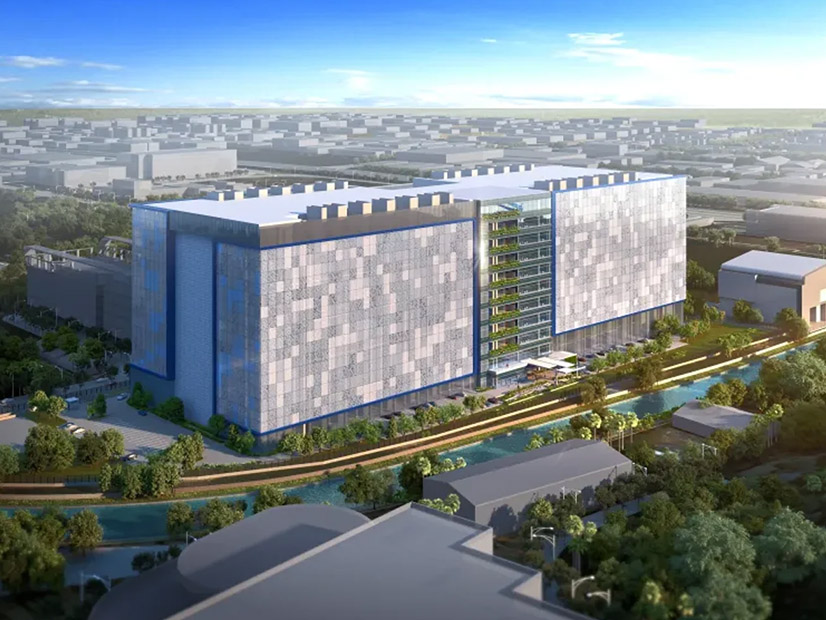
Earthjustice accused Meta of deliberately executing an unsanctioned financial arrangement to underwrite its planned, multibillion-dollar data center in northern Louisiana and asked the Louisiana Public Service Commission to investigate.
Representing the Alliance for Affordable Energy and the Union of Concerned Scientists, Earthjustice said it appeared Meta had ulterior motives for the financial risk it was willing to undertake for the data center.
Meta did not reply to a request for comment on the allegations.
In a Jan. 14 motion for investigation to the Louisiana PSC, the environmental law center said “immediately after” the commission approved Entergy Louisiana’s application for three new gas plants to power the data center in August 2025, Meta “fundamentally altered” the financing structure of the project.
Enter asset management firm Blue Owl Capital. In late summer, it and Meta created the joint venture Beignet Investor, which now reportedly owns an 80% stake in the data center. Meta owns the remaining 20%. Beignet acquired Meta company Laidley to secure the majority ownership. (Stay with us here.)
When the Louisiana PSC approved Entergy’s power supply proposal for the data center, Meta used Laidley, its development affiliate, to represent itself. Laidley is the sole signatory to the data center’s energy service agreement with Entergy Louisiana for the three natural gas plants. Earthjustice noted that Beignet Investor registered as a limited liability company in Delaware on Aug. 20, 2025, the same day the Louisiana PSC voted 4-1 to approve Entergy’s supply contracts (U-37425). (See Louisiana PSC Approves 3 Controversial Gas Plants Ahead of Schedule for Meta Data Center.)
Now, Meta would pay rent to Beignet to use the Meta Hyperion data center, with the option to exit the lease every four years. Should Meta decide to depart, Beignet would sell the center to pay outstanding bonds and then pay itself, Earthjustice told the Louisiana PSC. If sale proceeds fall short of what’s owed to bondholders combined with Blue Owl’s investment, then Meta would pay the difference. Meta would guarantee its rent and payment obligations via parent guaranty to Blue Owl.
To submit a commentary on this topic, email forum@rtoinsider.com.
Earthjustice said because Meta already has significant debt load, Blue Owl invested $3 billion for an 80% stake in the Hyperion data center. Meta’s existing $1.3 billion investment earned it the remaining 20%.
Beignet then borrowed $27 billion for the project. The new LLC has no assets beyond the data center; Earthjustice said that makes it a “riskier partner as the guarantor” of the supply arrangement with Entergy.
Meta’s rent payments would go to bond interest and principal payments, as well as dividends for Blue Owl.
The joint venture between Meta and Blue Owl is the largest private credit transaction ever and allowed Meta to receive a $3 billion cash distribution from the venture upon closing.
The convoluted arrangement was referred to as “Frankenstein financing” by The Wall Street Journal, which published a Nov. 11 investigative piece on the labyrinthine financing Big Tech uses to break ground on data centers.
‘A Secret’
Earthjustice said the “remarkable,” same-day creation of Beignet “illustrates that Meta and Blue Owl were working behind the scenes to significantly alter the financial structure of the data center project while the proceeding to examine the now irrelevant data center financial structure was ongoing.”
“Meta kept this significant change a secret, just like Meta kept how they developed their load forecast and how they determined their job numbers a secret,” Earthjustice claimed, adding that the PSC needs to know the facts behind the funding of the data center.
Earthjustice said if the AI boom were to dry up, Meta could walk away from the deal as soon as 2033. It said by then, the data center could lose prospects for another buyer and depreciate.
Meta, Entergy and the Louisiana PSC expect construction on the data center campus to continue through 2030.
“This novel financial arrangement lets Meta add computing power quickly and then wait to see how demand for AI shapes up before fully committing to projects that can last for decades. Thus, Meta is off-loading its own risk by placing that financial risk on others, including ratepayers who will be on the hook for all the infrastructure built solely for this data center should Meta exercise its option to walk away,” Earthjustice argued. The law organization said all the ratepayer protections the Louisiana PSC hammered out in its approval are “at best, called into question” because Meta no longer is Laidley’s parent company.
Throughout the PSC’s consideration of the gas plants to power the data center, the Alliance for Affordable Energy and the Union of Concerned Scientists voiced concern of the risk of after-the-fact changes to the electric service agreement with Entergy, the risk of stranded costs or capital cost overruns on the gas plants and an “inappropriately short” 15-year contract term on the power supplied by Entergy.
“This new, novel financial arrangement, which very likely was withheld from the commission prior to its action on [Entergy Louisiana’s] application, calls into question the meager ratepayer protections included in the application and contested settlement agreement and undermines the assumptions made by the commission when it voted to approve the application,” Earthjustice wrote.
The Louisiana PSC approved consumer protections including a provision that Meta’s minimum bill payments would cover 100% of the costs of the trio of generating units, including cost overruns. Meta also agreed to fund development of 1.5 GW of solar generation under the state’s Geaux Zero program and to provide up to $1 million per year for Entergy’s Power to Care, which is a bill assistance program for low-income, elderly and disabled Entergy Louisiana customers.
Entergy has entered the first of three gas plants into MISO’s expedited interconnection queue and submitted the 500-kV facilities needed to connect the data center into MISO’s expedited transmission approval process.
At publication time, Meta did not respond to RTO Insider’s questions on whether the new financing arrangement would transfer more risk to Entergy’s ratepayers; who would be responsible for termination fees should Meta take Beignet up on one of the four-year exit options; and whether Meta is prepared to honor its end of the deal as spelled out in the Louisiana PSC’s original approval order even with the additional investors involved.
Investigation Request
Earthjustice asked the PSC to launch an investigation to decide whether it was deliberately misled and establish the new financial setup’s effect on ratepayer protections. It also said the commission should open a prudence review to figure out whether Entergy Louisiana was aware of the financial reformatting and to decide whether it’s wise to allow Entergy to continue with the trio of gas plants.
Finally, Earthjustice said the PSC should direct Entergy Louisiana to file a copy of the “parent guaranty that is executed by Laidley’s current parent that does not include a cap on the parent’s cumulative liability;” and order Entergy to file a legal opinion clarifying that the parent is bound by the parent guaranty and confirming that termination payments to Entergy must be paid out before investors are compensated.
Meanwhile, Entergy is seeking a 10-year property tax exemption worth an estimated $237 million to build the first 1.5-GW natural gas plant for the Meta data center campus. Entergy submitted the application under Louisiana’s Industrial Tax Exemption Program, which waives local property taxes on some industrial projects.
Entergy plans to build the more than $2.3 billion Titanium Power Station first, which would consist of two combined-cycle combustion turbines.
Entergy has pledged that Meta will foot the bill for the power station — at least for the contract length of the first 15 years of the generating unit’s life — and that it should save ratepayers about $650 million in the long run.