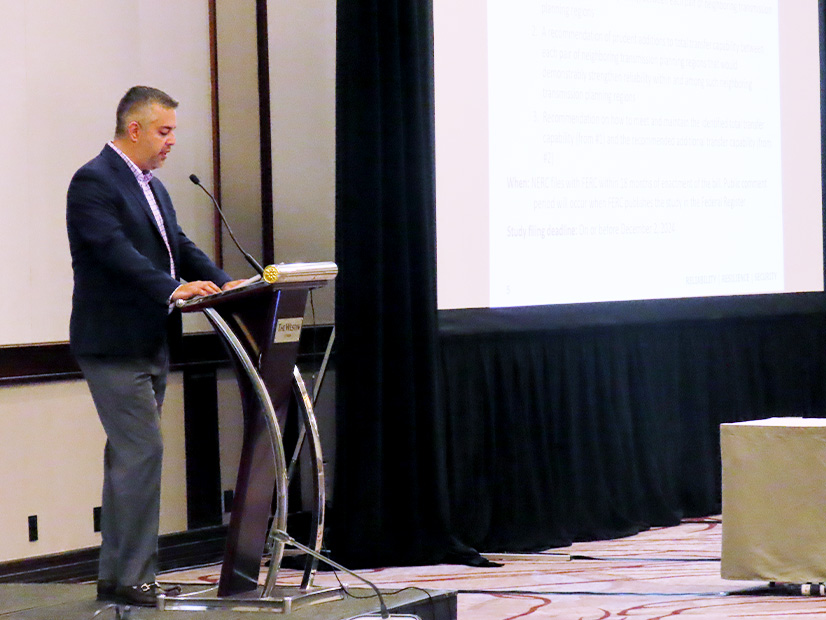
Speaking to members of NERC’s Reliability and Security Technical Committee, ERO Director of Reliability Assessments John Moura said the organization will continue to follow priorities developed over its previous three-year plan, which expired at the end of 2025.
Moura joined the RSTC’s annual work plan summit, hosted at the headquarters of Oglethorpe Power on Jan. 20, to share the ERO’s work plan priorities for 2026. NERC CEO Jim Robb said in 2025 that the ERO planned to approach 2026 as a “bridge year” between three-year plans in light of uncertainty around multiple issues including large loads, gas-electric coordination and trade policy that made long-term planning “a fool’s mission” at the time. (See 2026 to be ‘Bridge Year’ for NERC Budget.)
NERC is “already working on [the] next revision of a long-term strategy,” Moura said, but in the meantime is following the priorities of the previous plan. Those priorities are grouped into four categories: energy, security, engagement, and agility and sustainability.
The energy category involves “deepening and broadening” stakeholders’ understanding of reliability risks by improving the ERO’s reliability assessments. Interconnection-wide energy assessments will be a part of this effort beginning next year after a pilot program launched in 2025 to establish common platforms and standardized assumptions for the Eastern, Western and Texas interconnections, Moura said.
Another aspect of the energy category is addressing the reliability risks posed by data centers and other large loads by completing reliability guidelines that are already under development and developing new reliability standards if necessary. NERC may also conduct industry outreach and education on mitigation measures.
The next category, security, involves the rapidly developing landscape of threats against the grid’s cyber and physical assets. NERC aims to advance the grid’s resilience through multiple initiatives, including threat analysis through the Electricity Information Sharing and Analysis Center, the GridSecCon security conference and other mechanisms. NERC will also keep industry and policy makers informed of security threats and other priorities as part of the third category, engagement.
The final priority, agility and sustainability, involves updating the ERO’s internal process. A major area of focus here is the ERO’s efforts to modernize its standards development process. Moura also included NERC’s work on improving data access and efficiency by enhancing its software tools and leveraging artificial intelligence tools where appropriate.
Asked by RSTC Chair Rich Hydzik what issues NERC sees as most pressing in terms of impacts on grid reliability, Moura named the growth of demand outstripping the pace of construction, along with shifts in demand that challenge grid planners’ assumptions.
“I think the biggest trend we’ve seen … is this shift from summer risk, where you traditionally were peaking … and that’s slowly changing, where we’re actually seeing a lot of risk during the winter,” Moura said. “Not a lot of solutions that we’re building are for winter. We’re building a lot of storage, a lot of solar, [and that’s] not very good for winter.”
NERC Chief Engineer Mark Lauby added that the grid’s dynamic performance is another growing source of concern for the ERO, suggesting that building the tools to understand the system must be a priority for grid planners.
“How do we design the system so that it [has] the stiffness it needs [and] the ability to sustain events on the system? We need to have good dynamic models to do that,” Lauby said. “I worry that, right now, I don’t think we have a real good perspective of what’s happening on the interconnection and what’s happening on your neighbor’s system, and how that’s going to impact your system. So I think those are the things that keep me up at night.”