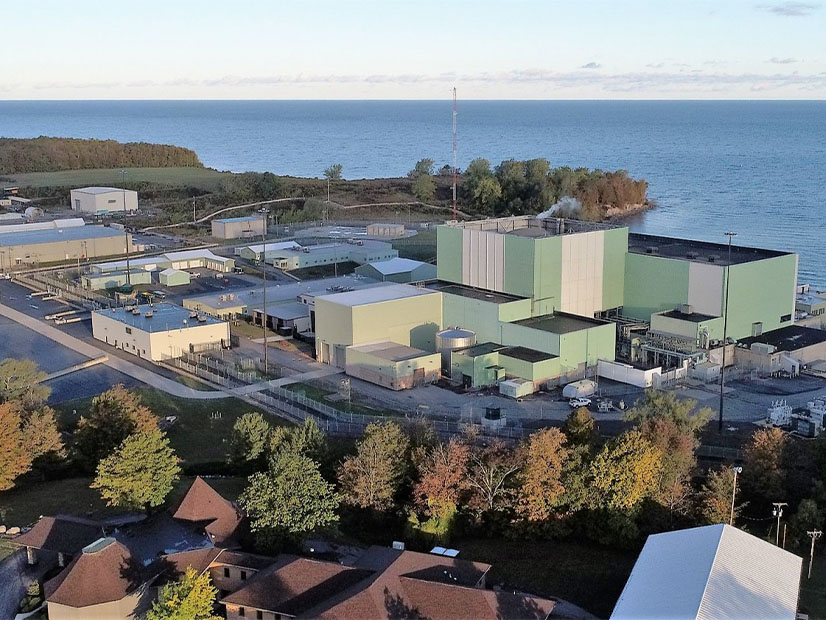
New York is extending its nuclear power subsidies as far as 2049 at a cost to ratepayers as high as $33.4 billion.
The four reactors and their 3.36 GW of output constitute an indispensable part of New York’s power portfolio and decarbonization strategy, NYISO and various stakeholders have said.
They are expensive to operate, however, and not economical at market power prices.
The state in 2016 created the nation’s first Zero-Emissions Credit (ZEC) program in recognition of these factors, and on Jan. 22, the Public Service Commission (PSC) extended the program’s expiration date from 2029 to 2049 (case 15-E-0302).
Constellation Energy, which operates all four reactors, has sought financial certainty as it plans the future of the two oldest operating reactors in the nation. They are licensed to operate only into 2029, and the deadlines to apply for their relicensing are March and June 2026.
“Failing to extend the ZEC program creates a risk of these plants closing, which could have significant impacts on reliability, resource adequacy and achievement of statewide clean-energy goals,” PSC Chair Rory Christian said in a news release.
Later Jan. 22, Constellation said it was still reviewing the order and deferred comment.
The PSC had long been moving toward extension, and in a July 2025 white paper, its staff at the Department of Public Service laid out the justification for what is being called ZEC 2.0.
A broad range of commenters offered opinions in support or opposition for a broad range of reasons.
Many clean energy advocates in the state are particularly unhappy that the state is embracing nuclear rather than doubling down on renewable energy.
New York is a national leader in small-scale solar, but deployment of wind, large-scale solar and storage so far has not matched grand ambitions, and it is unlikely to get easier under President Donald Trump.
The four reactors are a combined 202 years old. But unlike the planned wind and solar farms, they are online now and they produce a lot of power — 21% of in-state generation and more than 40% of the state’s emissions-free power.
NYISO reports that the reactors, with a combined nameplate capacity of 3.36 GW, generated 27,073 GWh in 2024.
The four reactors typically post annual capacity factors in the low- to mid-90% range and are steady except for refueling outages.
The output of New York’s wind and solar installations varies noticeably by region and greatly by time of day or time of year. NYISO assigned a capacity accreditation factor of 10.5 to 12.24% to solar panels for the 2025/26 capability year and 16.61 to 18.2% for land-based wind, with exact amount depending on location.
Mixed Reactions
Meanwhile, the state’s existing fossil generation is aging, the Trump administration is blocking offshore wind development, land-based renewables are slow and increasingly expensive to deploy, the governor’s vision of new nuclear development may not become reality for a decade, and the dispatchable emissions-free resources state energy planners are counting on to backstop a carbon-free grid do not exist in scalable or economical form.
The existing nuclear reactors, therefore, are viewed as indispensable and, for now, irreplaceable.
In Oct. 20 comments submitted on the ZEC proceeding, NYISO wrote: “The existing fleet of four nuclear generation resources must remain operational to avoid resource adequacy shortfalls and other electric system reliability issues.”
ZEC 1.0 cost $468.4 million to $600.5 million per year and $3.73 billion total in its first seven years.
ZEC 2.0 is capped at $33.4 billion, or about $1.6 billion a year, but DPS staff said the actual cost to ratepayers is expected to be much less — perhaps more than 50% less — due to rising market revenue for the electricity they produce.
The costs to consumers resulting from retirement of the reactors would be greater, staff said.
ZEC 2.0 was modified to include contract performance requirements, a mechanism to reduce the payments if Constellation obtains other financial support, a four-year review process and other ratepayer safeguards.
The PSC vote was cheered by Carbon Free NY, a business-labor-environmental-community coalition that includes Constellation.
John Carlson of the Clean Air Task Force said: “The ZEC program supports more than 14,000 jobs across the state and prevents more than 16 million tons of carbon pollution each year, providing the foundation for a more affordable and cleaner grid for New Yorkers. We applaud the New York Public Service Commission for extending the ZEC program to preserve existing nuclear resources and bolster the program’s tangible economic public health benefits.”
Food & Water Watch decried what it called a massive corporate bailout — the largest single use of ratepayer dollars and the largest subsidy to a single company ever approved by the PSC.
“It’s outrageous that New Yorkers will once again be forced to bail out this toxic, money-burning industry with billions and billions more in the coming years. Despite decades of evidence that nuclear power is both inherently dangerous and cost-foolish, Governor [Kathy] Hochul insists on throwing good money after bad, with everyday families footing the bill,” said Food & Water Watch’s New York state director, Laura Shindell.
The most recent nuclear reactor retirements in New York — Indian Point units 2 and 3 in 2020 and 2021 — resulted in a substantial increase in reliance on natural gas-fired generation.
NYISO reports 51.4% of the electricity generated in New York was produced with fossil fuels in 2024, compared with 39% in 2019, the last year of full operation for Indian Point.