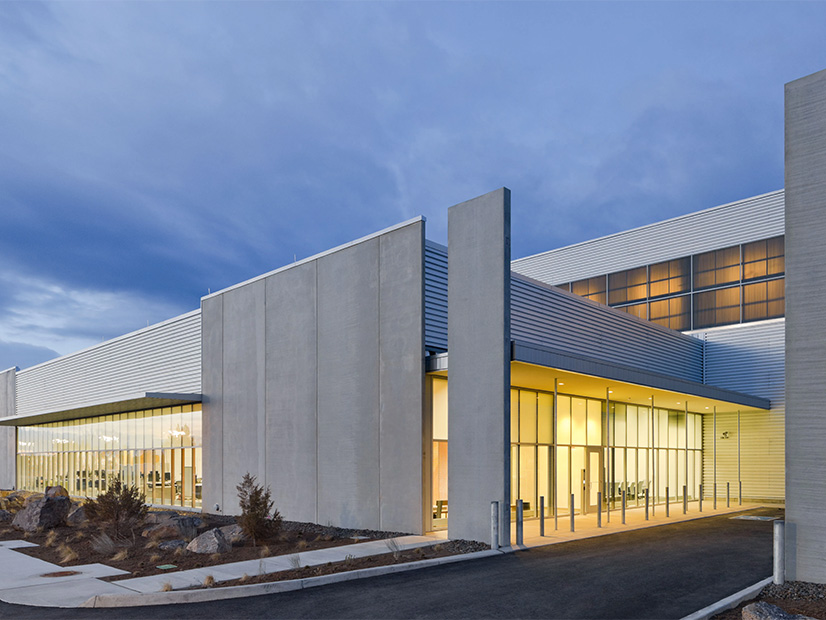
California continues to go all in on data center development, with Pacific Gas and Electric playing its role in the last quarter of 2025 by pushing gigawatts of projects through the investor-owned utility’s design and approval process.
From Q3 to Q4 2025, about 2 GW of data center projects moved into PG&E’s final engineering phase. An additional 50 MW began construction during that time.
“We are excited by the opportunity to bring on large loads and deliver savings to our bundled customers,” PG&E CEO Patti Poppe said during the utility’s Feb. 12 earnings call, which covered Q4 and full-year performance. “The good news is that real [data center] load growth in project stages makes [future load] very real. We have lots of confidence about that.”
An example of PG&E aiding data centers is a recent 20-MW project in San Jose owned by Equinix. The Equinix project is part of a joint agreement between the IOU and the City of San Jose to bring data centers on faster, Poppe said.
The data center will receive power through PG&E’s Santa Teresa substation, which was renovated to meet the new load. Equinix paid for the necessary substation upgrades, PG&E said in a Jan. 22 release.
“This [project] was an opportunity to demonstrate that PG&E is delivering on our promise to provide fast, reliable power to large energy users,” Poppe said.
One analyst on the call asked if the improved visibility of real data center load will help PG&E have “line-of-sight to higher growth.”
“I would say … yes,” Poppe said. “We had previously said that 1.5 GW of [data center load] would be online by 2030. Now we are saying it’s closer to 1.8 GW [that] would be online by 2030. Obviously that continues to change and evolve as we get more applications, we combine projects and bring things online faster.”
Data center load could lower customer bills, Poppe said.
“For each gigawatt of large load, we see the potential to drive savings of 1% or more on average monthly electric bills,” Poppe said. “To do this, it is actually quite simple: We just need to get the price right.”
“We want a relationship between data centers and customer affordability — [this is] receiving a lot of attention at the national level,” Poppe said.
Everyone should understand the value of the IOU model and how important attracting low-cost, high-quality investment is to spreading the cost for infrastructure for customers over the long haul, Poppe said.
In 2025, PG&E’s capital expenditures were $13.4 billion, with $12.4 billion forecast for 2026, $13.4 billion for 2027 and $15.4 billion for 2028. In addition to these forecast expenditures, PG&E identified opportunities for investment in transmission infrastructure for data centers, the IOU said in its Q4 2025 Form 10-k filing.
“There’s other things … that we’ve got in the hopper to help drive affordability [like] supply cost. There’s a lot that goes into a customer’s bill to help get us to that 0% to 3% [bill increase] range,” Poppe said.
PG&E’s unadjusted earnings came in at just over $3.3 billion for 2025 ($1.50/share), compared with $2.9 billion in 2024 ($1.36/share).