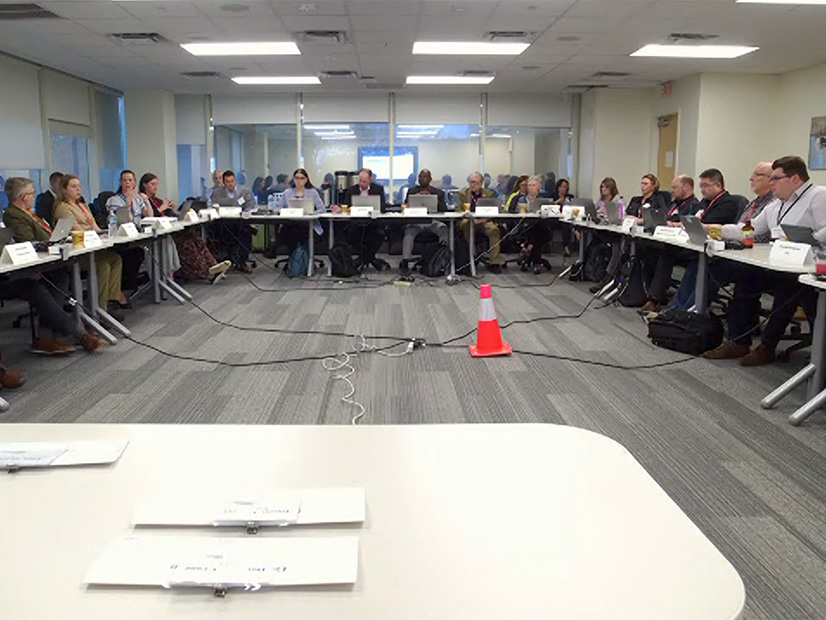
A new standards development project is a chance for NERC to pilot some of the recommendations from the ERO’s Modernization of Standards Processes and Procedures Task Force, ERO staff told members of the organization’s Standards Committee at their monthly meeting March 18.
The project will focus on computational large loads such as data centers, artificial intelligence computing clusters and cryptocurrency mining, an issue Howard Gugel, NERC’s senior vice president for regulatory oversight, reminded attendees “is coming at us like a freight train.”
“I just talked with a utility [whose] peak load is about 2,500 MW, and they have 15,000 MW of data center load that wants to connect to their system,” Gugel said. “It’s going to be important for us to get this right [and also] to move quickly on this. The data center folks want consistent, uniform standards across North America, and I think the transmission owners want some guidance as to what should be done … to make sure that everything operates reliably.”
That “need for speed” also made the new standards project a good candidate to test out the efficiency improvements proposed in the MSPPTF recommendations approved by the Board of Trustees in February, NERC Manager of Standards Development Sandhya Madan told SC members. (See NERC Board Accepts MSPPTF Recommendations.)
Among those recommendations were using AI to help NERC staff create a term sheet outlining the goals of the proposed standard, and the creation of a pool of subject matter experts to oversee standard development rather than the current practice of creating a dedicated standard drafting team, whose members must be recruited from industry and approved by the SC. (See NERC Modernization Task Force Leaders Present Final Recommendations.)
NERC is planning to test both proposals with the large loads project, Madan said, emphasizing that any experimentation would be “within the bounds of the current” Standard Processes Manual. She told attendees NERC had identified a group of SMEs that were “appropriately vetted and have already demonstrated some level of commitment to addressing emerging risk,” and recommended that these experts — who were not identified by name during the meeting — be chosen as the drafting team for the project.
Alison Oswald, manager of standards development at NERC, added that the ERO is “working on developing a template for a term sheet,” which the drafting team will use to create “a high-level explanation of who a standard would apply to, what goals it is trying to meet [and] what kind of requirements it might cover.”
NERC sees the project itself — which the ERO has dubbed Project 2026-02 after its approval by the SC — as the first phase of a larger effort, Madan said. This stage will focus on drafting new definitions for NERC’s Glossary of Terms, including for “computational load” and “computational load entity.”
Phase 1 will also initiate development of one or more standards to address “near-term” risks associated with computational large loads. These risks include reduced visibility into large load centers, potential instability during system disturbances and “increasing certainty for both system planning and real-time operations,” Madan said.
Michael Goggin of Grid Strategies pointed out a lack of representation by independent power producers on the proposed team and asked if there was any potential to “add one or two people to bring in that perspective” while still approving the rest of the slate. Gugel observed that the SC “at any point could bring a motion forward to do an augmentation for any standard drafting team.” Goggin agreed that this “may be a viable path” to add the needed expertise.
Final IBR Standards to be Posted
Only two other standards projects came before the committee, both of which address the final milestone of FERC Order 901, covering operational and planning studies for inverter-based resources.
The team for Project 2025-03 (Order No. 901 operational studies) brought a request to authorize posting two proposed standards for a 45-calendar-day formal comment and ballot period: TOP-003-9 (Transmission operator and balancing authority data and information specification and collection) and IRO-010-7 (Reliability coordinator data information specification and collection). (The standards are found on pages 36 and 64 of the committee’s agenda, respectively.)
According to Madan, the proposed standards would address FERC’s directive by including “IBR performance and behavior in operational assessments and real-time monitoring of individual IBR plants,” along with aggregated IBRs across an operator’s footprint.” They would also require distributed energy resources to be included in operational assessments.
At the same time, Project 2025-04 (Order No. 901 planning studies) requested that the SC post TPL-001-6 (Transmission system planning performance requirements) for comment and ballot (page 99 of the agenda). Madan explained that the standard includes new requirements to study registered and unregistered IBRs, including distributed IBRs, in planning assessments.
Both requests were accepted without objection by SC members.