FPL Urges Other Members to Start Using AI
Representatives of Florida Power & Light urged fellow SERC Reliability members to start using artificial intelligence tools, even in their own personal lives, warning that its use on the grid is spreading too rapidly to not understand how it works.
To that end, Robert Wargo, senior director of the utility’s Critical Infrastructure Protection program, and Robert Adams, senior director of compliance and regulatory affairs, briefed members at SERC’s annual meetings March 25 in Jupiter, Fla. on the many ways their utility is using AI to monitor its distribution grid, reduce outage times and avoid outages entirely.
Like virtually every state in the country, Florida is experiencing surging load growth that is expected to accelerate, driven primarily by the proliferation of data centers, and the Sunshine State is hurriedly building solar resources to meet it. “Think of a dispatcher in the future with all this volatile load out there,” Adams said. In the past, “generation was pretty stable. You had a defined number of generating plants, and nothing moved horribly quickly on the transmission grid.”
But “transmission is actually becoming a lot more distribution-like with that volatility, and that system operator is going to get absolutely overwhelmed with data inputs. … You go from roughly 20 generation plants to hundreds of generating plants and batteries. The number of contingencies that’s going to generate for a system operator is infinite.”
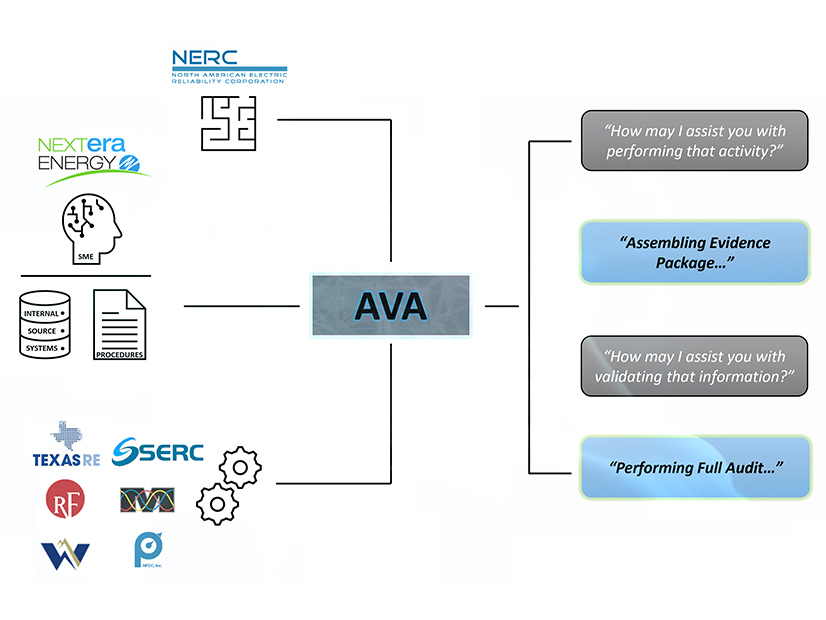
Wargo talked about NextEra Energy’s new NERC Information Command Center, which includes an Advanced Virtual Auditing (AVA) tool that constantly monitors compliance with the ERO’s Critical Infrastructure Protection. “Ava,” which Wargo referred to with she/her pronouns, can recognize voice commands and speak. “She is constantly in the background, checking our compliance. No longer do we have to say, ‘OK, we’re going spend six months with three people doing spot checks to see if we’re compliant.’ We have instant awareness of whether we are compliant.”
In between detailing AI’s uses for grid reliability, however, Wargo and Adams acknowledged a general hesitancy to use AI. They urged attendees to simply try using it in their personal lives first.
“We have to lead our teams through this transition,” Adams said. “All of the employees are afraid of AI, and if you’re not an AI user today, I strongly encourage you: Go plan a date with your significant other. Start with that. … ‘My wife does not like fish, but I want to take her out to dinner. Give me five recommendations for a great date night.’ I’m not kidding. Works like a champ.”
One attendee asked about the best way for smaller utilities to start using AI. After encouraging him to partner with larger entities, Adams noted that Microsoft’s programs — “some of the stuff that you use every day” — now have AI software embedded in them.
“AI is being integrated into all of our systems. … Every one of the Microsoft products you use has AI enabled in it, and it is transforming Word and Excel, especially. PowerPoint hasn’t quite caught up yet; I keep praying.
“Keep the human in the center,” he urged. “It is a very scary process for all of us. Embrace it.”
Dragos Warns About Iranian Cyber Group
Ben Miller, chief information security officer for Dragos, warned that one of the newly identified threat groups in its 2025 Year in Review report has shifted from cyber espionage and theft to actively seeking to disrupt operational technology.
Most of Miller’s presentation at the meeting reviewed the report, which was released in February, and the cyberattack on Poland’s grid, believed to be committed by a Russian-backed hacking group. (See Dragos: Cyber Threats Rose Worldwide in 2025.)
The report, however, was released before the U.S. and Israel began bombing Iran and assassinating its top leaders. With the start of the war, a group named by Dragos as “Pyroxene” has changed its modus operandi.
In 2025, Dragos observed that the group was using social media to trick users into giving up their credentials; for example, the hackers created fake LinkedIn profiles and posed as recruiters in the aerospace industry, sending potential “hires” to fake websites that infected their computers with malware. But aside from during the Twelve-Day War of June 2025 — in which Iran conducted cyberattacks against Israel after the latter bombed its nuclear facilities — the group has refrained from disruptive attacks.
But on March 11, hackers attacked Michigan-based medical device and equipment manufacturer Stryker, wiping 200,000 workstations; the company was still recovering, Miller said.
A group that claims to be made up of pro-Palestinian “hacktivists,” widely believed to be backed by the Iranian government, said it was responsible for the attack. Miller said the attack bore a strong resemblance to Shamoon, the attack on Saudi Aramco in 2012. The group also claimed responsibility for hacking FBI Director Kash Patel’s email March 27.
Board Nominees and Draft 2027 Budget Approved
SERC members approved without discussion the nominees to the Board of Directors for two-year terms to begin June 1.
Roger Clark of Associated Electric Cooperative Inc. (cooperative sector); Greg Henrich of the Tennessee Valley Authority (federal-state); Shawn Schukar of Ameren Services and Nelson Peeler of Duke Energy (investor-owned utilities); and Kent Cochran of Nashville Electric Service (municipal) were confirmed to replace Directors Denver York, Vicky Budreau, Lee Xanthakos and Beth McFarland, and Doug Lego, respectively. Directors Eric Laverty (marketer), Venona Greaff (merchant) and Lonni Dieck (independent) were re-elected.
The board and members also approved the regional entity’s draft budget of $40.5 million for 2027, a 7.9% increase over 2026, for posting and submission to NERC.
CFO George Krogstie said much of the increase comes from the addition of three full-time-equivalent employees, along with increases in merit pay and benefits.
“The accuracy of our work and the timeliness of our work is critical. We have to keep pace and remain a credible and trusted expert, not just for our entities, but also to be there for NERC, and to ensure that these studies of reliability and resource adequacy are done in an accurate methodology,” Krogstie said.
“We intentionally did not add FTEs in 2026. We wanted to allow our programs to mature and then see where the greatest needs would be in terms of the impacts from” the addition of inverter-based resources. “We’re confident in the efficiencies that we have gained over the last few years and have a clear picture … of what our resource needs are in the immediate future.”
The approval of the draft begins a lengthy process to gain approval from the NERC Board of Trustees and FERC, which should conclude in October.