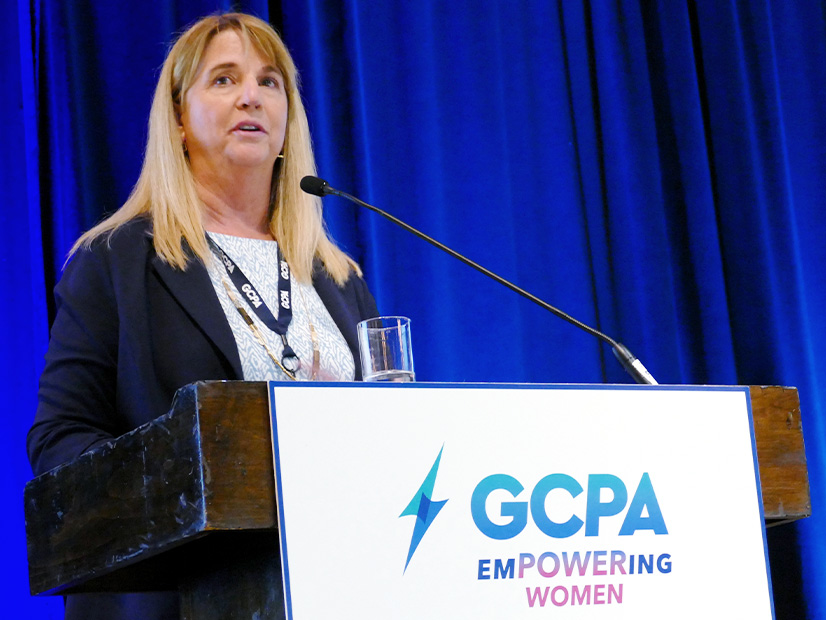
AUSTIN, Texas — Having ascended to the top of her profession as SPP’s CEO, which she left March 31, Barbara Sugg presents the image of a very accomplished woman who is confident of her abilities.
Sugg served as SPP’s chief executive for five years and also was the first woman to serve as a fulltime leader of a North American RTO or ISO. She guided the grid operator through a pandemic at the outset of her tenure, and she kept SPP’s sights on establishing markets in the Western Interconnection. For that, the Gulf Coast Power Association (GCPA) has named an award after Sugg and MISO’s Clair Moeller that celebrates excellence, innovative strategies, influential contributions, unwavering enthusiasm and dedication to their work.
A 39-year veteran of the industry, Sugg founded and developed the Leadership Foundation for Women, a nonprofit that seeks to equip women for career success. A “proud Ragin’ Cajun” despite her many years in Little Rock, Ark., she also makes a mean gumbo that is the hit of her 200-person nonprofit dinners. “Real gumbo doesn’t really exist in Arkansas unless it came out of my kitchen,” she said.
Despite all that, Sugg battles with imposter syndrome. It is defined as a psychological phenomenon characterized by persistent feelings of inadequacy, fraudulence and self-doubt, despite evidence of one’s accomplishments. Individuals with imposter syndrome often chalk up their successes to luck or external factors, rather than their own abilities.
And that’s Barbara Sugg.
“The only place I don’t have imposter syndrome is at home, where everyone loves me unconditionally,” she told her audience during a November 2024 keynote address to the GCPA emPOWERing Women Leadership Conference. Sugg initially was reluctant to have media coverage of her speech, saying the topic was very personal to her. In the end, she relented.
“The thing about imposter syndrome, it isn’t just present at work. I’ve only realized this in the last couple of days,” Sugg said during her keynote. Referencing her foundation’s gumbo dinners, she said, “Every year, without fail, I’m thinking, ‘I hope they like it. I hope they feel it was worth their donation. I don’t know if they’ll donate again.’
“Why do we do this to ourselves?” she said before asking her listeners to stand up if they were their own worst critic. Many did.
“I just needed to get some reassurance because I have said for years that I’m my own worst critic. I criticize my cooking; I criticize my work; I criticize how I presented. I promise you I will criticize myself later today for this presentation,” Sugg said. “I am my own worst critic. You are your own worst critic. So why are you so worried about everybody else’s criticism? You give yourself more criticism than anybody else is ever going to give you.
“I wish someone had told me that 20 years ago, because it’s so true. I so much fear the criticism of other people that it can be paralyzing unless I can say, ‘You know what? That’s just a voice. It’s just a voice that’s trying to keep me safe, because if I don’t take the risk, I can’t fail.’ Nobody else is ever going to judge me as harshly as I’m going to judge myself. So cut yourself some slack. Stop fearing other people’s judgment.”
Sugg’s comments were met with a standing ovation. “Thank you so much,” one woman said. “I didn’t know I needed your speech until it happened.”
“I felt good about the reception I got from the audience at GCPA,” she told RTO Insider. “Apparently, the keynote right after lunch started with, ‘I also got a promotion today. I’m the president of the Barbara Sugg fan club.’”
During a Q&A after her speech, Sugg was asked how she was approaching retirement. She said she had been going through different emotions about leaving an organization she had been with since 1997.
“Leaving is a big deal, and in my position, not many people leave on their own terms,” she said. “I have a lot of emotions about leaving because I care very deeply for our employees. So, my latest analogy — because I love a good analogy — is that I’ve put my family up for adoption, but I don’t get to pick the new parents. It’s an open adoption so I can still check in on them [and] make sure everybody’s doing okay.”
SPP in December selected Lanny Nickell as its CEO, effective April 1. (See SPP Names COO Nickell to Replace Sugg as CEO.)
Sugg told her questioner she believes a work culture that feels like family is “tremendously valuable.”
“When you feel like you’re working with family, you and they will do anything for you. You need help? People are there for you. The competition in the workplace can be very challenging. It creates all kinds of insecurities around you … but to have people that feel like family, that you care about and they care about you, that makes going to work a whole lot better.”
It wasn’t always that way for Sugg. She said no one during her childhood told her she was smart, kind or important. “What a difference that would have made for me throughout my life and my own confidence.”
Sugg found her computer science classes in college to be hard and herself to be dependent on her classmates. She said everyone is dependent on each other within their own “tribe” in school. Sugg’s first job was a disaster: the “first and worst situation I ever saw with women being ugly to other women.” That included her female manager, who would dress her down in front of others.
“I’ve tried to unravel why she was that way, but it just fed that voice in my head that I wasn’t good enough, because here’s this woman yelling at me, telling me I’m not good enough,” Sugg said.
Fortunately for her, she was recruited to the Louisiana Energy and Power Authority by the person she had replaced — “She probably knew she needed to rescue me,” she said — and that led her to SPP and an IT department with about 10 people.
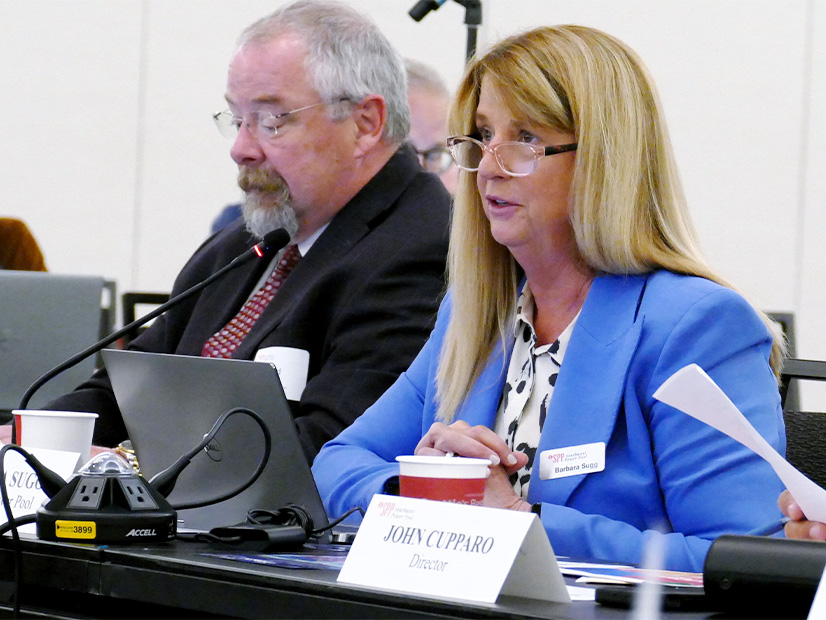
“I loved solving problems, especially with technology. I loved helping people understand how things worked,” Sugg said.
She recalled the day her boss came into her office and told her IT employees tend to fall into one of two tracks.
“‘They’re either on the technical track, where they’re great at solving problems and providing solutions and technology and support, or they’re in the managerial track, where they’re leading people.’ With every fiber of my being, I looked at him, and I said, ‘Well, I totally see myself on that technical track.’ He closed his eyes and he shook his head.
“I can remember it like it was yesterday. At the time, I was insulted because what he had just told me is, ‘You’re not good enough to be technical, therefore you probably belong in the managerial track.’ That’s what I heard. Now, how crazy is that?”
As it turned out, Sugg’s manager knew better. He surprised her by promoting her into management. However, Sugg’s inner voice said, “Unearned. Undeserved.” Sugg continued moving up the corporate ladder, attributing it to luck.
“These were not jobs I was applying for. I was just trying to be the best I could be in the job I was in,” she said. The voice in her head said, “You don’t know anything about this job.”
Still, SPP board members would suggest to Sugg from time to time that she consider applying to be CEO. Nick Brown, the only chief executive most staffers had known at the time, is going to retire at some point, they would tell her.
“I was like, ‘No, I don’t think so.’ I had this image that the CEO is this amazing person that has all this knowledge and well, most of them have really big egos to go along with that knowledge,” she said. “They carry themselves a certain way, and they look a certain way. I thought, ‘That is definitely not me,’ because I look in the mirror and think, ‘You don’t know what you’re doing. You’re not very smart. You’re not very good at this.’”
Sugg said she did not work on her resume from the time she joined SPP in 1997 until she eventually put her name in the hat for the CEO job in 2019. Two events helped quiet her inner voice. She read a book that stressed the importance of “knowing what you don’t know,” and she hired a coach who taught her the power of self-awareness.
“Knowing what you don’t know is not about becoming an expert at those things. The key is just knowing what you don’t know because I can have a lot of confidence about what I do know,” said Sugg, who places sticky notes around her home and office inscribed with “KWYDK.”
“If your self-awareness is high, you can almost step back from a situation and watch it from above, and then you can use that ability to step back from it, to be intentional about what you do next,” she said. “I learned a lot about self-awareness. I learned I started getting a lot more comfortable about being confident in what I knew and being OK with what I don’t know, because I have this awareness about what I don’t know, and I know who knows it. I don’t need to be the expert at these things.”
Having taken a new outlook on life, Sugg applied for the CEO job under one condition: “That I can be me.” During her interview, she detailed what she was great at and listed the things she didn’t know.
“‘If you need the CEO to be great at these things, please don’t pick me.’ I actually said that in the interview,” Sugg said. “I was so confident about the type of leader that I would be and confident about the type of expertise that I didn’t have, but who knew who had it and how to empower them to be successful in those roles. That was refreshing to the Board of Directors, and lo and behold, I got lucky again.” (See Sugg Prepares to Take ‘Dream Job’ at SPP.)
And now, five years later, Sugg enters retirement. She plans to take care of her elderly mother, spend more time with her two grandchildren and explore the “deep blue sea” with her husband. She has been feted by SPP staff and delivered her final president’s report to the board.
“I remain convinced that our expansion into the Western Interconnection and the desire that so many Western entities have to look to SPP for their market services will absolutely provide massive value to SPP in the long run,” she told stakeholders in January. “I look forward to watching those successes from the sidelines.”
Concluding her November speech at the GCPA conference, Sugg told her audience that 2025 will be SPP’s biggest year ever.
“If you really want to know what drives me, it’s making a difference in the lives of other people,” she said in an email. “I’ve been telling people that I feel like I’m running out of time to make a difference, but then … aren’t we all?
“So what are we waiting for?”