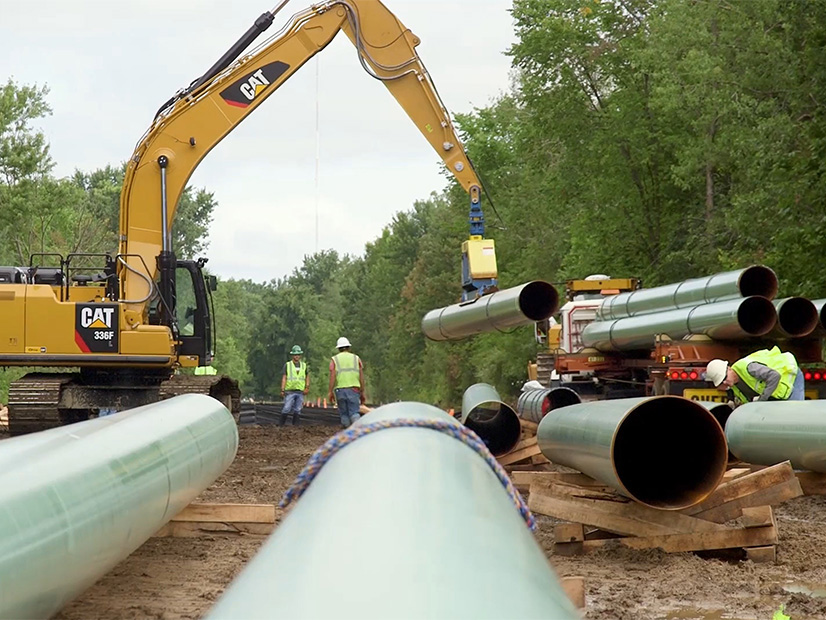
A three-judge panel of the D.C. Circuit Court of Appeals on March 28 rejected a challenge to FERC’s decision approving a pair of pipelines being built mainly to supply a proposed LNG export facility in Louisiana.
Healthy Gulf and the Sierra Club challenged FERC’s approval of Driftwood Pipeline’s application to build two new pipelines —lines 200 and 300 — in southwestern Louisiana (22-1226). The two pipelines would run alongside one another for 30 miles connecting an existing pipeline system in the north to the Lake Charles gas market.
Part of the project would run alongside another Driftwood pipeline called the Mainline, and both pipeline systems would serve Driftwood LNG.
FERC did an environmental impact statement for the project under the National Environmental Policy Act (NEPA), which acknowledged adverse environmental impacts but found none to be significant. The project was expected to increase greenhouse gas emissions, but FERC declined to characterize those emissions as significant.
The environmental groups argued that FERC should have done more to calculate what upstream impacts the pipelines would have by spurring development of new wells for natural gas.
“FERC adequately explained why it could not reasonably predict those two factors,” the court said. “As to the number of new wells, FERC concluded that it did not know ‘whether transported gas would come from new or existing production.’ And as to their location, FERC explained that the ‘specific source of natural gas to be transported via the project is currently unknown and would likely change throughout the project’s operation.’”
Executives from Driftwood’s parent company, Tellurian, have said gas for the Driftwood project would come from the Haynesville Shale in northern Louisiana, but at best, that means FERC could tell where some wells might be drilled, not their number, the court said.
The fact that the 200 and 300 lines are secondary to the Mainline project also complicates figuring what sources of gas will flow through them. Driftwood testified that it expects the pipelines will just bring existing gas to its LNG facility.
The environmentalists argued FERC could use the social cost of carbon to calculate the impacts of greenhouse gas emissions from the projects. FERC said it was unaware of any scientific method that could assess the climate impacts of pollution associated with the specific pipelines.
The court agreed that FERC lacked a non-arbitrary way to determine when identified social costs become significant under NEPA.
The environmentalists also argued that FERC should have calculated the pipelines’ impact alongside that of the Driftwood LNG project, especially since they are planned to supply it with gas in its early day of operation, as the Mainline will be built later. But the petitioners failed to raise the issue before FERC, which means the court did not address it substantively.
The environmental groups also questioned the market need for the project under the Natural Gas Act, but the court agreed with FERC’s finding that the signed contracts for most of pipelines’ capacity was evidence enough. The two lines will also connect with different gas supplies than the Mainline, which offers the Driftwood LNG project some diversity in supply to export.