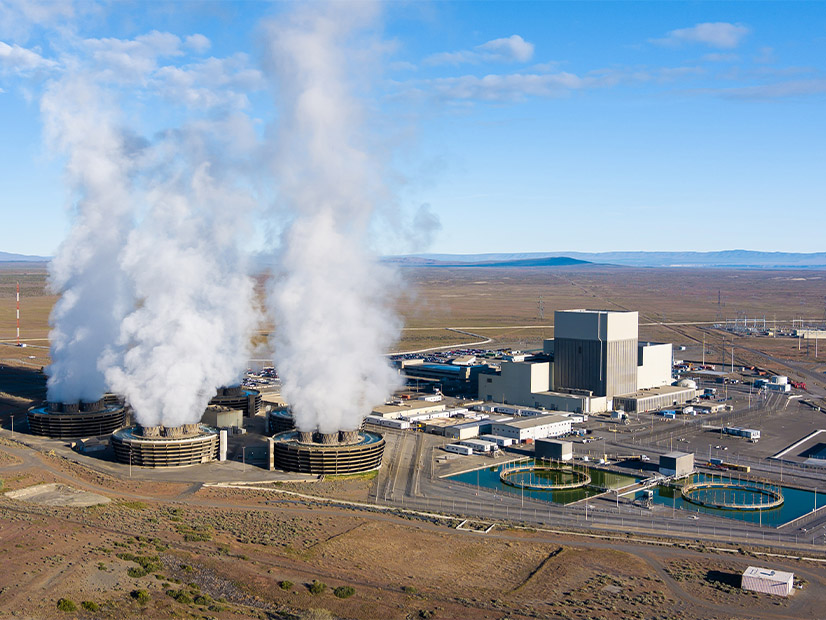
Operators of the Columbia Generating Station are seeking an extended power uprate for the facility, which is the Northwest’s only commercial nuclear power plant and a supplier of electricity to the Bonneville Power Administration.
Operators of the Columbia Generating Station (CGS) are seeking an extended power uprate for the facility, which is the Northwest’s only commercial nuclear power plant and a supplier of electricity to the Bonneville Power Administration.
Energy Northwest’s extended power uprate and efficiency improvement project for CGS would increase the power plant’s electric generating capacity from the current 1,207 MW to 1,393 MW in 2031.
Energy Northwest, a consortium of utilities from across Washington state, owns and operates the plant near Richland, Wash. BPA markets the energy produced and pays all costs, which are included in the revenue requirements of its power services rate structure.
BPA and Energy Northwest hosted a meeting April 8 on the proposed uprate. Energy Northwest said it would seek BPA Finance Committee approval next month. The uprate also requires Nuclear Regulatory Commission (NRC) approval.
Energy Northwest also is considering seeking a 20-year license renewal for CGS, which would extend operations through 2063.
Synergizing Projects
The uprate would coincide with so-called lifecycle management projects at the power plant, in which work on certain components already is scheduled. For example, replacement of the high-pressure turbine would cost the same with or without the power uprate, said Tammi Oldham with Energy Northwest.
In addition, the project potentially could take advantage of tax credits: either the production tax credit, an annual credit based on incremental generation, or the one-time investment tax credit.
“We see there is a growing demand for power, and we think an extended power uprate is a very [easy], cost-effective way to meet that growing need,” said Energy Northwest’s Jeff Windham.
“Overnight” direct costs, which don’t include interest expenses, are projected at $465 million for the lifecycle management projects and an additional $670 million for the extended power uprate, for a total of $1.135 billion, according to an Energy Northwest presentation. Indirect costs are estimated at $30 million.
Work related to the uprate would occur during refueling and maintenance outages scheduled for 2027, 2029 and 2031, Energy Northwest said.
Although the lifecycle cost and benefits of the extended power uprate are expected to reduce rates, Energy Northwest noted that rate pressure would increase during construction until the project starts generating energy.
BPA’s resource program includes the CGS extended power uprate in the least-cost portfolio for meeting future customer needs, a Bonneville representative said during the meeting. The uprate would reduce the amount of new solar and wind capacity BPA otherwise would need to acquire.
Uprates on the Rise
Nuclear power plants across the U.S. have been turning to power uprates to meet soaring electricity demand. In one recent example, Georgia Power has proposed uprates to four of its nuclear reactors in its 2025 Integrated Resource Plan. (See Georgia Power Proposes Nuclear Uprate, Delay in Fossil Retirement.)
Since the 1970s, the NRC has approved 171 uprates totaling 8,030 MW of electric power, roughly equivalent to eight new reactors. Nuclear plants typically increase their output by using slightly more enriched uranium fuel or a higher percentage of new fuel, Energy Northwest said.
Power uprates fall into different categories based on the percentage by which power will be increased, according to the NRC. Stretch power uprates fall within the design capacity of the plant and generally are up to a 7% increase.
In contrast, extended power uprates require “significant modifications” to a plant’s major equipment. Power increases in extended uprates may be as high as 20%.
The NRC said it’s preparing for more uprate requests.
“We’re already looking at our past reviews to see how we can process these requests as efficiently as possible while maintaining safety,” the agency said on its website.