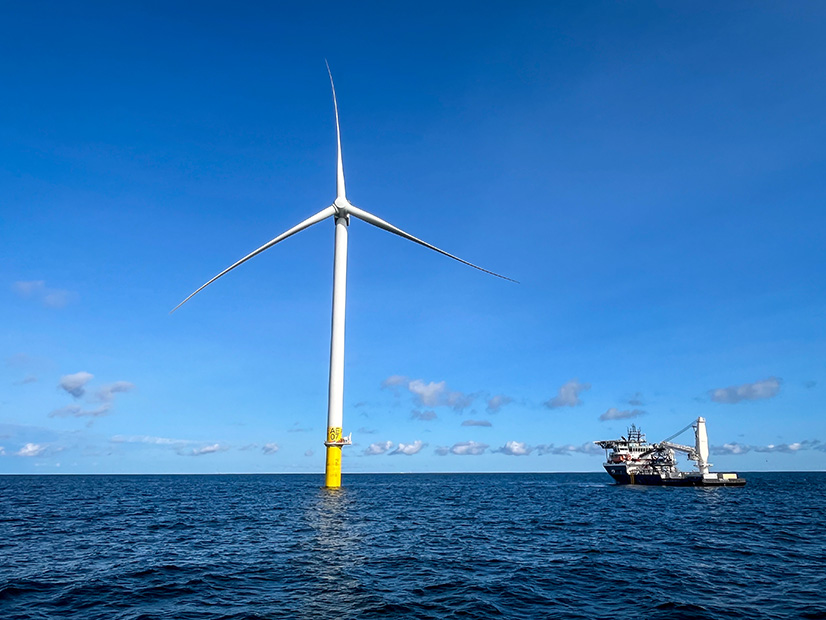
A U.S. Government Accountability Office study has concluded that offshore wind energy development carries both potentially positive and negative impacts and flags gaps in federal oversight of its development.
But because the industry is only in its early stages in U.S. waters, the authors write, the extent of some of these impacts is unknown, and there is further uncertainty about the long-term or cumulative impacts of multiple wind farms.
The independent nonpartisan watchdog agency performed the study at the request of 21 members of the House of Representatives and issued the results April 14. Its immediate impact is unclear, as President Donald Trump has halted the progress of federal regulatory reviews.
The GAO cites several potential impacts from construction and operation of offshore wind turbines, including:
-
-
- effects on marine life and ecosystems through acoustic disturbance and changes to marine habitats;
- disruption of commercial fishing;
- job creation and economic investment in nearby communities;
- global climate and public health benefits;
- interference with radar;
- alteration of search-and-rescue methods; and
- alteration of historic or cultural landscapes.
-
These are not new revelations. The lead federal preconstruction regulator of U.S. offshore wind, the Bureau of Ocean Energy Management, routinely flags these potential effects in the environmental impact statements it prepares as it reviews construction and operation plans submitted for proposed wind farms.
BOEM often outlines those effects in imprecise terms, however, as the specific degree of positive or negative changes is unknown — particularly when considering the cumulative impact of multiple wind farms in a region where none currently exists.
As of January, BOEM had leased 39 wind energy development areas on the Outer Continental Shelf. A small wind farm is completed and operating on one lease area, and larger facilities are under construction on four others. Construction had been authorized but not commenced on six lease areas, and permitting was in process on five others, before Trump in a Jan. 20 memorandum halted federal leasing and permitting for offshore wind.
The GAO examined not just the effects of offshore wind but also the effectiveness of BOEM’s review process. The study notes that:
-
-
- Tribal nations feel BOEM has not engaged with them as fully or effectively as they would like.
- Fisheries stakeholders are concerned BOEM has not adequately considered or addressed their concerns, and the bureau has not shown how it will ensure wind power developers address impacts to the fishing industry.
- BOEM requires lessees to submit community engagement plans but does not monitor or enforce compliance with those plans.
- BOEM and the Bureau of Safety and Environmental Enforcement have not ensured they have resources in place for effective oversight — neither has a physical presence in the North Atlantic region, which is the epicenter of U.S. offshore wind development.
-
The office made five recommendations to address these points. The U.S. Department of the Interior, parent agency to BOEM and BSEE, concurred with the recommendations and agreed generally with the report’s findings. Its only objection was to the use of “Gulf of Mexico,” rather than “Gulf of America.” Interior also noted that its actions on offshore wind would be guided by Trump’s Jan. 20 memorandum.
The GAO also recommended that Congress consider amending legislation to allow BOEM to better involve tribal organizations in the offshore wind leasing process.
The agency carried out the study from August 2023 to April 2025.
Two New Jersey Republicans who signed the request for the study — both firm critics of offshore wind development — continued their attacks, citing parts of the study.
Rep. Chris Smith said the potential radar interference from the hulking wind turbines provides additional scientific justification for Trump’s pause. “Ocean wind energy development is an egregiously flawed and dangerous initiative and must be stopped,” he said in a statement.
Rep. Jefferson Van Drew cited the potential effects the GAO flagged on defense, aviation, safety and ecology in a statement, saying: “The Biden administration ignored the warnings, ignored the experts and ignored the local communities who raised legitimate concerns. Now we have an independent, nonpartisan report that makes it clear: These risks are very real. President Trump did the right thing by putting these projects on hold, and it is time to put an end to them once and for all before more damage is done.”