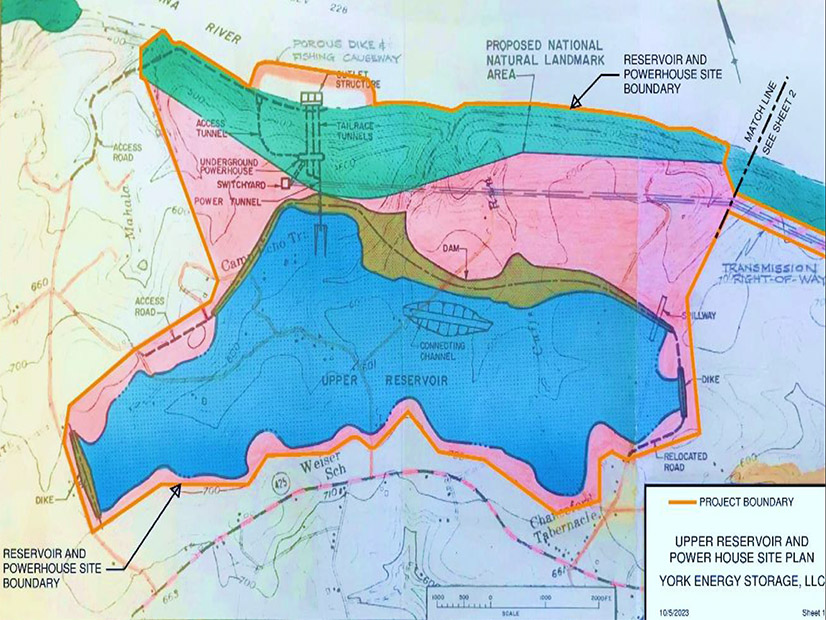
FERC has upheld the fourth preliminary permit (P-15332) granted in three decades for a pumped hydro concept in southeastern Pennsylvania.
FERC in November 2024 granted a 48-month preliminary permit to York Energy Storage LLC for an 858-MW facility along the Susquehanna River near Lancaster and York that could produce 1.5 million MWh per year.
Environmental advocates, local governments and other interested parties protested and requested a rehearing.
FERC’s April 17 order shot down the various arguments they submitted with their request.
The ruling states that concerns raised about the potential impact of the YES project — should it be built — are speculative and premature; one of the purposes of a preliminary permit is to give the permittee a chance to determine the potential impacts and design the project to avoid or mitigate them.
Issuance of a preliminary permit also does not require a finding of public interest or a balancing of interests, FERC wrote; licensing, construction and operation of the YES project might cause environmental and other impacts, but preliminary licensing would not.
FERC also rejected the contention that it should have found YES unfit for a preliminary permit for reasons including that it is a paper entity, has not demonstrated how it will fund its activities and has a history of noncompliance. FERC wrote that its past practice does not dictate a financial review for a preliminary permit, and that YES has no history of serious violations of hydropower licenses.
Finally, FERC rejected the argument that it had violated the Federal Power Act by granting multiple preliminary permits for the same project, three of them to entities with a common principal.
FERC issued two to Mid-Atlantic Energy Engineers LTD in the 1990s and one to Cuffs Run Pumped Storage LLC in 2011. But FERC said in its April 17 order that even if it treated Mid-Atlantic as the same entity as YES, more than 20 years separated the permits, so it is reasonable to treat the YES request as a new application rather than a successive application.
The issues raised in the rehearing request are speculative, the order reads.
It concludes: “We continue to find that it is in the public interest to consider such impacts at the licensing stage, when such impacts are more defined, after York Energy has completed preliminary study, thereby resulting in a more accurate and complete record, and that declining to issue a preliminary permit based on speculative impacts or incomplete impacts is not appropriate at this stage of potential development.”