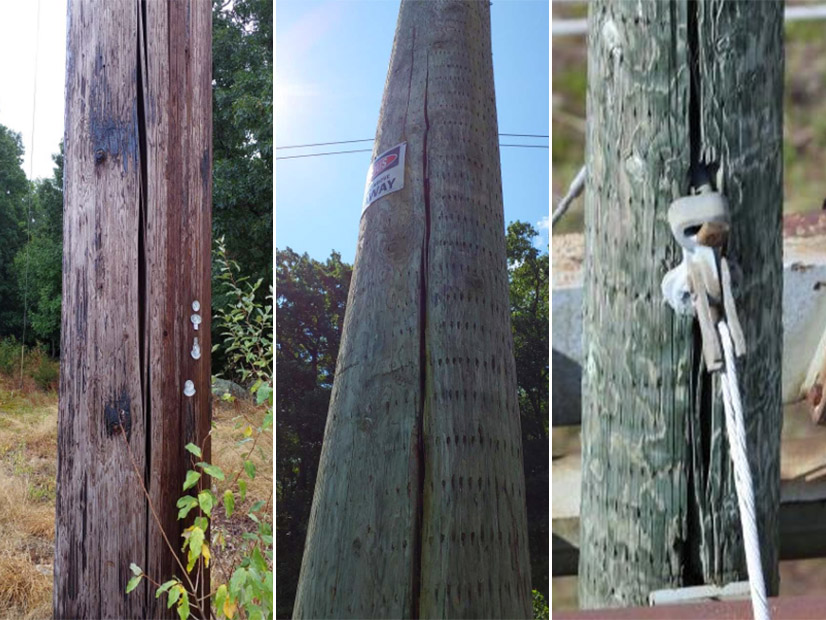
The New Hampshire Office of the Consumer Advocate (OCA) has expressed concern that there is “reasonable grounds to object to at least some of costs” of two asset condition projects proposed by National Grid and argues the transmission owner should justify why the reliability needs addressed in its proposals should not be addressed through a competitive procurement process.
The OCA letter, published April 18, is the latest in a series of complaints by New England states and consumer advocates about a lack of transparency and oversight into the planning and approval processes for asset condition projects.
National Grid proposes to rebuild, reconductor and install optical ground wire on two lines in northeastern Massachusetts for about $271 million. For both projects, National Grid proposes to expand the scope of work beyond the most critical needs, in part to prevent more projects addressing reliability issues expected to arise over the next 10 years.
Incumbent transmission owners typically have the authority to determine when and where asset condition projects are needed to address aging or deteriorating infrastructure and pass the costs on to ratepayers through formula rates. Asset condition projects are not subject to competitive solicitations for proposals.
However, because the issues addressed by the proposals overlap with reliability issues identified by ISO-NE’s Boston 2033 Needs Assessment study and 2050 Transmission Study, the OCA argued the issues may require competitive procurements.
“It remains unclear why a competitive solution process is not being used for these projects,” the OCA wrote. “It appears that the only reason a competitive process is not happening is because National Grid has chosen to treat these projects as [asset condition projects] and the ISO has disclaimed any responsibility for testing that choice.”
The OCA highlighted ISO-NE tariff language that states that “where the solution to a Needs Assessment will likely be a Market Efficiency Transmission Upgrade, or where the forecast year of need for a solution that is likely to be a Reliability Transmission Upgrade is more than three years from the completion of a Needs Assessment, the ISO will conduct a solution process based on a two-stage competitive solution process.”
The OCA said there appears to be enough time to pursue competitive procurement because the projects are not scheduled to begin construction until the second half of 2028 and are categorized by the Boston 2033 Needs Assessment as non-time-sensitive.
“The objection isn’t necessarily to the projects themselves. … The system might genuinely need this to happen,” said Matthew Fossum, assistant consumer advocate at the OCA. “My concern is that this could allow National Grid to sidestep a competitive process that could meet the needs at a lower cost.”
The National Grid proposals are not the only asset condition projects to draw scrutiny in the past year. In August 2024, the New England States Committee on Electricity (NESCOE) expressed concern about a “lack of compelling evidence to support the scope” of a $385 million asset condition project in New Hampshire. (See New England States Raise Alarm on Eversource Asset Condition Project.)
Meanwhile, in March, NESCOE called for a “holistic, regional planning process” to ensure a proposal by Eversource to replace nearly all its underground transmission cables in the Boston area is conducted as cost-effectively as possible. NESCOE estimated the project’s costs could be in the $8 billion to $9 billion range “based on recent similar cost estimates.”
At the urging of the states, the region’s transmission owners have taken steps in recent years to increase transparency around asset condition spending, including standardizing the format of informational presentations made to the ISO-NE Planning Advisory Committee, allowing stakeholder feedback and creating an asset condition project database.
However, states and consumer advocates continue to argue there’s inadequate oversight for the projects, which make up a growing portion of the region’s transmission costs. In a March filing to FERC, NESCOE urged the commission to adopt “NESCOE’s long-standing request to implement an Independent Transmission Monitor” (EL25-44). (See New England Officials Discuss Tx Oversight and Rising Energy Costs.)
Fossum said it was concerning that National Grid took nearly five months to respond to his request for more information on the projects, and he said the response he received was “essentially a non-answer.”
National Grid declined to comment for this story, but wrote in a response to the OCA on April 15 that the expanded scope of the two asset condition projects will provide a longer-term solution “with the added benefits of also addressing future reliability needs.”
It also included a response from ISO-NE, which said “asset condition projects will move forward independent of whether there are any [ISO-NE-]identified needs on the facility, resulting from Needs Assessments, Public Policy studies or Longer-Term Transmission Studies.”