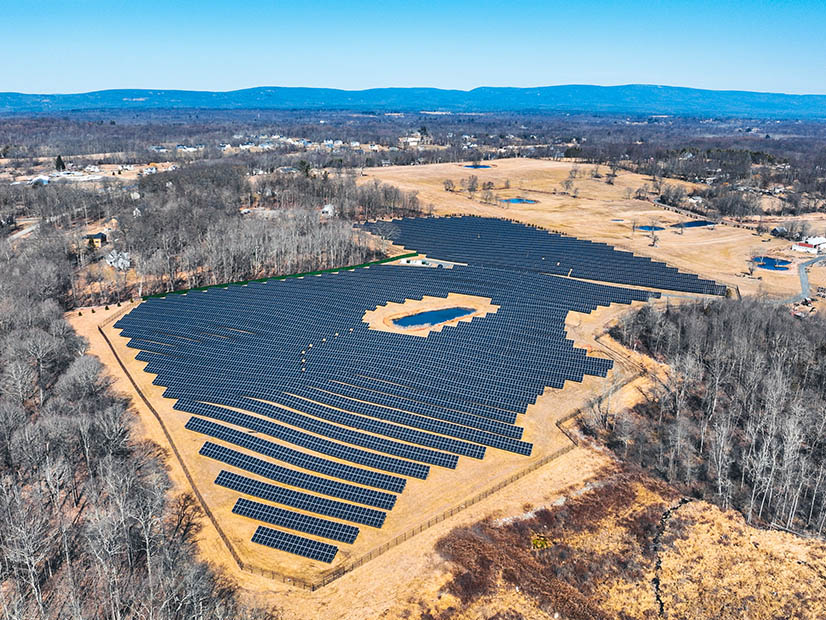
New York’s distributed solar incentive program is ahead of schedule and under budget, so state regulators are reallocating some of its funding to other clean energy programs.
Solar advocates and their allies in the state Legislature framed the decision as a misguided move that penalizes success, while the Public Service Commission framed its decision as recognition that the industry has matured.
The New York State Energy Research and Development Authority in January 2024 had proposed leaving the entire $421 million surplus in NY-Sun to additional solar development.
The Public Service Commission took comments on the matter (Case No. 21-E-0629), then voted unanimously April 25 to use $150 million on additional solar incentives that benefit low-income customers and $153 million on NYSERDA to use for future clean energy programs. The remaining $118 million was money that was to be repurposed from other allocations to fund NY-Sun but now will not be.
NYSERDA explained in its Jan. 4, 2024, filing that the surplus was generated largely by the tax policies contained within the Inflation Reduction Act signed into law in 2022, a year after the PSC approved New York’s 10-GW Distributed Solar Roadmap.
The IRA provisions are under direct threat of revision or revocation, as are other federal funding streams to states for various initiatives not favored by the Trump administration, such as those promoting solar power generation and economic justice.
The PSC’s April 24 order does not directly address this, or the fact that the Trump administration has actively attempted to claw back certain funding awarded during the Biden administration, such as EPA grants.
There does seem to be some tacit acknowledgement of the situation, though, as when the order states: “The commission highly encourages NYSERDA to evaluate how [EPA grant] funding could be creatively used to further support the commission’s clean energy and distributed solar objectives, while also supporting low-income customers and disadvantaged communities.”
There also appears to be an acknowledgment of the impact New York’s expansive decarbonization ambitions will have on ratepayers who already face high utility costs. The $3 billion NY-Sun program is funded through utility bills.
In a formal statement after the PSC meeting, Chair Rory Christian recognized all these things, saying the order gives NYSERDA “flexibility to adjust incentive levels to respond to market conditions, ensure efficient use of program funds, and … continue to monitor changes in federal energy policy.”
“With these changes,” he added, “we will be able to expand our capacity to additional crucial policy matters, including, critically, energy affordability.”
The economic disparity of rooftop solar deployment has long been recognized. Many lower-income residents do not own their own homes or have rooftops suitable for the installation of panels.
New York’s efforts to promote community solar have attempted to address this by giving lower-income communities a chance to benefit from off-site solar, and the changes to NY-Sun are designed in part to accomplish the same thing.
Due to the various policies, distributed solar has proliferated in New York to the point that it is a national leader in community solar capacity. The state surpassed its original goal — 6 GW of distributed solar by 2025 — a year early and has set a new target of 10 GW by 2030. (See NY Surpasses 6 GW of Distributed Solar Capacity.)
All this stands in marked contrast to the slow pace of large-scale renewable development in New York and has led advocates for distributed solar to urge more policy support, with a further increase in the target to 20 GW.
During the public comment period, the New York Solar Energy Industries Association endorsed NYSERDA’s initial request to retain the surplus funds within NY-Sun.
“The highest priority now should be authorizing the reinvestment of the surplus funds as soon as possible to avoid any lapse in the NY-Sun program,” it wrote Oct. 31. “This decisive action will not only support New York’s ambitious clean energy goals, but also foster a more inclusive and resilient energy future for all New Yorkers.”
NYSEIA joined other organizations and legislators in a joint statement April 28 criticizing the PSC’s decision. It notes prominently the sharp changes in federal funding streams.
One problem with New York’s regulatory mechanisms is they can take a long time to reach a conclusion, and the parameters on which a proposal is based sometimes change as stakeholders, politicians and bureaucrats research, create, discuss, revise and debate the provisions of a particular rule or regulation.
Nearly six years after the state Legislature mandated 100% zero-emissions energy by 2040, for example, there still is no decision on the politically fraught question of what will constitute zero emissions.
When NYSERDA noted in January 2024 that money was flowing out of Washington to subsidize distributed solar, President Biden still was in office and photovoltaic installations were starting a record-setting run that would reach nearly 50 GW nationwide by the end of the year.
As the PSC voted to cap NY-Sun funding, more than a year later, the message from Washington is “drill, baby, drill” and widespread federal layoffs and funding cuts target environmental initiatives.
Sen. Pete Harckham (D), chair of the state Senate Environmental Conservation Committee, recently introduced the Accelerate Solar for Affordable Power Act (S.6570). ASAP would raise New York’s rooftop and community solar goal to 20 GW by 2035 and direct the PSC to implement reforms to the utility interconnection process to lower costs and accelerate deployment.
In the April 28 statement, Harckham chided the PSC, saying NY-Sun largely is responsible for the success of small-scale solar in New York. “Putting the brakes on this clean energy momentum, which is creating thousands of green jobs and saving ratepayers millions of dollars, makes no sense at all,” he said. “In fact, we should be doubling down on this program’s success and ramping up gigawatt goals instead of standing pat and congratulating ourselves on a job well-done in the middle of our climate crisis.”