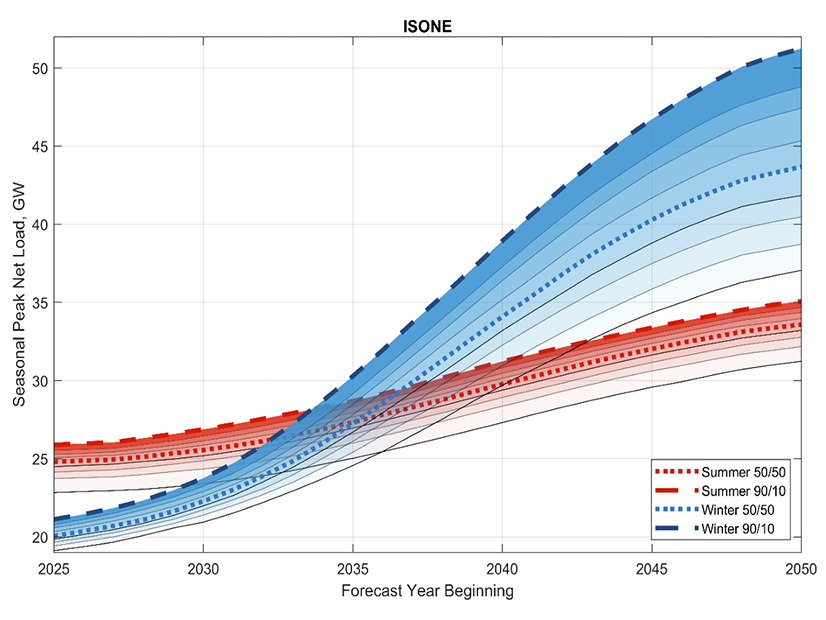
ISO-NE has significantly lowered the peak load and net energy estimates in its final 2025 10-year load forecast but still predicts the region’s peak demand will grow by over 2 GW by 2034, the RTO told its Planning Advisory Committee on April 29.
The reduced demand growth expectations are driven largely by reductions in ISO-NE’s adoption forecasts for heating and transportation electrification. The RTO cut its electrification forecasts in response to data indicating its previous forecasts significantly overestimated the adoption of electric vehicles and heat pumps. (See ISO-NE Scales Back Vehicle, Heating Electrification Forecasts.)
The final forecast predicts the RTO’s summer peak for an average year will grow from 24,803 MW in 2025 to 26,897 MW in 2034. It expects the winter peak to grow more rapidly — from 20,056 MW in 2025 to 26,020 MW in 2034. Compared with the 2024 10-year forecast, ISO-NE reduced its 2033 summer peak projection by 2.1% and its winter peak projection by 7.1%.
The RTO expects the winter peak to surpass the summer peak at some point in the 2030s due to heating electrification. The model predicts that average winter and summer peaks will be about equal by 2035, though the winter peak could pass the summer peak earlier under more severe winter weather conditions.
The projections also reflect major changes to ISO-NE’s base modeling methodology, including the incorporation of hourly data, additional weather scenarios and climate change effects. (See ISO-NE Cuts Winter, Summer Peak Load Forecasts for 2033.)
Hourly modeling allows ISO-NE to evaluate “a wider variety of system conditions, not just peak loads,” and capture peak loads that occur any time of day, not just in the evening, said Victoria Rojo, supervisor of load forecasting at ISO-NE. Rojo said ISO-NE expects morning winter peaks to become more common as load from heating electrification increases.
Based on an evaluation using the updated hourly forecasting, Pradip Vijayan, manager of transmission planning at ISO-NE, said the RTO plans to simplify its transmission planning studies to focus on just two scenarios: a midday peak high renewable scenario and an evening peak scenario.
“For transmission planning high net summer peak load analysis, the ISO proposes modeling 95% of the coincident gross peak load with 0% PV,” Vijayan said, noting that, as the net summer peak load moves to later in the evening in the coming years due to rooftop solar, “this load level should cover both the coincident net peak load conditions in New England and non-coincident net peak loads for most load zones.”
For the winter, he said ISO-NE plans to continue modeling the peak as “100% of the gross New England winter peak with 0% PV,” noting the “significant variance in PV availability on high winter load days.”
Updated Interface Limits
Also speaking at the PAC meeting, Alex Rost, ISO-NE’s director of transmission services, said the RTO will increase the Surowiec-South and the Maine-New Hampshire interface transfer limits to 2,200 MW because of network upgrades associated with the New England Clean Energy Connect (NECEC) transmission line. The Surowiec-South limit in Maine now is set at 1,800 MW, while the Maine-New Hampshire limit now is 2,000 MW.
Rost said the increase of the Surowiec-South interface will allow for the increase in the capacity import capability of the New Brunswick-New England interface from 980 MW to 1,000 MW.
The updated interface limits will be used in forward capacity market analyses, beginning with the overlapping interconnection impacts analysis for the 2025 interim reconfiguration auction qualification process, which will “determine whether there is sufficient capacity capability to qualify any proposed new capacity resources,” Rost said.