The 2025 edition of DNV’s Energy Industry Insights report finds long-term optimism that the energy transition will continue but widespread uncertainty about its direction in the near term.
Trade agreements and tariffs drive the pessimism while growth of the world’s population, economy and need for electricity drive confidence that electrification — with its promise of greater energy security and energy independence — will continue.
But the uncertainty has been palpable lately.
The Global Economic Policy Uncertainty Index spiked in early 2025 as President Trump was hitting his stride in his second term and as DNV was conducting its survey. It eclipsed its previous record high, set in early 2020 as the scope of the COVID-19 pandemic became apparent.
“To think that, by this metric at least, we are in more uncertain times than April 2020 shows just how much disruption and unpredictability there is in today’s policy environment, much of it caused by national issues, such as energy security, self-sufficiency and shifts in voter sentiment,” the authors write.
By contrast, there is no doubt about the value prospect of electrification or the threat posed by greenhouse gas emissions, they write, and a successful transition remains possible, with sufficient investment.
The transition also remains necessary, DNV Energy Systems CEO Ditlev Engel said in an April 29 news release accompanying the report.
“A successful energy transition is not impossible, but the urgency to accelerate action has never been greater,” he said. “The path to a cleaner, more sustainable energy future is inherently complex and uneven, but delay is not an option. Immediate, coordinated efforts are essential to ensure momentum is not lost.”
Lucy Craig, DNV’s director of energy systems growth, innovation and digitalization, said technology will play a critical role in the energy transition.
“As the energy system becomes more electrified, distributed, interconnected and dynamic, adopting a whole-systems approach will be essential,” she said. “This means viewing the energy system as an interconnected whole, one that enables greater efficiency, flexibility and resilience.”
Craig said 64% of respondents say a whole systems approach is impossible without fully digitalized infrastructure and 59% plan to boost their spending on digitalization, including artificial intelligence.
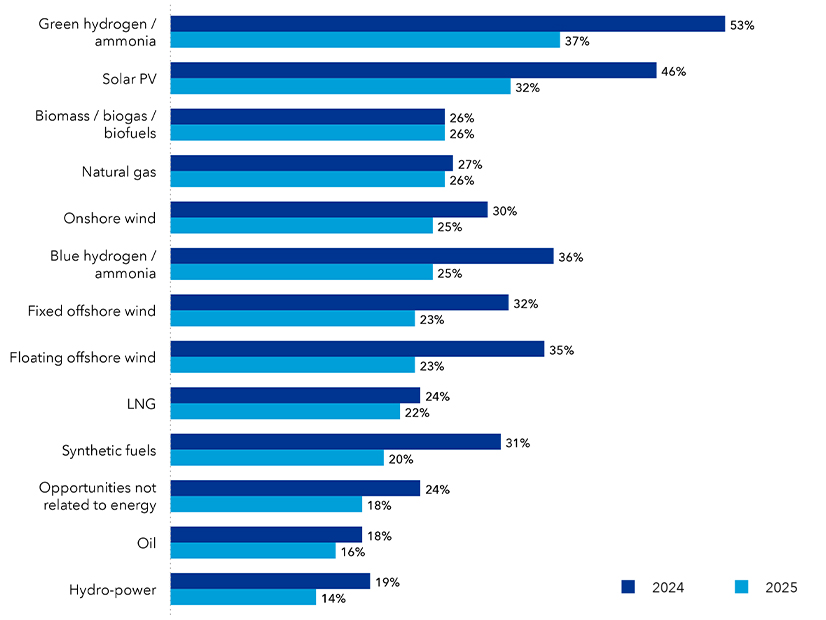
Some other takeaways from the 2025 report:
-
- 55% of respondents say the energy transition is accelerating, compared with 72% in 2024 and 79% in 2023.
- 51% say a successful energy transition will negatively impact some communities.
- 31% identify expansion of energy storage technologies as key to accelerating the energy transition.
- 96% of those in the power sector see a need for urgent investment in grid modernization, and more than 75% see outdated grid infrastructure as a barrier to renewables adoption.
- 50% of those in the renewables sector expect to meet revenue targets, and 43% are optimistic about profits, down from 75% and 67% three years ago.
- 39% of those in renewables expect to increase investment in the next 12 months.
- 31% identified expansion of energy storage technologies as key to accelerating the energy transition.
- The top five barriers seen to investments contributing to the energy transition are policy uncertainty, capital outlay, regulatory constraint, profit limits and infrastructure shortcomings.
This is the 15th edition of DNV’s annual report.
It is based on the comments of more than 1,100 senior professionals in the energy industry surveyed by the Norwegian company. They are heavily weighted toward Europe (54% of respondents) and Asia (22%), with North America third at just 12%.
The majority of respondents came from the renewables (35%) and oil/gas (33%) sectors, with the electric power industry third at 17%.