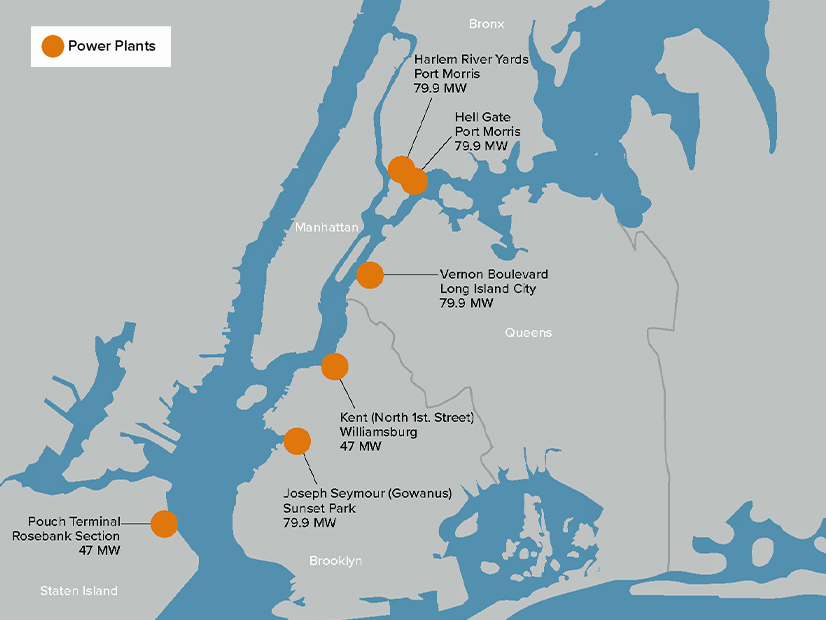
Federal policy changes and slow buildout of emissions-free generation may change the timetable for the retirement of New York Power Authority gas-fired peaker plants in New York City.
Environmental and neighborhood advocates have long sought a reduction in fossil-fuel power generation within the city, due to serious local impacts on air quality and residents’ health.
NYPA had begun planning for such a transition years ago, such as by installing battery storage on the sites.
Then 2023 state legislation mandated the shutdown occur by 2030 — if doing so would not harm grid reliability or result in a net increase of air pollutants within any disadvantaged community.
On May 9, NYPA produced its Small Natural Gas Power Plant Transition Plan, which said there is rising uncertainty about whether reliability or air quality concerns can be met.
Advocacy groups working as a coalition called Public Power NY criticized this as excuse-making by a state entity not living up to their vision of it becoming a new driver in a lagging energy transition.
When the 2023 legislation was drafted, negotiated and enacted, a clean energy transition backed by hundreds of billions of federal dollars was ramping up and New York state had a robust-looking pipeline of more than 10 GW of renewable energy generation proposals working their way through to potential construction.
Two years later, a new federal administration is racing to turn the emphasis back to fossil fuels and in some cases actively thwart renewable energy development. New York’s pipeline is in tatters, with many projects having paused or terminated offtake contracts amid cost escalations.
NYPA said in the transition plan that its small gas plants — 10 simple-cycle units at six sites in New York City and one in suburban Long Island, totaling 460 MW — are among the cleanest and most efficient in the area. By law, NYPA needs to ensure that shutting them down will not cause dirtier plants to run more and degrade air quality further by doing so.
Meanwhile, electricity demand is growing and NYISO has raised reliability concerns of varying severity.
These things informed the transition plan. It reads:
“The plan concludes that, at this time, NYPA must conduct additional studies with the NYISO and expert consultants to determine the impact to air quality in disadvantaged communities across New York state, including in New York City and Long Island, when the small plants are shuttered.”
NYPA will consult with utilities and the Department of Public Service to decide if plants whose retirement would not harm air quality also would not harm grid reliability by retiring.
The problem is there’s “unprecedented uncertainty” about the future resource mix that would determine grid reliability.
Just three weeks before the transition plan was released, federal regulators slapped a stop-work order on Empire Wind 1, a fully permitted offshore wind project that would send up to 810 MW of emissions-free power right into New York City.
Clean energy advocates and public power supporters have long chafed at the pace of decarbonization in New York state, where energy development is slow and expensive.
Some of these advocates also sought for years to place a greater responsibility for renewables development on NYPA, reasoning that it could do the work at a lower cost than the private sector.
They got much of what they were seeking in the spring of 2023, when the state budget included provisions directing NYPA to start developing renewables and stop running the fossil peakers, with the air quality and reliability caveats.
Public power advocates had been hoping for NYPA to kick off its new role with a robust 15-GW debut plan for renewables development. They were sorely disappointed when NYPA adopted a 3-GW plan and predicted a high rate of attrition.
They were disappointed again with the transition plan.
Public Power NY Co-chair Michael Paulson said May 12: “The Build Public Renewables Act directed NYPA to shut down their peaker plants by 2030 and begin to redress environmental injustices and extreme public health impacts. Unfortunately, their plan is short on detail and long on excuses for potential failure. New Yorkers deserve better: a proactive plan to shutter the peakers and a commitment to build 15 GW of public renewables to facilitate that transition.”
NYPA is self-funded. Its roughly 6 GW of capacity generates about 22% of the state’s electricity, most of it emissions-free hydropower.