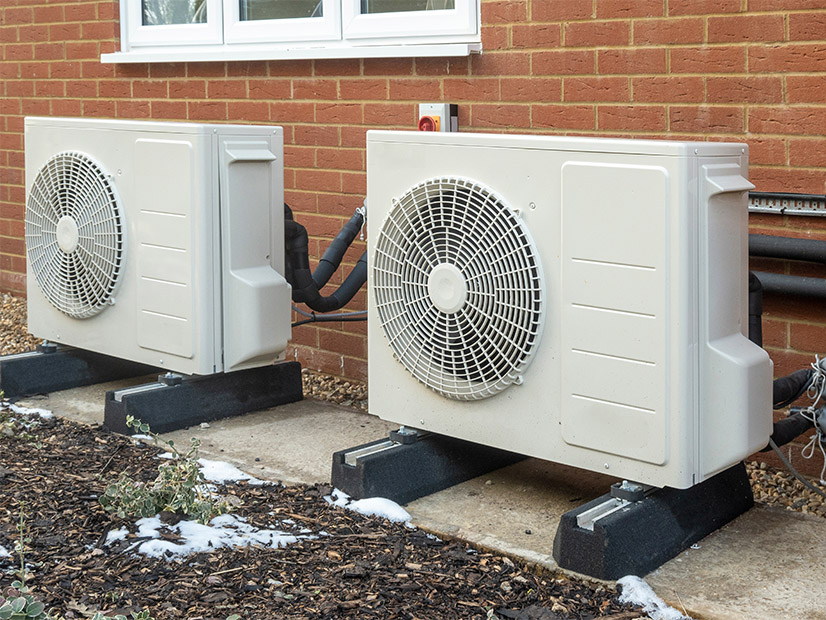
Time-of-use (TOU) electricity rates could save Massachusetts ratepayers with electrified heating hundreds of dollars each year per household, according to a new report by Advanced Energy United and Demand Side Analytics.
The report concluded that TOU rates — which price electricity at a higher level during peak periods — would enable a “steady savings rate of roughly 8-9% per year” for customers who electrify and invest in energy efficiency.
While the scale of the savings would depend on the efficiency of the heat pump and the scale of household weatherization, the report estimated TOU rates would save a household switching from a gas furnace to a minimum-efficiency heat pump about $570 per year relative to the existing rate structure. For the TOU rate design, the report assumed on-peak prices to be three times higher than off-peak prices.
“Time-varying rates … can act as a demand management strategy by incentivizing reductions in electricity consumption during grid stress periods,” the authors wrote. “Overall, this rate offers preferential bill savings to electrified customers while also mitigating electrification’s contributions to peak load and the associated capacity costs.”
The authors estimated that replacing gas heating with a lower-efficiency heat pump under the state’s current rate structure would cost residential customers about $2,000 on their annual electric bills. However, customers who pair high-efficiency heat pumps with weatherization upgrades would save $700 in annual energy costs compared to gas customers.
TOU rates would improve the cost comparison for electrified households across efficiency and weatherization scenarios, the report found, adding that overall cost savings would be greater with lower-efficiency heat pumps due to higher starting rates.
The report also found that TOU rates would reduce the systemwide costs associated with heating electrification in both a summer and winter peaking system, with greater cost-reduction benefits associated with a winter peak. ISO-NE expects the New England system to transition from a summer to a winter peak in the mid-2030s.
“The modeled TOU rate can be expected to reduce electric system cost increases by approximately 7.8% in a winter peaking system when the cost of additional minimum efficiency electrification on current rates could otherwise be expected to drive up system costs by almost $2,000 per customer,” the study found.
The study did not evaluate the effects of TOU rates on emissions, but noted that peak reductions should reduce overall emissions, as the peak demand is typically associated with the most carbon-intensive generation mix.
Demand response initiatives, including TOU rates, have been an area of interest for policymakers in New England in recent years, as the region faces a growing peak load caused by transportation and building electrification. Advocates view demand flexibility as a key strategy for limiting costs associated with grid buildout and electricity supply.
New England has been relatively slow to scale up demand response programs, and most customers lack the advanced metering infrastructure (AMI) needed to participate in TOU programs or receive ISO-NE market revenues.
According to a January 2025 report by the Energy Systems Integration Group, ISO-NE in 2023 had the lowest percentage of customer participation in demand response programs of all RTOs and ISOs and was tied with NYISO for the lowest participation in dynamic pricing.
However, this situation may change in the coming years as New England states push utilities to deploy AMI. In Massachusetts, despite just 2% of utility meters being classified as AMI in 2023, the investor-owned electric utilities expect to complete AMI installations across their service territories by 2030.
Meanwhile, the New England Conference of Public Utility Commissioners (NECPUC) convened a working group in 2024 to identify and address challenges for retail demand response and flexibility programs, leading to a report by the Berkeley Lab published in mid-April.
The Berkeley Lab report concluded that ISO-NE’s compliance with FERC Order 2222 — which requires RTOs to eliminate barriers for aggregations to distributed energy resources to participate in the wholesale markets — should enable more widespread participation in aggregations.
The report identified several remaining challenges, including requirements for expensive metering infrastructure, a lack of standardized data processing procedures among utilities, and difficulties calculating and crediting the actual contribution of demand response resources in wholesale markets. It recommended more coordination between PUCs, utilities and ISO-NE around market participation requirements to facilitate broader participation.