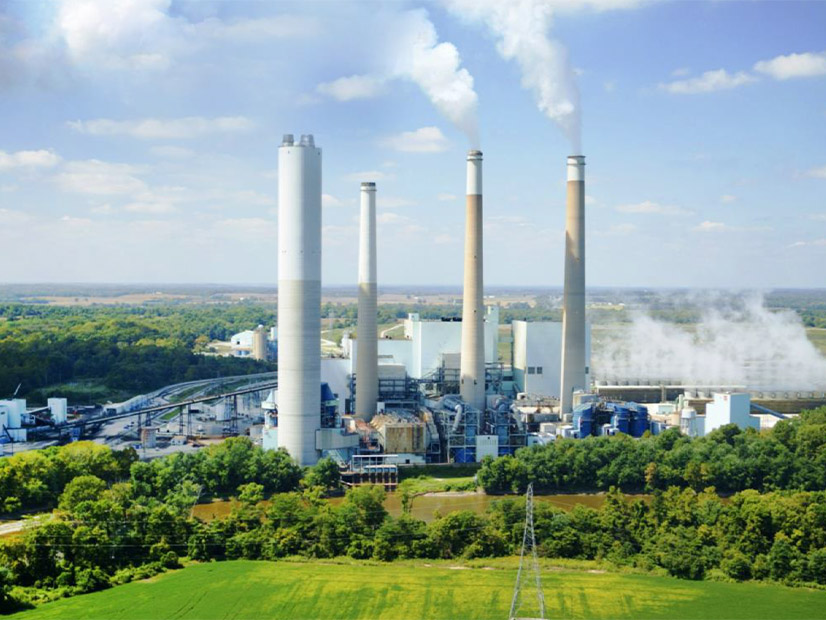
Indiana has a new law aimed at motivating new capacity in the state to serve rising load and restricting when utilities can shut down plants.
The legislation expedites the Indiana Utility Regulatory Commission’s approval process on utilities’ generation plans to serve large-load customers like data centers. It also creates cost recovery processes for utilities to recover the projects to accommodate big-need customers and makes it more difficult for utilities to retire their existing generation.
Finally, the law provides for a 20% state tax credit for in-state producers that manufacture small nuclear reactors.
Gov. Mike Braun (R) signed the bill into law May 6. House Republicans advanced the bill April 22 in a 63-23 vote along party lines (HB 1007).
The law defines a large-load customer as one requesting new electricity demand greater than 5% of the utility’s peak load or 150 MW.
The law mandates customers requiring a big grid buildout to make “significant and meaningful financial assurances” for the projects they need, covering at least 80% of costs and shielding other customers from picking up the bill.
It also compels public utilities to annually report to the IURC any generating units of at least 125 MW that they plan to retire. The IURC then would initiate an investigation into the withdrawing generation. If the commission finds that a utility cannot reliably meet demand without the unit or is unable to meet its planning reserve margin requirement, it would block the plant closure or direct the utility to acquire or build equivalent capacity. The law dictates that utilities must have replacement plans of “approximately the same accredited capacity” as the retiring unit within their RTO.
Per Indiana’s existing law, any utility not meeting at least 85% of its peak load must provide the IURC with capacity projections for the next three years.
A fiscal analysis from the legislature found that the SMR state tax credit could cost taxpayers about $280 million. It also found that the new retirement investigation provisions will increase the IURC workload. Indiana lawmakers are not dedicating more resources to the IURC to handle the added work.
Indiana’s Republican representatives said the law is necessary to incentivize capacity additions. Democratic representatives voiced concerns the measures would keep coal plants online longer and have taxpayers spending too much to subsidize small modular reactors.
The Sierra Club said the law would “increase electric bills and spew more pollution throughout the state.”
Rep. Ed Soliday (R-Valparaiso), who authored the bill, told local news outlets that Indiana is in competition with other states to entice large-load customers.