Texas regulators have declined to respond to ERCOT’s request for an exemption from including certain loads without interconnection agreements in its forecasts and have asked the grid operator to fine-tune its methodology for estimating coming demand.
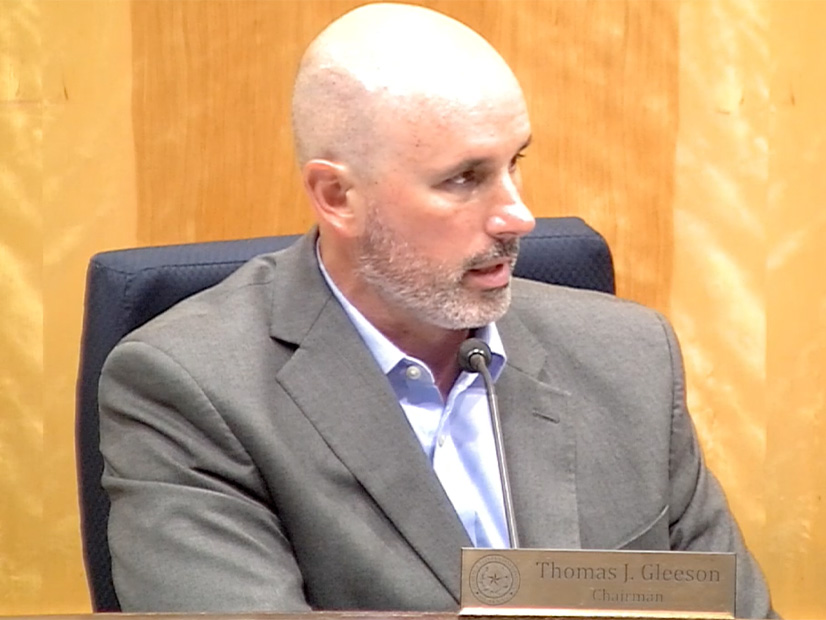
Public Utility Commission Chair Thomas Gleeson found the ISO’s proposed methodology, which would discount data center loads and those certified by a utility, makes sense “directionally” but could use some refinement (55999).
“I’ve asked them to kind of think through some other options of ways we can look at refining this number,” Gleeson said during the PUC’s May 15 open meeting. “I’ll be working with ERCOT to hopefully present other ways that we could look at refining this number, other than the methodology presented here.”
ERCOT staff briefed the commission on the latest changes to its ERCOT-adjusted load forecast after recent projections startled industry observers and lawmakers. CEO Pablo Vegas said in 2024 that demand would peak at 150 MW by 2031. In February, the grid operator released a capacity, demand and reserves (CDR) report that projected demand peaking at 140 GW in 2029.
The report also said planning reserve margins, currently 18.9% for peak load and 10.5% for net peak load, will drop into negative territory for the 2027/28 winter. (See ERCOT’s Revised CDR Report Met with Doubts.)
The latest CDR report, released May 16, results in an increase to peak demand of 218 GW by 2031. The grid operator’s current peak is 85.5 GW, set in August 2023.
Recent state legislation requires ERCOT to include any load in its projections that doesn’t yet have a signed interconnection agreement. The grid operator has aligned its protocols with the rule to define “substantiated load” as being supported by an executed interconnection or other agreement, an independent third-party load forecast deemed credible by ERCOT, or a letter from a transmission and distribution service provider (TDSP) officer attesting to the coming load.
“The vast majority of load included in the TDSPs’ forecasts are loads that were attested to in a letter from an officer of the TDSP, rather than being supported by an interconnection agreement between the TDSP and the customer,” ERCOT said in a filing with the PUC.
The ISO proposes a 49.8% reduction in data center loads and a 55.4% cut in officer-letter loads to “achieve alignment with historical realization rates.”
CenterPoint Audit Released
Certified public accountants Moss Adams shared the results of an audit it conducted of CenterPoint Energy’s management activities associated with the utility’s controversial $800 million lease and operation of mobile generation units that turned out to be only somewhat mobile (58049).
The Houston-based CPA firm found that CenterPoint followed best practices for competitive bidding and established specifications and requirements to meet business needs. However, it said the utility did not adhere to those practices for consistent completion of vendor risk assessments or adequate consideration of conflict of interest and that it “somewhat” met adequate documentation and record-keeping best practices.
Moss Adams made several recommendations related to procurement and emergency management, including implementing a more detailed framework for identifying, assessing and managing conflicts of interest, and ensuring that vendor risk assessments are completed for all procurements.
CenterPoint has responded by detailing how it already has addressed or will respond to each of Moss Adams’ findings and recommendations. The commissioners asked the utility to file updates on its progress and return to an open meeting after the findings are closed out.
The PUC engaged Moss Adams to perform the audit after customer and lawmaker outrage over CenterPoint’s recovery efforts following Hurricane Beryl in July 2024. The mobile generators were acquired to prepare for hurricane season, but the larger 30-MW units proved too unwieldy to move and sat unused during the weekslong recovery. (See Texas Politicos, Residents Bash CenterPoint.)
CenterPoint, CPS Energy and ERCOT are working to move the 15 30-MW units to resolve reliability needs in the San Antonio area. (See ERCOT Plans on Mobile Generators in San Antonio.)
19th TEF Project to DD Review
The commission approved staff’s recommendation to advance another project to due-diligence review as part of the Texas Energy Fund’s In-ERCOT Loan Program (56896).
The 123-MW project is sponsored by EMPower USA, Emerging America Financiera and Integrated Gas Services de Mexico. Staff said the applicants have given an “indication of a binding equity” and an equity agreement and provided general acceptance to the term sheet.
The project boosts the TEF portfolio to 19 applications, $5.15 billion in requested loaned funds and 9.59 GW in potential new dispatchable generation. The PUC will release individual nameplate capacity and loan amounts for each project upon loan execution.
The low-interest loan program, designed to add 10 GW in gas generation, has seen eight projects drop out or be removed in recent months. (See 2 More Projects Fall out of TEF Loan Program.)