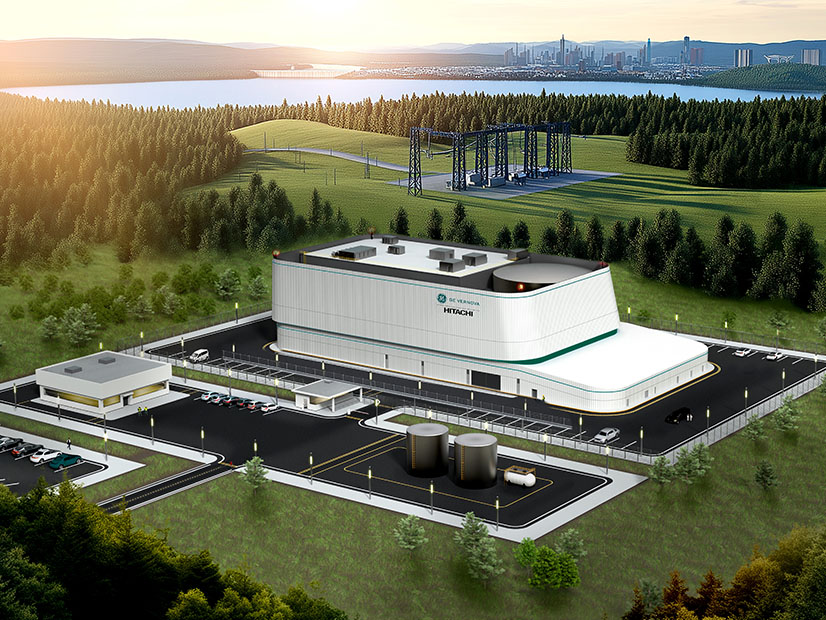
The Tennessee Valley Authority crossed a milestone May 20, becoming the first U.S. utility to request a construction permit for a small modular nuclear reactor.
The facility would be built around a GE Hitachi BWRX-300 near Oak Ridge, Tenn., at TVA’s Clinch River site, where plans to build a breeder reactor were pursued and then abandoned 40 years ago.
In its announcement, TVA said its plan has the best path to success because the site holds the first — and still only — early site permit issued by the Nuclear Regulatory Commission for an SMR.
But there are many competing plans. The SMR field is crowded with technology developers, site developers and would-be off-takers eager for the non-intermittent, emissions-free electricity this next class of nuclear reactors is expected to provide.
If the technology evolves as hoped, and if it is widely deployed, permitting and construction could be streamlined and standardized to the point that SMRs come online much more quickly and at markedly lower cost than their large-scale forebears.
TVA’s milestone comes amid a series of firsts in the SMR sector:
-
- The NRC on May 13 accepted a construction permit application for X-energy’s first SMR, which would power Dow Chemical’s manufacturing facility in Seadrift, Texas, and be the first advanced nuclear reactor at an industrial site in the U.S.
- Ontario Power Generation on May 8 received provincial approval to build what is expected to be the first SMR to come online in North America, also a BWRX-300. (See Ontario Greenlights OPG to Build Small Modular Reactor.)
- In March 2024, TerraPower submitted the first application for permission to construct a commercial advanced reactor, its Natrium demonstration project in Wyoming. NRC’s draft safety evaluation is underway.
- 2024 and 2025 have seen many other SMR announcements. Most were not milestones, yet they carried a tone of confident certainty. But at least some amount of revision, delay or failure seems likely for these proposals, given all the financial, regulatory and technological hurdles standing between the announcements and start of commercial operation.
If nothing else, a key value prospect of SMRs — serial production of identical facilities — would be diluted if 10 technology developers all bring their assorted designs to market.
The Clinch River SMR project joins TVA — the country’s largest public power supplier and a nuclear operator — with GE Hitachi Nuclear Energy, which has a decadeslong legacy of dozens of completed reactor projects worldwide.
TVA is leading an industry coalition in an application for up to $800 million in grant funding from the U.S. Department of Energy’s Generation III+ Small Modular Reactor Program, designed to bridge the gap between the existing U.S. reactor fleet and more advanced designs.
TVA CEO Don Moul highlighted this in the official announcement. “This is a significant milestone for TVA, our region and our nation because we are accelerating the development of new nuclear technology, its supply chain and delivery model to unleash American energy,” he said. “TVA has put in the work to advance the design and develop the first application for the BWRX-300 technology, creating a path for other utilities who choose to build the same technology.”
TVA said preliminary site preparation for the SMR could begin as soon as 2026.