The Bureau of Land Management has proposed changes to three of its Northern Nevada resource management plans to accommodate NV Energy’s 235-mile Greenlink North transmission project.
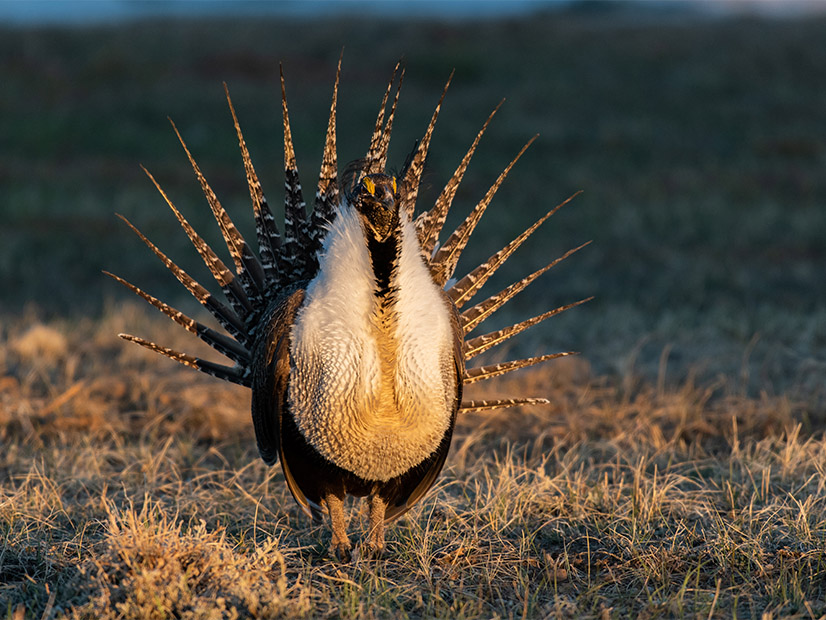
The proposed amendments would loosen restrictions for building near greater sage-grouse habitat and courtship areas known as leks.
The amendments were released along with BLM’s final environmental impact statement for Greenlink North on May 27, opening a 45-day objection period. BLM expects to issue a record of decision for the project this year.
Greenlink North would be a 525-kV line connecting the Robinson Summit substation in northeastern Nevada to the Fort Churchill substation in the northwestern part of the state. The line would run parallel to U.S. Highway 50 and an existing 230-kV transmission line for most of its length.
Greenlink North will connect with NV Energy’s existing One Nevada Line, a north-south line along the eastern side of the state, and Greenlink West, a 525-kV, 350-mile line under construction on the west side of the state, to form a transmission triangle around Nevada.
The project is aimed at increasing transmission redundancy, reliability and resiliency. It will facilitate access to state-designated renewable energy zones to help meet greenhouse gas reduction targets.
The project also will “increase northern Nevada’s transmission import capacity required to meet the region’s electric demand, grid reliability and [FERC] requests for service,” according to the BLM document.
Greenlink West is expected to be in service by May 2027, and Greenlink North’s expected in-service date is December 2028.
Plan Amendments
BLM’s proposed resource management plan (RMP) amendments would designate a new utility corridor up to 3,500 feet wide on land where the Greenlink North project would be built. That would provide enough space to avoid electrical interference with the existing 230-kV line, the bureau said.
Under the amendment, the utility corridor would be exempt from requirements to stay a certain distance from sage-grouse leks. Roughly 100 miles of Greenlink North would be within a 3.1-mile buffer zone for ground disturbances around leks. The buffer requirement would impact geotechnical investigations, construction work, and operation and maintenance activities, BLM said.
“The transmission line’s proximity to leks would be unavoidable,” the BLM document said. “Exempting the BLM utility corridor from the lek avoidance buffers would ensure the viability of the utility corridor if future applications for energy transmission projects were submitted to the BLM.”
The utility corridor also would be exempt from a seasonal restriction for activities in greater sage-grouse winter range, under the proposed amendment.
With seasonal restrictions in place for breeding, brood-rearing and winter habitats, 190 miles of the Greenlink North project would have only 45 days a year remaining for construction, from Sept. 16 to Oct. 31.
With the winter-range seasonal restriction removed, the construction season would run from Sept. 16 to Feb. 28.
Making Progress
The release of the BLM documents is the latest piece to fall into place for the Greenlink projects. (See NV Energy’s Greenlink West Poised for Progress in 2025.)
Work has started at both ends of Greenlink West, NV Energy said in a March project update. In April, construction crews drilled the first holes for the project’s transmission poles. Material yards have been established in strategic locations to reduce distance to construction sites.
NV Energy said it’s been taking delivery of lattice and tubular transmission structures, conductor and shield wire for the transmission line, high-voltage circuit breakers and steel support structures for the substation equipment.