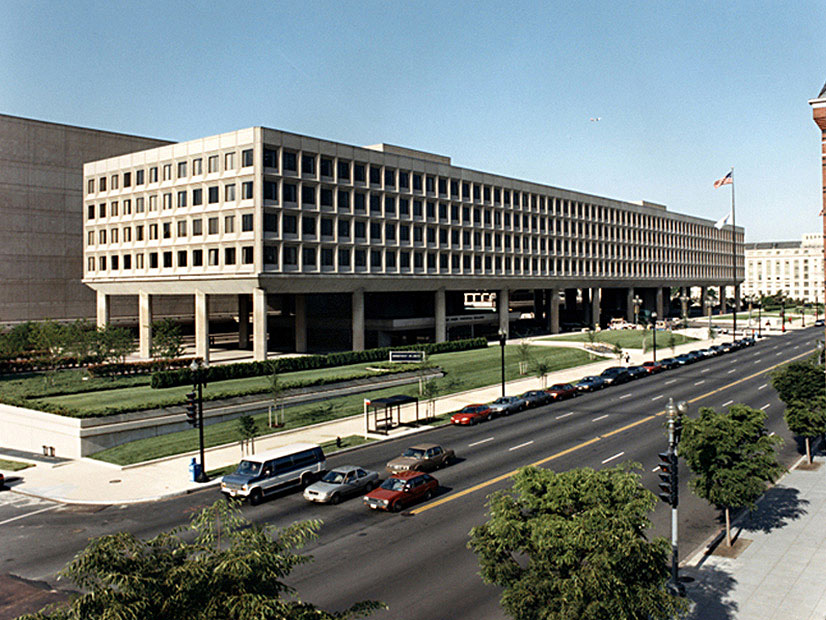
Government job cuts have been a major theme of the Trump administration, and while DOE has faced some cuts former officials say are already significant, many more employees are going to leave in the months to come.
The U.S. Department of Energy is poised to lose thousands of employees this year through early buyouts and other mechanisms, but the cuts are heavier in certain offices.
Cutting down the size of government is a major policy goal of President Donald Trump, as stated in a memo from the White House’s Office of Management and Budget and the U.S. Office of Personnel Management issued about a month after he took office.
“The federal government is costly, inefficient and deeply in debt. At the same time, it is not producing results for the American public,” the memo said. “Instead, tax dollars are being siphoned off to fund unproductive and unnecessary programs that benefit radical interest groups while hurting hard-working American citizens.”
The memo called on federal agencies to submit “agency [reduction in force] and reorganization plans that include a “significant reduction” in full-time employees, lower budgets and “better service for the American people.”
The full effects of that process still are being played out, with the deferred resignation program that many employees have signed up for not being final until the end of September. The law firm Mintz said that up to 5,000 employees at DOE alone could leave, which is out of a total workforce of around 16,000, according to the Equal Employment Opportunity Commission.
In testimony before the Senate Appropriations Committee on May 21, Energy Secretary Chris Wright said only a small percentage of employees had left the department.
“We are looking at larger reductions and … we have offered voluntary plans and programs for people to be compensated by the government as they transition to another career,” Wright said. “We’ve done this slowly, carefully, with a lot of engagement with people and while looking at how to restructure our department. So, the ultimate reduction in workforce will be larger than it’s been today.”
The Federal Reserve Bank of St. Louis estimates that total federal employment has fallen from 3.015 million in January to 2.989 million at the end of April, which still is above January 2024 federal employment levels.
Speaking during a webinar in May put on by the World Resources Institute, where he is a senior fellow, former DOE Loans Program Officer Director Jigar Shah said some of the smartest people at DOE “were forcibly told to resign” over the previous couple of months.
“So that expertise is gone,” the former Biden administration official said. “Even if they wanted to figure out a nuclear renaissance, those people decided to take the early retirement program; the same with geothermal; the same with advanced battery storage. So they’re not there to do that planning.”
Shah listed his old office along with the Office of Clean Energy Demonstrations, the Grid Deployment Office, and the Office of Manufacturing and Energy Supply Chains as being particularly hard hit by staff cuts.
“If you have a new technology right now, and you go to the Department of Energy … I don’t think there’s actually anyone to talk to over there to help you with commercialization of your technologies,” Shah said.
Lasting Impact
While administrations and their policies come and go, the staff losses will be difficult to unwind if in four years a new president wants a more active DOE.
“It is possible, but it’s going to be very difficult,” another former DOE official said in an interview. “You’re going to need to have some kind of authority, from either the administration or Congress, that allows you to hire much more quickly than the normal civil service hiring rules have allowed you to do.”
Even if hiring can be sped up, many of the employees let go or who left because of new requirements, such as return-to-office, were young and doing their first stint in public service, the official added. Their trust in the system will need to be rebuilt, they said.
The National Energy Technology Laboratory in Pittsburgh has not been hit as hard as some of the offices that were implementing key Biden-era policies, but about 100 employees have taken the deferred resignation program, said American Federation of Government Employees Local 1916 President Lilas Soukup.
“Obviously it’s excruciating to lose about 15 to 20% of your workforce and not [be] able to replace them,” she said.
A hiring freeze is in place until July 15, and it could be extended. Additionally, new rules allow departments to hire only one employee for every four who leave, Soukup said.
NETL has different focuses, and those dealing with solar energy are being reduced by the Trump administration. But it also works on fossil fuels, so Soukup said hopefully some of the staff losses could be offset by having her members switch to other programs.
While NETL — as well as the Department of Health and Human Services, whose Pittsburgh-area employees Soukup also represents — have not faced the same cutbacks as other parts of DOE, she worried about the long-term impacts of the staff cuts on public service.
“Who’s going to want to take and work for the government after all of this fiasco is over with?” she asked.
DOE Reorganization Goes Beyond Staffing
DOE did not respond to requests for comment on its staff cuts, but on May 30, it put out a press release highlighting the shift in its direction under President Trump and Secretary Wright.
While the press was bombarded with releases on funding authorized by DOE under President Joe Biden, the department trumpeted $3.7 billion in savings from 24 canceled projects.
“While the previous administration failed to conduct a thorough financial review before signing away billions of taxpayer dollars, the Trump administration is doing our due diligence to ensure we are utilizing taxpayer dollars to strengthen our national security, bolster affordable, reliable energy sources and advance projects that generate the highest possible return on investment,” Wright said in a statement. “Today, we are acting in the best interest of the American people by canceling these 24 awards.”
Of the canceled projects, 16 were approved between Election Day in November and Trump’s inauguration Jan. 20, and they primarily were for carbon capture and storage projects.
The cuts came under criticism from the American Council for an Energy Efficient Economy, which argued they go against the goal of reshoring manufacturing.
“This program could have been a centerpiece of achieving the administration’s goal to bring manufacturing back to the United States,” ACEEE Executive Director Steven Nadel said. “Choosing to cancel these awards is shortsighted, and I think we’re going to look back at this moment with regret. Locking domestic plants into outdated technology is not a recipe for future competitiveness or bringing manufacturing jobs back to American communities.”