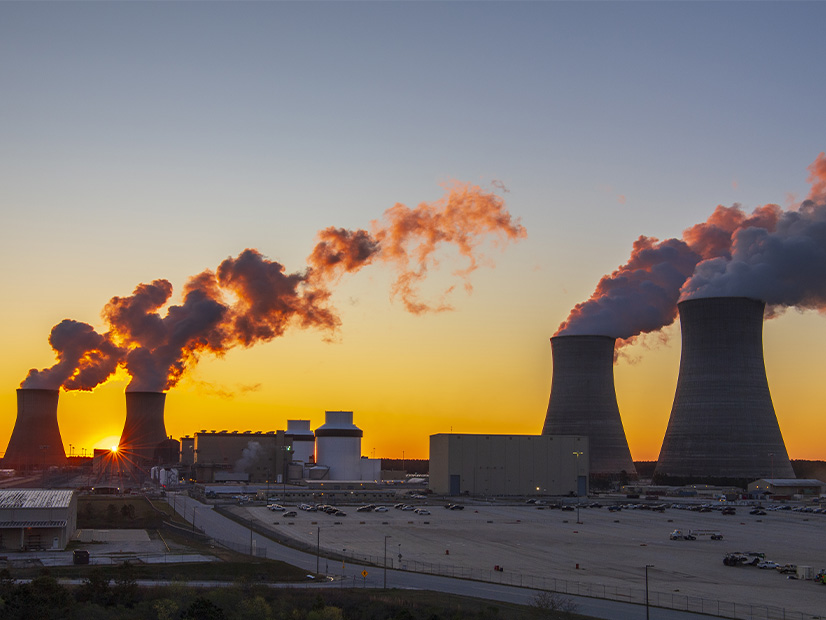
The U.S. hasn’t built new nuclear plants over the past 50 years (other than the Vogtle disaster) because they haven’t made any economic sense, argues columnist Steve Huntoon.
President Donald Trump issued four executive orders on nuclear power in late May, bizarrely bragging that this number of executive orders is twice the number of new nuclear plants started in the U.S. since 1978.
Say what? We haven’t built new nuclear plants over the past 50 years (other than the Vogtle disaster) because they haven’t made any economic sense, as I discussed years ago.
One of his executive orders directs a program for installing nuclear reactors at critical defense facilities, based on the claim that nuclear reactors can deliver resilient, reliable power to these facilities.
Trump’s claim is wrong and misleading for many reasons.
Reason No. 1: Nuclear reactors cannot provide resilient, reliable power to defense facilities. As FERC has observed, in the event of an outage on the grid the nuclear reactor has to shut down and cannot restart until grid power is restored (page 44).

And as 41 transmission owners in PJM recently said to FERC: “Further, load that is co-located with a nuclear unit depends on services such as load following, voltage support, black start and other ancillary services that will be and can only be delivered over the grid. Nuclear units cannot move their output up and down from moment to moment to match variations in the load, and because the nuclear units cannot provide these services, they must instead be provided through connection to the grid” (page 13). Thus, nuclear reactors would contribute 0.0 reliability value to critical defense facilities.
Reason No. 2: Critical defense facilities already have backup power, generally on-site diesel generators. Thus, nuclear reactors would be superfluous.
Reason No. 3: A total of 87% of defense facility outages are due to problems on the distribution systems inside the bases. Thus, a nuclear reactor outside a base would provide 0.0 reliability value relative to such outages.
Reason No. 4: Nuclear reactors have lengthy refueling outages and obviously couldn’t provide power during such outages.
Reason No. 5: If nuclear is to have any hope of commercial viability — which it doesn’t have for reasons I’ve given —then it has to achieve economies of scale through modular production. Since every defense facility has its own unique power needs, that means every nuclear reactor for a given defense facility would need to be unique, thus defeating the only conceivable purpose of having taxpayers subsidize this Trump program.
Defense facilities are only one aspect of Trump’s four executive orders, which collectively are intended to increase the U.S. nuclear fleet from today’s 100 GW to 400 GW by 2050.
What’s that going to cost us? If we take the Ontario SMR cost per reactor (excluding the most expensive first unit) of $3.5 billion, optimistically assume no cost overruns, and divide by the SMR capacity of 300 MW, we get $11.5 million/MW. If we plug that capital cost into the Lazard capital cost range, it interpolates to $181/MWh in the levelized cost of energy range (page 38).
That is an excess of $143/MWh over the $38/MWh average cost of generation in PJM (Figure 3, transmission costs excluded). At nuclear’s 90% capacity factor, Trump’s 300 GW would translate to 2.6 million GWh/year, or 2.4 billion MWh/year, and thus into excessive costs of $343 billion/year for the U.S. overall, and an average excessive cost of $1,000/year for each of us. Please note that this would be a total “own goal” relative to the U.S. Energy Information Administration’s base case for 2050, which has nuclear output and electric customer costs essentially unchanged from today.
Simply put, Trump’s extra 300 GW of nuclear means each of us, as taxpayer or electric consumer or both, would lose $1,000 every year.
Now that is one Big (Not So) Beautiful Bill!
Columnist Steve Huntoon, a former president of the Energy Bar Association, practiced energy law for more than 30 years.