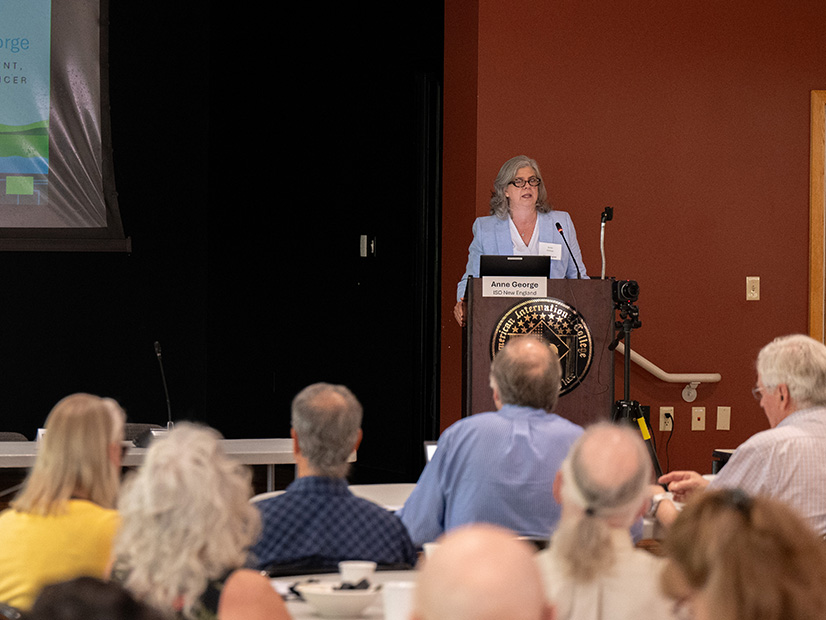
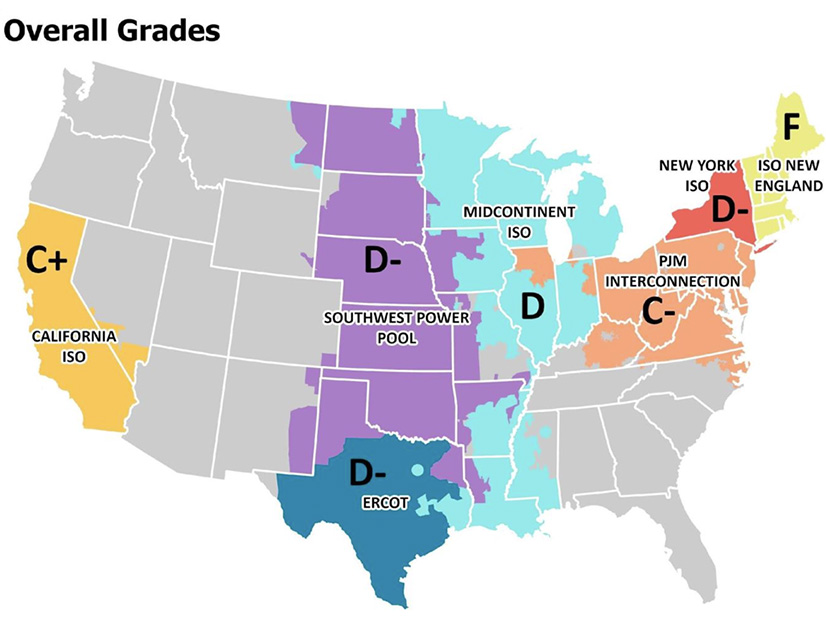
A recent report on RTO accountability, transparency and accessibility gave ISO-NE an "F," citing its "exclusive stakeholder process and inaccessible" board meetings.
Speakers and attendees of the ISO-NE Consumer Liaison Group’s quarterly meeting June 4 advocated for governance changes at the RTO after the grid operator received a failing grade on a recent report card on RTO transparency.
The report, commissioned by New England-based environmental justice nonprofit Slingshot, graded each RTO and ISO on public accountability, transparency and accessibility. ISO-NE was the only grid operator to receive a failing grade, which the report attributed to the RTO’s “exclusive stakeholder process and inaccessible, opaque board proceedings.”
The report also detailed concerns about the limited voting power of end-user organizations in the NEPOOL voting process, language barriers, the lack of a “streamlined public comment process” and the entrenchment of existing leadership.
None of the grid operators, however, received higher than a “C+.”
Governance issues have been a major topic at the CLG since a coalition of environmental and consumer advocates took control of the CLG Coordinating Committee in late 2022. (See Climate Activists Take Over Small Piece of ISO-NE.)
Activists have argued frequently that the nonpublic nature of NEPOOL proceedings and meetings of the ISO-NE Board of Directors prevents meaningful public engagement, while the RTO has pointed to recent steps taken to increase engagement, including annual public board meetings and the addition of an environmental and community affairs policy adviser. (See In Conversation with ISO-NE’s First Community Affairs Policy Adviser.)
Anne George, chief external affairs officer at ISO-NE, called the Slingshot report inaccurate and said it overlooked data and information the RTO has made available to the public.
“Obviously we’re not happy receiving an ‘F’; we disagree with a lot of what’s in that report, and we think it would have been helpful to talk with the researchers,” George said. “I don’t think we’re planning any major changes in what we’re doing based on that report.”
Bryndís Woods, principal analyst at the Applied Economics Clinic and one of the report’s authors, defended its methodology, stressing that the researchers were able to consider only publicly available inputs. Woods noted ISO-NE has made recent steps toward translating some materials into Spanish that were not captured in the report.
Charles Hua, executive director of PowerLines, an affordability-focused nonprofit, said cost pressures have caused increased consumer interest in engaging with energy policy issues.
“The vast majority of Americans feel powerless to do anything about their utility bills,” Hua said, adding that limited public education and opportunities to engage with public utility commissions and RTOs create “significant risk for all stakeholders in the system.”
“It’s critical we create opportunities and processes for consumers to participate,” he said.
Joshua Macey, associate professor of law at Yale Law School, made the case that RTOs and ISOs across the country, including ISO-NE, structurally favor the interests of incumbent transmission and generation owners.
“What you see across all [RTOs and ISOs] is that the voting empowers entities that owned facilities in the 1990s,” Macey said, adding that utilities — and transmission owners in particular — played a major role in establishing the existing governance structures.
NEPOOL voting rules give each of the six sectors an equal share of the voting power and require an approval threshold of 60% for market tariff changes, 66% for non-market changes and 70% for endorsing candidate slates for the ISO-NE board. The high thresholds create a requirement for broad support for rule changes and board endorsements.
While ISO-NE is an independent organization, the transmission and generation sectors, which have a “a significant financial interest in the assets that are already on the system,” would have the power to block any slate of candidates for the board, Macey said.
So far, no slate of candidates for the board has ever been rejected. Slates are chosen by the Joint Nominating Committee, which typically consists of members of the ISO-NE board, representatives from each sector and a state representative.
Macey said the power of incumbent interests has contributed to resource adequacy rules that typically “favor incumbent resources” and provide inadequate incentives for resource entry. He also added that the TOs’ retention of filing rights over local projects likely has contributed to the high costs of asset-condition projects. (See ISO-NE Open to Asset Condition Review Role amid Rising Costs.)
Macey said the RTO has made progress in recent years in changing its rules to enable the addition of new renewables and said electricity restructuring has driven “meaningful cost reductions” and lowered barriers to decarbonization.
“As many challenges as we have here in New England … we should thank our lucky stars that we are not in a vertically integrated market,” Macey said.