

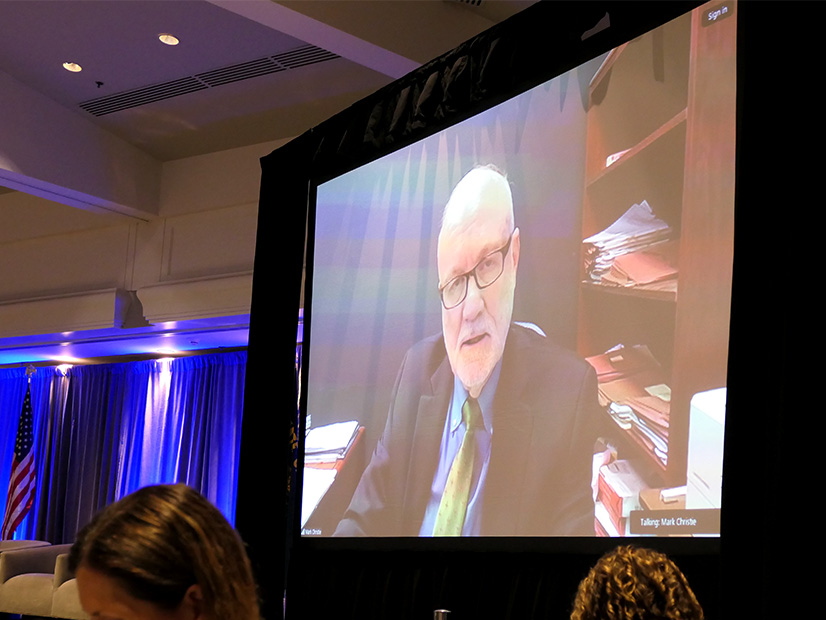
Outgoing FERC Chair Mark Christie and former Colorado Gov. Bill Ritter both emphasized that the West controls the future of the Western interconnection, not Washington.
PORTLAND, Ore. — In their respective speeches during the annual meeting of the Western Conference of Public Service Commissioners, outgoing FERC Chair Mark Christie and former Colorado Gov. Bill Ritter both emphasized that the West controls the future of the Western Interconnection, not Washington.
Christie addressed WCPSC participants remotely June 2, a few hours before news broke that President Donald Trump would nominate Laura Swett of Vinson & Elkins to replace Christie on FERC. (See related story, Trump Replacing FERC Chair Christie with Laura Swett.)
Christie said in his speech that the “early days” of FERC trying to force states and utilities to join an RTO are over.
“It’s called standard market design, and I remember that, and I thought that was a horrible mistake. And fortunately, it didn’t happen,” Christie said.
“It’s not for us at FERC to tell you what to do,” he told the audience. “You’ve got to make that choice on what’s right for you.”
The chair said if the West decides to create an RTO, the industry should think of it “as a bundle of services,” functioning mainly as a grid operator.
An RTO is “not one single service. … I liken it to going through a cafeteria,” he said. “You can pick what you want and not pick what you don’t want.”
Christie’s comments come as many in the power industry in the West are deciding whether to join day-ahead markets offered by either SPP or CAISO.
“You’ve had the choice for years to go into CAISO’s energy market, the [Western Energy Imbalance Market], without even joining … the CAISO itself. So, you can even pick the market without the RTO, but you’ve got a choice of a real-time energy market,” Christie said. “You’ve got a choice of a day-ahead market now; CAISO has it; SPP offers it.”
Christie also heaped praise on the Western Power Pool’s Western Resource Adequacy Program (WRAP), saying, “I think the concept is great.” (See related story, Industry Needs ‘New Planning Paradigm,’ BPA Chief Tells Regulators.)
SPP operates WRAP, and the program will provide a mandatory RA framework for participants in Markets+ in an effort to ensure members with a surplus generating capacity assist those with a deficit.
“Resource adequacy is a challenge everywhere,” Christie said. “And we’ve seen with the data center explosion … load forecasts that are just mind-boggling.”
In a similar vein, Ritter, founder of Colorado State University’s Center for the New Energy Economy, noted the energy industry is grappling with significant change, both politically and technologically.
For example, artificial intelligence will impact technologies that provide power to the grid, but also power demand on the grid, Ritter said during his WCPSC address June 4.
Another change is shifting views on the energy transition, Ritter noted. He pointed to the One Big Beautiful Bill Act that recently passed in the House of Representatives. The bill would extend tax cuts for individuals and render energy tax credits effectively useless. The proposed legislation is a sharp departure from the Inflation Reduction Act of 2022, passed by Democrats, which expanded clean energy tax credits. (See House Passes Reconciliation Package that Would End Energy Tax Credits.)
Long-term planning and near-term decision-making become difficult when “the politics of the moment can shift on a dime,” Ritter said.
However, the West still exercises control over how it chooses to modernize its grid, whether it’s through RTOs or day-ahead markets, but that requires bipartisan discussions over state lines, according to Ritter.
“We need to talk across political boundaries, within states, in order to solve this issue about how we should build out transmission of the West and what that should look like as we go forward, as we look at the things that are going to change,” Ritter said.
“It’s going to be difficult, but if we don’t do it, we’re going to wind up a little bit like Washington, D.C., sounds right now,” Ritter said. “A fairly toxic place — difficult to operate.”



