California is setting records with battery energy storage operating on its grid every day, but in one Southern California beach county, residents have come out in large numbers to oppose a proposed 250-MW battery project because of safety and aesthetic concerns.
California is setting records for the amount of battery energy storage operating on its grid, but in one Southern California beach county, residents have come out in large numbers opposing a proposed battery facility because of fire safety concerns.
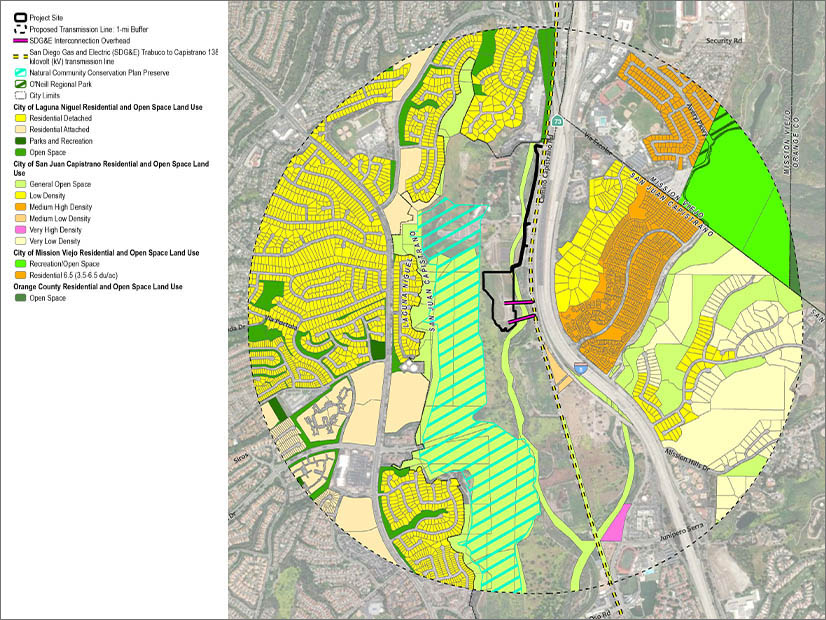
The proposed Compass Energy Storage Project would operate as a 250-MW facility in San Juan Capistrano, near Laguna Niguel and Laguna Beach. California now has more than 12,000 MW of battery storage operating on its grid.
The project is under review with the California Energy Commission, specifically the CEC’s Opt-In Certification program, which began in 2022 as part of Assembly Bill 205. The program’s permitting process offers “developers an optional pathway to submit project applications, facilitating faster deployment of renewable technologies,” the CEC said.
Most residents and government officials in opposition are worried about a fire at the facility and the release of toxic chemicals. Laguna Niguel, for example, is located directly downwind of the project site during offshore winds, which not only occur during Santa Ana wind events but also on most nights, especially during the winter months when the inland valleys cool more than the ocean, the city said in comments filed with the CEC.
Laguna Niguel officials pointed to the Moss Landing battery storage facility that caught fire in January 2025 and required the evacuation of approximately 1,200 people within an eight-mile radius. A fire at the proposed Compass Energy Storage facility would require the evacuation of more than 37,000 people in a two-mile radius alone, the city said. An eight-mile radius could require 100,000 or more people to move out, the city said.
In response to safety concerns, Brett Fooks, CEC manager of safety and reliability, said the Moss Landing facility has two different safety characteristics compared with the proposed Compass Energy Storage project. First, the Moss Landing batteries are nickel magnesium cobalt lithium-ion batteries. This type of battery is more prone to thermal runaway than is the Compass battery, which would use a lithium-ion phosphate chemistry, Fokes said.
Second, the Moss Landing batteries are located indoors, whereas the Compass project’s batteries would be located outdoors. Indoor battery facilities are less fire-safe, Fooks said.
Objective Review
Not all local parties oppose the project. The Orange County Hispanic Chamber of Commerce offered support in comments to the CEC. The permanent shutdown of the San Onofre Nuclear Generating Station, combined with San Diego Gas & Electric’s forecast of a doubling in energy demand by 2045, underscores the importance of this initiative, the chamber said.
“The Compass facility will play a critical role in storing renewable energy and ensuring its availability during periods of high usage,” the chamber said. “In addition to its environmental contributions, the project is expected to provide over $50 million in local tax revenues, directly benefiting public schools, infrastructure development and community safety.”
The CEC currently has three projects with completed applications in its Opt-In Certification program, CEC staff told RTO Insider. The first project, Darden Clean Energy, has been recommended by staff for approval and will be considered by the commissioners at a business meeting June 11.
The second project, the Fountain Wind project, has been delayed beyond the 270-day timeline in alignment because of significant changes to the project discovered during development of the environmental impact report. CEC staff have recommended against the Fountain Wind project, which is anticipated to go before the commission at a business meeting in August or September, CEC staff said.
The CEC plans to vote on the Compass Energy Storage Project near January 2026.
If approved, the facility would interconnect into the existing SDG&E Trabuco-to-Capistrano 138-kV transmission line, which is about 500 feet from the project site. The project would connect to the transmission system through a “loop-in” transmission line. No downstream upgrades or off-site transmission upgrades are required for the proposed project, CEC staff said.
The CEC does not decide on the location of energy projects in California, leaving that to developers, CEC Executive Director Drew Bohan said at a May 29 public meeting.
“We evaluate projects when the [developer] applies,” Bohan said. “We then make recommendations as CEC staff to the CEC … about how they should dispense with the proposal.”
“I want to make clear that the CEC does not advocate for or against any proposal. Instead, we review each application objectively … on safety, environmental standards and community feedback,” Bohan said.