A new report from ACEG argues comprehensive transmission planning can help maintain affordability as the power system grows to meet rising demand from data centers and other sources.
Rising demand means the U.S. needs to expand the transmission grid, and doing so also will keep power prices affordable, according to a report released June 9 by Americans for a Clean Energy Grid.
“We find that comprehensively planned, high-capacity transmission saves consumers money on electric bills, reduces congestion on the grid, unlocks access to lower-cost generation, avoids costlier investments in new generation or lower-capacity transmission and improves overall system efficiency,” the report says.
“Large-scale Transmission Deployment Saves Consumers Money,” prepared by Grid Strategies, says large-scale, proactive and collaborative planning and development are essential to savings for customers. Proper planning cuts costs by decreasing the need for generation and transmission investments overall, while allowing the grid to operate more efficiently.
“The affordability of electricity supply depends in no small part on the efficiency and cost effectiveness of the associated transmission expansion,” the report says.
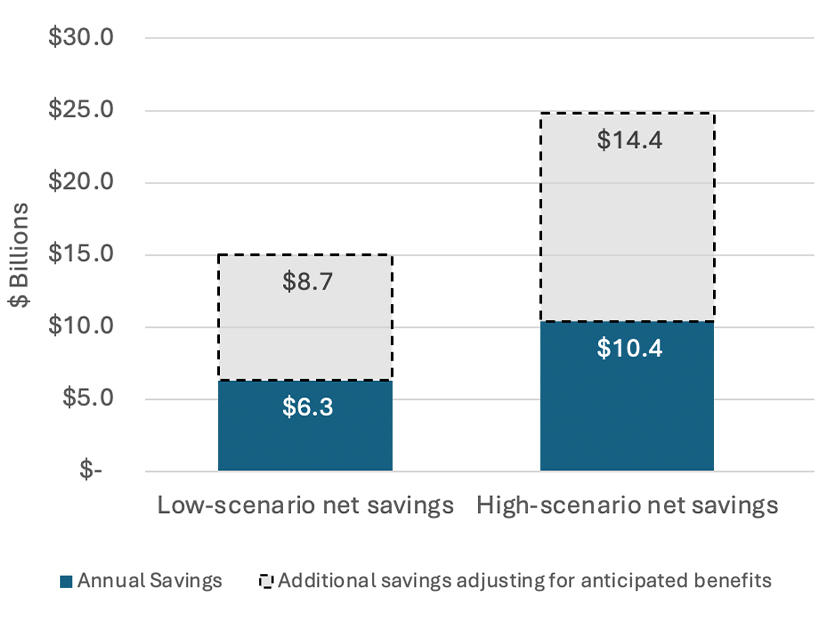
Well-planned, high-capacity transmission could save residential customers $6.3 billion to $10.4 billion across the country after taking into account the cost of new power lines. Across all customer classes, the savings are estimated at $16.8 billion to $27.7 billion.
Transmission planners often underestimate benefits in their initial planning studies, and ex post assessments of consumers savings often are 20 to 40% higher. Applying that to potential annual savings for residential customers brings the range up to $8.7 billion to $14.4 billion, the report says.
Most of the estimated savings come from lower production costs, which means savings from lowering the cost of the power supply by accessing low-cost generation.
Investing in transmission as the report suggests would raise the transmission component of bills by 2% overall, which is a $19 increase annually. But that comes with a 3% cut in generation costs, which translates to $92 in savings annually for the average household.
The report based its estimates on annual savings in recent transmission planning efforts in several regions of the country, but that does not reflect the optimal buildout in doing well-planned, coordinated and cost-effective investments. Some regions are not engaged in that kind of planning at all.
“Extrapolating from a combined set of the recent portfolios planned by MISO discussed in this report, which are among the most robust examples of well-planned, high-voltage transmission, gives a better idea of the full savings consumers might see from more holistic, comprehensive transmission planning,” the report says. “This analysis reveals that every residential household in the country could expect over $100 in net savings on their annual electric bill if this type of planning were the norm nationwide.”
Beyond the savings, transmission supports a reliable, resilient and competitive power system, which benefits national security because of the race to develop artificial intelligence and the high-demand data centers it requires, the report says. A lack of transmission can delay electricity for consumers, slowing economic growth and jeopardizing national goals.
Expanding transmission also means more options to manage the uncertainties facing the power sector today, such as unpredictable load growth, volatile fuel prices, policy uncertainty, uncertain cost trajectories for costs of different types of generators and extreme weather.
“The reality is that price spikes can be crippling for electricity customers, even if they appropriately reflect market design and supply-and-demand fundamentals,” the report says. “As a commodity, electricity is different. It requires hedging and long-term planning that reflects the importance of the service to residential, industrial and commercial customers, as well as the relative degree of price inelasticity for American households. Well planned, high-voltage transmission investment is an essential piece of this puzzle.”