The U.S. Department of Energy is preparing a case-by-case review of all the agency’s financial assistance awards under the Biden administration that it says could have “significant ramifications” for current and prospective recipients.
The U.S. Department of Energy is preparing a case-by-case review of all the agency’s financial assistance awards under the Biden administration that it says could have “significant ramifications” for current and prospective recipients.
That review includes a $464.5 million grant to MISO and SPP under DOE’s Grid Resilience and Innovation Partnerships (GRIP) program.
The grant, the largest awarded by DOE, would offset about 25% of the capital cost for five projects in the RTOs’ $1.6 billion Joint Targeted Interconnection Queue (JTIQ) portfolio. (See DOE Announces $3.46B for Grid Resilience, Improvement Projects.)
A spokesperson for the Minnesota Department of Commerce said all GRIP funds are subject to the process review. Grant applicants face a June 16 deadline to provide the requested data to DOE, said Kristen Glazer, Commerce’s assistant communications director. The department is the lead applicant on the project, which also involves the Great Plains Institute, along with the two RTOs.
MISO and SPP both told RTO Insider they are coordinating with each other and the other JTIQ partners to respond to the data request. Minnesota said it has not been given a “definitive timeline” by DOE for the review’s completion.
“In the meantime, we remain confident in the value of the proposed projects,” SPP spokesperson Derek Wingfield said.
MISO told stakeholders earlier in 2025 that DOE had not indicated that GRIP funding is in jeopardy. It said the JTIQ portfolio “is not contingent upon the receipt of GRIP funding.”
The grid operators say the five 345-kV JTIQ projects will enable the interconnection of “tens of thousands of MW of new generation” on their seam to serve new data centers and other large loads.
The GRIP funds were awarded in 2023 but to date, only the Minnesota Commerce Department has received disbursement from the DOE. Glazer said the department is working with the RTOs and other partners to develop the contractual mechanisms ensuring they get funds for their work.
DOE announced the review process in a May press release. It requested additional information to evaluate 179 awards covering more than $15 billion in financial assistance. The agency said it is prioritizing “large-scale commercial projects” that require more detailed information from the awardees in a process that could extend to other DOE program offices.
Energy Secretary Chris Wright said agency staff had spent 110 days reviewing “billions of dollars that were rushed out the door, particularly in the final days of the Biden administration” that it found concerning. He said agency staff would ensure due diligence to use “taxpayer dollars to generate the largest possible benefit to the American people.”
“Any reputable business would have a process in place for evaluating spending and investments before money goes out the door, and the American people deserve no less from their federal government,” Wright said.
DOE is requiring recipients to provide written responses and supporting documentation and to cooperate with program personnel on any follow-up requests. Projects that meet the agency’s standards will proceed, but those that don’t will be modified or terminated, based on the department’s outcome.
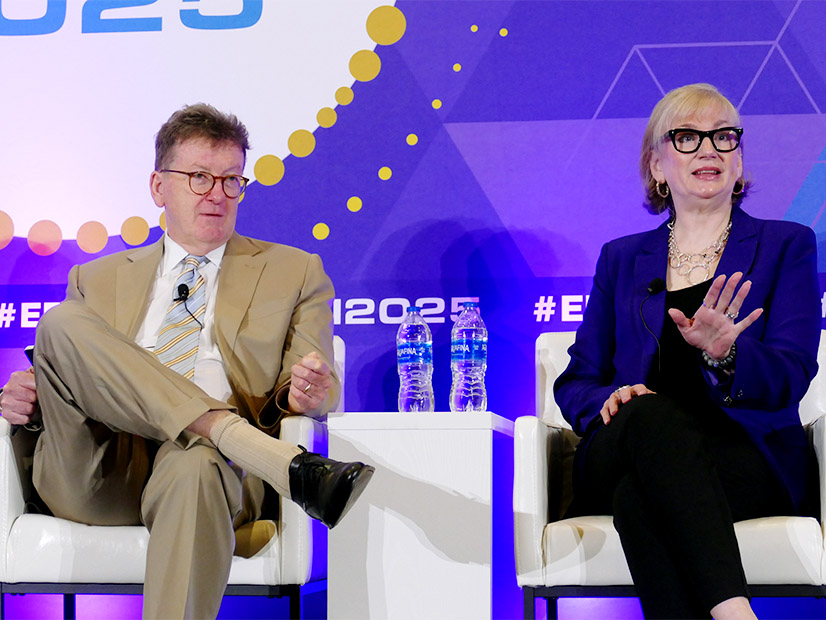
“It feels like they’re going to use that process to down-select, including projects that were awarded but maybe not contracted,” Grid United CEO Michael Skelly said during the Edison Electric Institute’s annual meeting in June. “It’s not totally clear what’s happening there, but the one kind of wild card is there’s a real interest in moving quickly because they get the imperative around load growth and the need to build things.”
Sitting next to Skelly on the EEI panel, ALLETE CEO Beth Owen said her organization operates an HVDC modernization project that relies on federal and state support. She said ALLETE is attempting to make the case with the federal government that the granted dollars need to flow.
“We’ve spent a lot of time with the administration helping explain why these projects are important and why the DOE grant is an important part for customers,” Owen said. “This is an existing project that’s being modernized that will help ensure reliability and energy security. We’ve been using all of the things that we know are important to this administration. … In a high inflationary environment, those dollars are going to be critical to this project for those reasons.”
FERC in November 2024 approved tariff revisions and modifications to the joint operating agreement between MISO and SPP that enshrine a structural and cost-allocation framework for the JTIQ projects. Their novel approach to joint planning focused on backbone projects they say will unlock 28 GW of capacity and reduce curtailments in a highly congested region. (See FERC Approves JTIQ Framework, Cost Allocation.)
Amanda Durish Cook contributed to this article.