Despite interest from the Trump administration, new gas pipelines into New England remain unlikely due to a lack of counterparties willing to pay for the new lines, energy industry experts said.
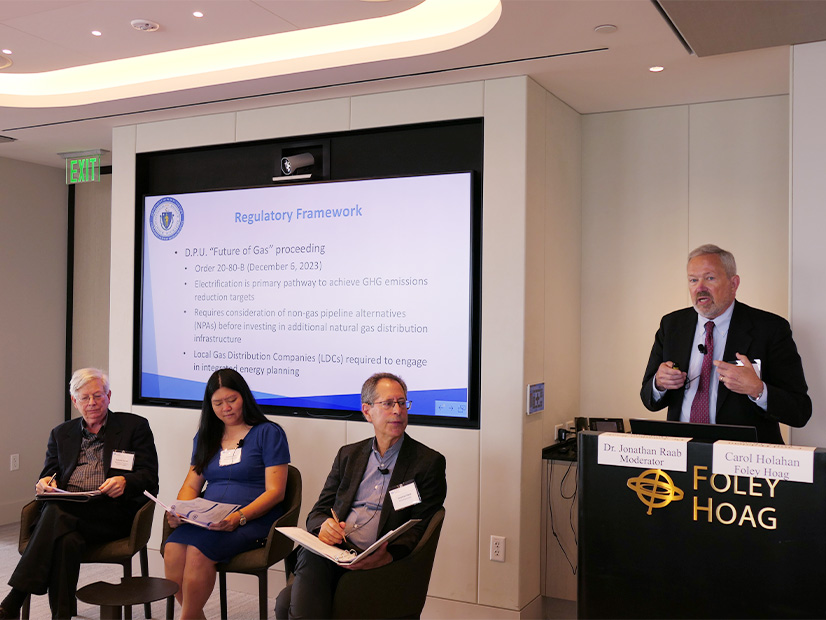
BOSTON — Despite interest from the Trump administration, new gas pipelines into New England remain unlikely due to a lack of counterparties willing to pay for the new lines, energy industry experts said at a recent roundtable discussion.
The pipeline financing uncertainty is driven by the New England states’ push for heating electrification, the lack of incentives for gas generators to procure firm capacity, and a 2016 ruling by the Massachusetts Supreme Judicial Court that electric customers cannot cover the costs of a new pipeline.
“The biggest reason I am skeptical of a new pipeline is: Who is the counterparty?” Dan Dolan, president of the New England Power Generators Association (NEPGA), told attendees of Raab Associates’ New England Electricity Restructuring Roundtable on June 13. “Unless Enbridge or Williams or Kinder Morgan are willing to build on spec and are willing to take merchant risk … I don’t see it.”
Cheryl LaFleur, chair of the ISO-NE board of directors, highlighted financing challenges and a lack of interest from the states as the key obstacles to the development of new pipelines.
“A pipeline is definitely the most efficient way to move gas from point A to point B — that has always been true,” LaFleur said. “It is up to the states how much gas they think the region will need and if they want a pipeline. It is not up to ISO New England.”
In May, the Trump administration reportedly reached a deal with New York to lift a stop-work order on the Empire Wind project in exchange for concessions from Gov. Kathy Hochul (D) on the Constitution Pipeline project, which was halted after failing to receive permits from the state in 2018. (See BOEM Lifts Stop-work Order on Empire Wind.)
Several speakers agreed that, if New England was offered a similar, hypothetical deal lifting regulatory barriers for offshore wind and gas pipeline projects, lawmakers should take the trade.
Rachel Fox, director of policy and strategy at the American Petroleum Institute, speculated that, while offshore wind “is by no means favored by this administration,” the Trump administration may allow projects to move forward “if it’s part of a deal for a natural gas pipeline.”
Liz Stanton, executive director of the Applied Economics Clinic, warned about the health effects of gas generation on local communities, but said the New England states should take the deal because efforts to bring a pipeline to New England appear unlikely to succeed.
Dolan of NEPGA was skeptical the Trump administration would seek this type of deal with the region, noting that the under-construction Vineyard Wind and Revolution Wind projects are well under way and have not been specifically targeted by the Trump administration. He said a deal likely would need to clear obstacles to incremental offshore wind generation beyond these projects, which the administration may be reluctant to do.
Retail Gas Demand
On the gas distribution side, speakers discussed an apparent rift that has emerged in Massachusetts between lawmakers and utilities over the interpretation of language in a major 2024 clean energy bill passed in the state. (See Mass. Clean Energy Permitting, Gas Reform Bill Back on Track.)
According to Sen. Michael Barrett, one of the lead negotiators on the bill, the bill authorized gas utilities to disconnect customers from the gas system if viable heating alternatives are available. This change was intended to amend the utilities’ “obligation to serve,” preventing a single gas customer from holding up the decommissioning of an entire section of gas pipe.
“Last year, we amended Section 92 of Chapter 164, which is the sole basis for the so-called obligation to serve in Massachusetts, and we amended it with the legislative intent of giving our state DPU flexibility … to resolve the so-called holdout problem,” Barrett said.
But despite the legislative changes, gas companies continue to argue they are not authorized to deny gas services to existing customers, and that the change in state law applies only to new customers.
“There’s a disagreement, I think, in terms of what authority the utilities have to substitute electric for gas, or for the DPU to authorize that substitution,” said Jamie Van Nostrand, chair of the Massachusetts Department of Public Utilities.
He said the issue of holdout customers has come up in a National Grid electrification demonstration project, which aims to “decommission one or more leak-prone gas pipe segments through coordinated whole-home electrification of customers.”
The company, Van Nostrand said, has taken “is taking the position that decommissioning a segment will require 100% participation of the customers on that segment,” creating numerous potential points of failure for the efforts to decommission each segment of pipe.
As the state looks to move the bulk of its residential gas customers to electric heating, it would be “very hard to achieve a gas transition without addressing this issue,” Van Nostrand said.
Looking forward, Van Nostrand said the DPU plans to look at the issue more closely “and give the parties an opportunity to brief on that, because it is a real critical issue as we look at the success of these electrification projects.”
Caroline Hon, vice president of New England regulation and pricing for National Grid, did not directly answer a question from Sen. Barrett about why National Grid continues to take the stance the utilities do not have the authority to disconnect customers when viable alternatives exist.
Hon framed customer conversions as an equity issue and said that “if we aren’t thinking about this thoughtfully, it can be very regressive, and the most vulnerable people, the customers who can’t actually to convert, are going to be the ones who really suffer.”