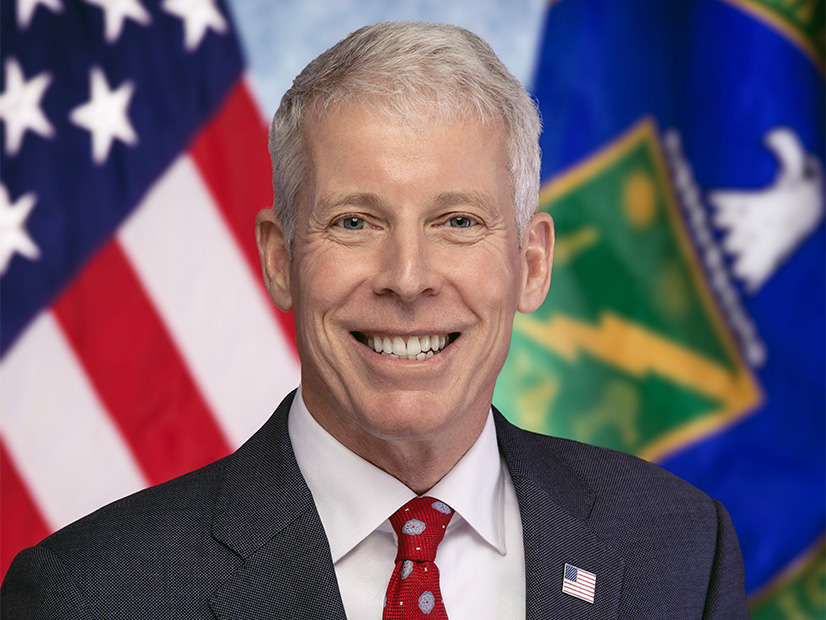
Senators had a chance to ask Energy Secretary Chris Wright about project spending his department has put under review — or already cut — when he testified at the Senate Energy and Natural Resources Committee about the Trump administration’s 2026 budget request.
“It is deeply concerning how many billions of dollars were rushed out the door without proper due diligence in the final days of the Biden administration,” Wright said during his June 18 testimony. “DOE is undertaking a thorough review of financial assistance that identifies waste of taxpayer dollars, protects America’s national security and advances President Trump’s commitment to unleash American energy dominance.”
He said that led DOE to terminate 24 projects totaling $3.7 billion in spending that failed to meet the economic, national security or energy security standards needed to sustain the agency’s investment.
Ranking Member Martin Heinrich (D-N.M.) said those deals were canceled without notice or justification and that DOE crossed into “impoundment territory,” which is when the executive branch cancels congressionally approved funds, an act only legal in narrow circumstances.
“Actions like these will severely damage our country’s ability to lead in developing and commercializing next generation technologies while ceding ground to our competitors,” Heinreich said.
Sen. Steve Daines (R-Mont.) asked about the North Plains Connector transmission project, which would run through his state and connect the Eastern and Western interconnections. Last summer it was awarded funds under the Grid Resilience and Innovation Partnership (GRIP). (See DOE Announces $2.2B in Grid Resilience, Innovation Awards.)
The project would open new markets to the Colstrip power plant, which currently is linked to utilities in Oregon and Washington, Daines said.
“This project would have the potential to diversify Montana’s generation assets, unlocking billions in private investment and enhance our nation’s energy security by connecting the Eastern and Western Electric grids,” he said.
Wright said he has met with the North Plains Connector’s developer previously and called the project — and the general idea of increasing transfer capability across the two interconnectors, a good idea.
“We are committed to following this project review process where a crew of people evaluate — not political, not biased for this or that,” Wright said. “Just look at the math, look at the numbers, and is this thing viable and beneficial for America. You know, yes, no or adjustable — it’s modifiable. So, we haven’t finished that on that project yet, but I think you make a strong case for the project.”
‘Demand and Pressure’
Sen. Angus King (I-Maine) noted that GRIP funding was approved under the bipartisan Infrastructure Investment and Jobs Act, and not the Inflation Reduction Act, which is much more unpopular with Republicans. He asked whether the DOE’s review of projects will be fair.
“We’re evaluating the engineering, the science, the finance and just the viability of the projects,” Wright said. “It is just a business review. Unfortunately, it wasn’t done before when grants were given. But I would say, in the GRIP program, there’s a lot of very good projects there.”
King then asked about a major energy storage project being built north of Bangor, Maine, by Form Energy, which is under review by DOE currently. (See: Form Energy to Develop First Multiday Storage Project in New England.)
“We stood up this process a few weeks ago,” Wright said, adding that the agency expects to do at least 20 reviews a week and telling King that he’s “very interested” in storage as well. “My chief of staff here is here with me, and we’ll make sure that in the next few weeks at most, we will get on to that project.”
King additionally said he didn’t understand why the Grid Deployment Office is facing a 75% cut in funding under DOE’s budget request, given the “demand and pressure” on the grid.
Wright said he thinks DOE’s most important grid-related offices are the Office of Electricity and the Office of Cybersecurity, Energy Security and Emergency Response. The budget cuts to GDO are part of a reorganization that will refocus its work in the Office of Electricity.
King said he hoped the funds earmarked to strengthen the grid are not slashed in the face of rising demand and more expensive power bills for consumers.
“One of the things I’ve noticed just in my career in energy is it used to be that the principal part of your electric bill was the cost of energy,” King said. “Now, in many places, transmission and distribution is 50% or more, and that’s only going to increase, unless we start to think about new technologies, what are called GETs, which I’m sure you’re familiar with — grid enhancing technology, so that we’re not simply rebuilding massive facilities that could be obviated by new technologies.”