Tenaska Power Services and the Texas Public Utility Commission have reached a settlement in which the company will pay a $353,500 penalty and disgorge $28.24 million in excess revenue made in the ERCOT market in violation of agency rules.
The commission consented to the penalties during its June 20 open meeting (57437).
The PUC’s Compliance and Enforcement staff recommended the action after investigating Tenaska Power’s assignment of ancillary services (AS) from January 2016 through April 2021. Staff said Tenaska, a qualified scheduling entity (QSE) and ERCOT market participant, assigned the services to unqualified load resources.
“Tenaska Power was paid to keep capacity available to provide ancillary services during this period but was incapable of providing the ancillary services assigned to unqualified load resources,” staff said.
The investigation found four separate events where Tenaska Power was at fault:
In 2018, two separate load resources under common ownership were provisionally authorized to provide AS responsibilities for a 90-day period. After a clerical oversight, Tenaska Power continued to assign the responsibility to the unqualified load resources after their provisional authorizations had lapsed. During the 31 days that followed, the resources were inadvertently assigned AS responsibilities for 5,261 intervals.
In January 2018, the company telemetered an incorrect resource status code as the QSE for a third party’s generation resource. That led to ERCOT issuing a reliability unit commitment instruction for a unit that was unable to fulfill the request.
During Winter Storm Uri in February 2021, Tenaska Power received real-time off-line reserve price adder payments for a resource that was on a planned outage when it telemetered incorrect information to ERCOT.
During the storm, Tenaska Power also telemetered high sustainable limits (HSLs) that incorrectly represented the maximum sustainable energy production capability of resources it represented. The company offered to refund the HSL-related revenues using ERCOT’s alternative dispute resolution process. However, at the time, the process was not an available method to return the excess revenues to the market.
Staff said Tenaska Power has since taken corrective measures to prevent similar issues in the future.
Tenaska Power, a subsidiary of Nebraska-based Tenaska, agreed to the administrative fee and the disgorgement.
Tejas Power Eligible for TEF Bonus
The commission sided with staff’s recommendation to affirm Tejas Power Generation’s eligibility for the Texas Energy Fund’s Completion Bonus Grant program. The generator seeks $17.52 million in performance-dependent grants over a 10-year period for a 146-MW project.
Staff said Tejas Power’s application was administratively complete and that it completed a review process. The grant is contingent on the resource’s timely interconnection to the grid and meeting annual performance measures, including availability for ERCOT dispatch.
Tejas Power is the second recipient of the bonus grant program. The PUC in April entered into a grant agreement with the Lower Colorado River Authority, which is seeking $22.5 million in loans to help build the first of two 188-MW gas-fired units at its Timmerman Power Plant. (See “4 Projects Added to TEF,” Texas PUC Approves 765-kV Transmission Option for Permian Basin.)
LCRA says the unit is scheduled to reach commercial operations in 2025, ahead of its June 1, 2026, deadline to interconnect.
SWEPCO Resiliency Plan OK’d
The PUC approved Southwestern Electric Power’s system reliability plan, but not before reducing the proposed vegetation-management spend by $5.1 million to $83.7 million (57259).
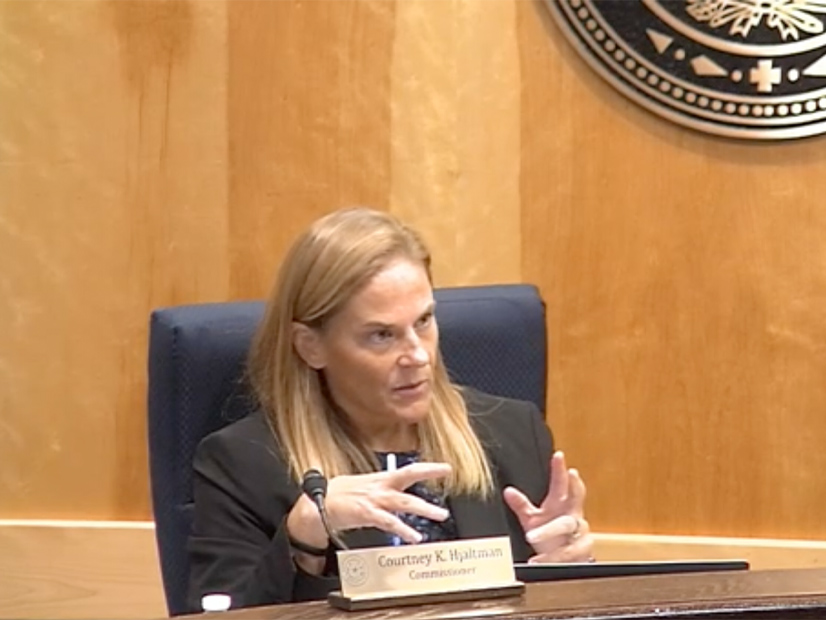
Commissioner Courtney Hjaltman suggested the reduction to reflect what she said were “excessive estimates” for the project costs. The commissioners agreed to remove 26 projects with benefit/cost ratios of less than 1.0, considered the industry standard.
SWEPCO filed the plan consisting of about $183 million of resiliency projects in November 2024. It reached a unanimous agreement with commission staff, the Office of the Public Utility Counsel, Cities Advocating Reasonable Deregulation, Texas Industrial Energy Consumers and Walmart in March.
The PUC also agreed to intervene in support of MISO’s revised expedited resource addition study before FERC that allows a study of a limited set of interconnection requests on an accelerated timeline. FERC rejected the RTO’s first attempt in May, saying the grid operator failed to limit the number of projects that could apply (ER25-2454). (See MISO Reapplies for Generator Interconnection Fast Lane with FERC.)