IESO will revise its procedure for breaking capacity auction ties in time for the 2025 contest in November.
Bowing to stakeholder requests, IESO officials said they will implement a revised method for breaking capacity auction ties in time for the 2025 contest in November.
A tie-break occurs when two or more participants offer the same price for the last available quantity of capacity in a zone.
Under current rules, the ISO uses time stamps to select the bid submitted first, a method stakeholders have complained about for years.
IESO’s Laura Zubyck, capacity auction supervisor, said in a June 26 webinar that the ISO agreed to accelerate development of a new tie-break procedure in response to stakeholders’ feedback that changing the rules for 2025 was a “top priority.”
Revised Methodology
The new rules will create a multi-step process that IESO said will be more equitable.
In the first step, the ISO will divide the remaining available capacity by the number of offers involved in the tie to determine an equal share of capacity per offer, rounded down to one-tenth of a megawatt.
For example, if there is 40 MW remaining to be allocated and three offers totaling 70 MW, the equal share is 40 MW divided by 3, or 13.3 MW.
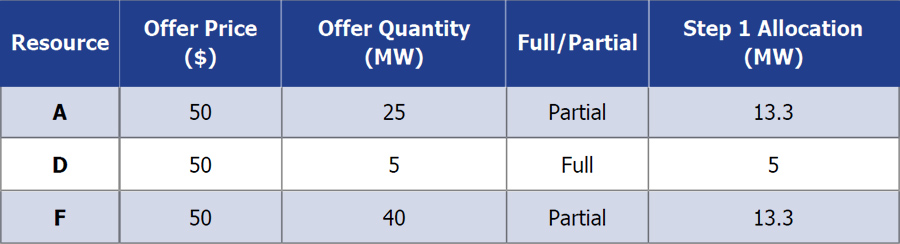
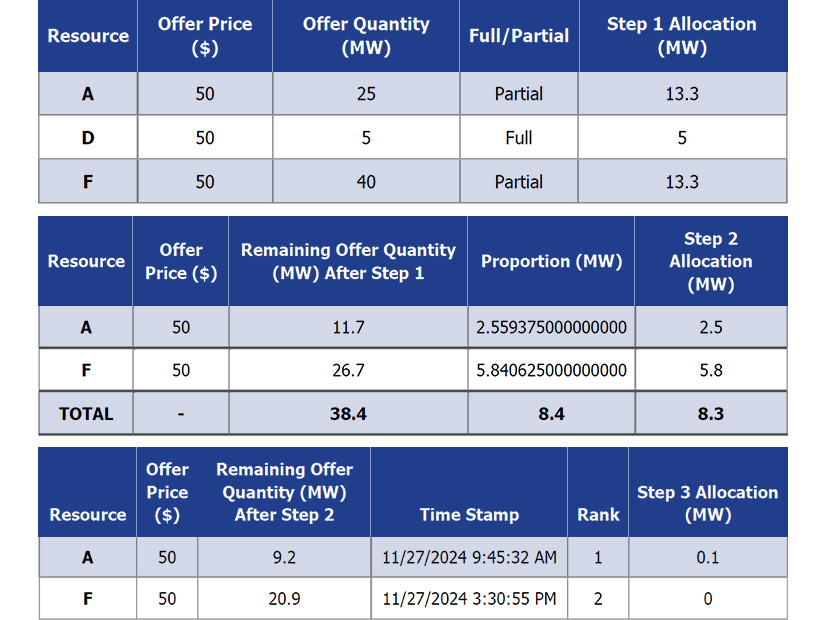
Step 1: Resource D, which offered 5 MW, is allocated the full 5 MW because it is less than 13.3 MW. Resource A, which offered 25 MW, and Resource F, which offered 40 MW, each are awarded 13.3 MW, leaving 8.4 MW unallocated.
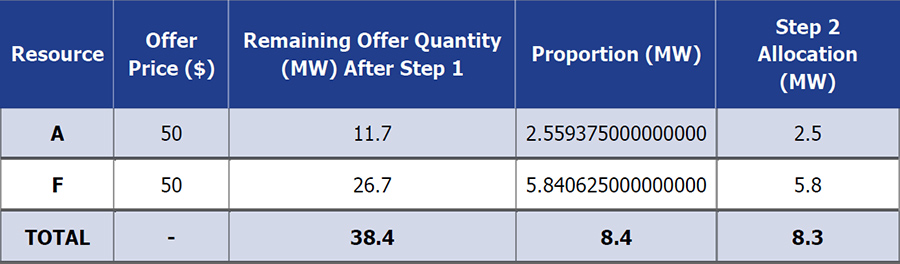
Step 2: The remaining tied partial offers are awarded proportional shares of the capacity remaining after Step 1. Resource A, which had 11.7 MW remaining in its offer after Step 1, is awarded 2.559 MW (rounded to 2.5 MW) and Resource F, which had 26.7 MW remaining, is awarded 5.84 MW (rounded to 5.8 MW). That leaves 0.1 MW to be allocated in Step 3.
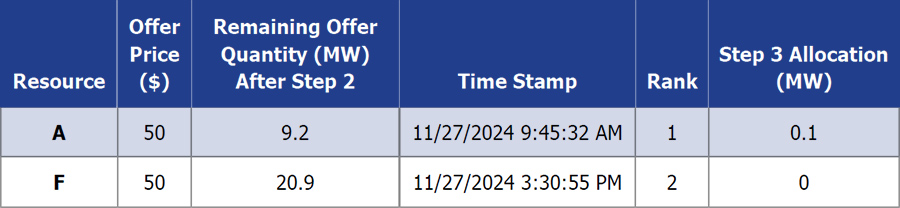
Step 3: Offers are ranked by time stamp. Resource A, which filed earlier, is awarded the final 0.1 MW.
Allotments of Less than 1 MW
One wrinkle: ISO officials said the tie-break process could result in a total capacity allotment of less than 1 MW for a resource, which is not permitted by market rules.
In such a scenario, the resource that would be awarded an obligation of less than 1 MW will be eliminated, and the tie-break process will be repeated starting with Step 1.
For example, if four offers shared the same price for the final 3.9 MW and one would have been allocated only 0.9 MW, it would be eliminated, resulting in three equal allocations of 1.3 MW.
Multiple Constraints
ISO officials also discussed a situation in which multiple constraints are involved in a tie-break — for example an intertie limit and a zonal limit — with the available capacity of one limit lower than the other.
The tie-break for the lower limit would be resolved first using the tie-break steps. The remaining capacity would be allotted to the remaining tied offers associated with the higher limit.
Next Steps
IESO asked stakeholders to provide feedback on the proposed rules by July 10. IESO’s Technical Panel will begin considering the changes in July with a vote to post scheduled for September and board approval anticipated in October. The Nov. 26-27 auction will seek capacity for the periods beginning May 1 and Nov. 1, 2026, with results posted Dec. 4.
The ISO board also is expected to vote in August on rule changes to reduce unfulfilled capacity commitments by making it easier for participants to transfer their obligations and harder to buy them out. (See IESO Seeks to Shore up Capacity Market.)