The Nuclear Regulatory Commission has taken multiple steps to speed and smooth the path forward for the U.S. nuclear power industry.
In two weeks, the NRC announced it has:
-
- changed policies to accommodate factory-built microreactors;
- reduced the hourly rate charged to advanced nuclear reactor applicants and pre-applicants;
- accelerated its review of a construction permit for an advanced reactor planned in Wyoming; and
- finalized a rule extending design certifications from 15 to 40 years.
- NRC also extended the expiration date of the operating license of a South Carolina nuclear reactor from 2042 to 2062, giving it a potential 80-year lifespan.
President Donald Trump on May 23 issued a series of orders intended to ease and expedite development of new nuclear power generation. Among these was a strongly worded directive for reform of the NRC, its structure, its personnel, its regulations and its basic operations.
On July 2, NRC published the design certification (DC) rule in the Federal Register. It is using the direct final rule procedure because it considers the action to be non-controversial. The rule will take effect Sept. 15 unless “significant adverse comments” are received by Aug. 1.
The change pertains to the five reactor DCs now in effect, as well as future DCs and renewals. The 15-year period dates to 1989; NRC said time has shown too little operating experience accumulates in 15 years for review at time of renewal. Extending the window to 40 years will allow this to happen, NRC wrote, adding, “it will reduce unnecessary burdens with no reduction in safety or security.”
Also on July 2, NRC said it had moved forward to no later than Dec. 31 its target date for completion of review of TerraPower’s construction permit request for its Kemmerer Power Station Unit 1.
TerraPower subsidiary US SFR Owner submitted the application in March 2024. Before adopting the “more aggressive schedule,” NRC had expected completion of its review no later than June 30, 2026.
The company seeks to build TerraPower’s Natrium design near an existing coal-fired power plant in Kemmerer, Wyo. The facility would be rated at 345 MW; an energy storage system would boost maximum temporary output to 500 MWe. If it is built, it will need an operating license through a separate NRC application procedure.
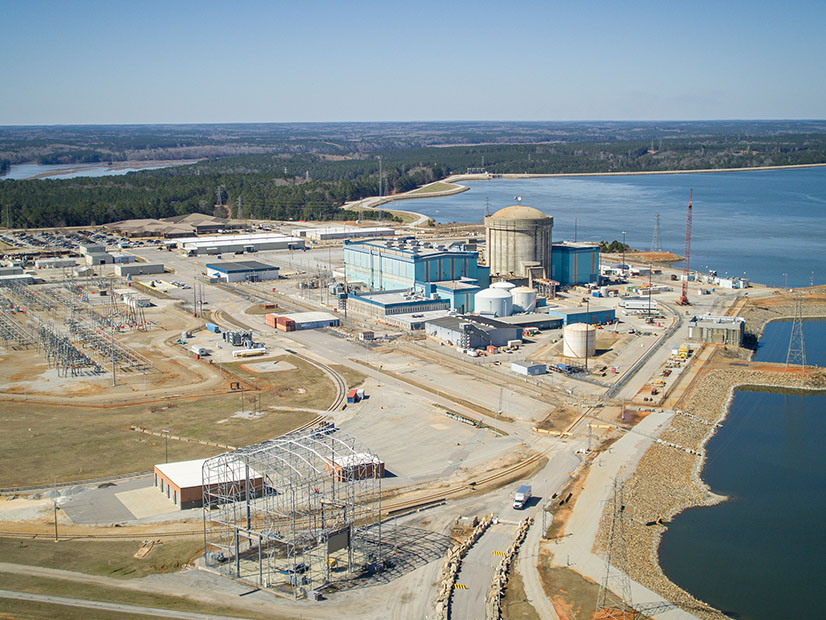
On June 30, NRC announced renewal of Dominion Energy South Carolina’s operating license for V.C. Summer Nuclear Station Unit 1.
The 966-MW pressurized water reactor in Jenkinsville, S.C., first was licensed to operate from 1982 through 2022. In 2004, NRC approved a renewal to 2042. This latest renewal will extend its license through Aug. 6, 2062.
The Nuclear Energy Institute’s database indicates this is the furthest-reaching license of any U.S. reactor other than the brand-new Plant Vogtle Unit 4, whose initial 40-year license extends to July 28, 2063.
There is widespread interest in expanding the aging U.S. nuclear fleet, but given the high cost and long time frame of new construction, operators are keen to keep existing facilities in service, uprate their capacity and even bring retired units back online.
Dominion said July 1 it has been conducting upgrades at V.C. Summer to ensure its longevity, including the recent replacement of the main transformer.
On June 24, NRC amended the fees it will charge applicants and licensees for fiscal 2025, as required by the ADVANCE Act of 2025. The hourly rate will be reduced from $318 to $148 effective Oct. 1.
The NRC is required to recover as much of its operating budget through fees as possible. Its fiscal 2025 budget authority is $944.1 million; it expects to recover $205.4 million through service fees and $603.4 million through annual fees.
On June 18, NRC announced three policy decisions to expedite deployment of microreactors — reactors built, fueled and tested at a factory that would generate 1% or less of the output of a large plant such as V.C. Summer. Under the changes:
-
- A factory-fabricated microreactor can be loaded with fuel at the factory under NRC license if it has features to prevent a nuclear chain reaction.
- Also, such a reactor can be excluded from “in operation” status.
- Finally, NRC staff can authorize testing of a microreactor at the factory before it is shipped to its operating site.
NRC said it had directed staff to continue other efforts focused on microreactors in compliance with the ADVANCE Act and the executive orders.