SPP stakeholders have rejected a proposed tariff revision (RR687) that would help the grid operator connect generation more quickly.
Staff said the change would improve the definitive integration system impact study (DISIS) process by modifying the RTO’s dispatch method to ensure the added generation’s reliability and also lower exports to a realistic level. The proposal failed with only 36% of the vote during the Markets and Operations Policy Committee’s June 30 virtual special meeting.
Natasha Henderson, SPP’s senior director of grid asset use, said during a June 26 education session that the large amount of generation in the queue, combined with the dispatch method, is causing unrealistic generation exports. That assigns noncommercial viable upgrades to generators.
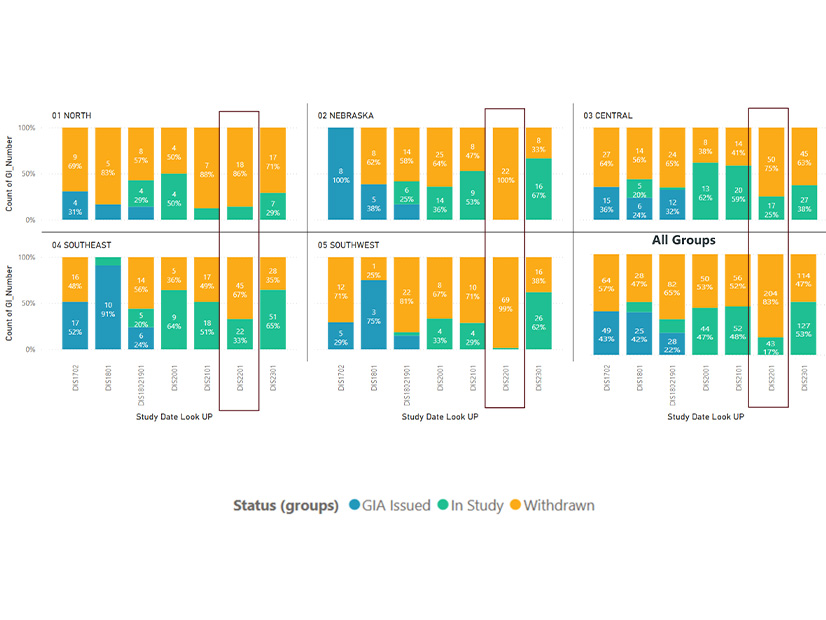
The 2023 DISIS includes 28 GW of capacity from 127 projects, about half of which are wind and solar resources. Like all SPP study clusters, staff analyze them in five groups: North, Nebraska, Central, Southeast and Southwest.
Henderson said SPP is seeing dropout rates between 67 and 100% in the study clusters that are causing further downstream issues.
“What happened in the 2022 DISIS is after all of this generation dropped out, $22 billion of associated upgrades also went away,” she said. “So, when we finish the 2023 DISIS Phase 2, it’s likely those generators are now going to see that same $22 billion of upgrades assigned to them. The proposed dispatch changes will mitigate that. It will not completely eliminate it, but it will help a little bit.”
Oklahoma Gas & Electric’s Adam Snapp, a member of the Transmission Working Group (TWG), cautioned against the proposal, saying no one knows the full effect the modified dispatch will have on the 2023 DISIS. The TWG twice rejected RR687 in June, 0-13 with five abstentions, and 6-14 with three abstentions.
“There are still a large number of resources that are in the 2023 queue that are benefiting from billions of dollars of upgrades that are currently assigned to the 2022 cluster,” Snapp said. “Once those 2022 cluster resources withdraw, those costs will shift to the 2023 resources that will trigger a lot of resource withdrawals from the 2023 cluster. What we’re effectively doing here is asking the policy to overrule TWG on a very technical matter without understanding the whole impact of … that decision.”
SPP had hoped to receive an expedited approval from MOPC so it could apply RR687 to the DISIS 2023 Phase 2 clusters that hadn’t been completed before July 1. That study will conclude before the committee’s regularly scheduled July 15-16 meeting.
“We do think that this needs to be ported over in future generation interconnection processes,” said SPP’s Casey Cathey, vice president of engineering.
The issue will be sent back to the TWG for further consideration and discussion. The group next meets July 29 in Kansas City.