A new study warns that the United States is not building anywhere near enough high-voltage transmission to support the anticipated needs of the evolving economy.
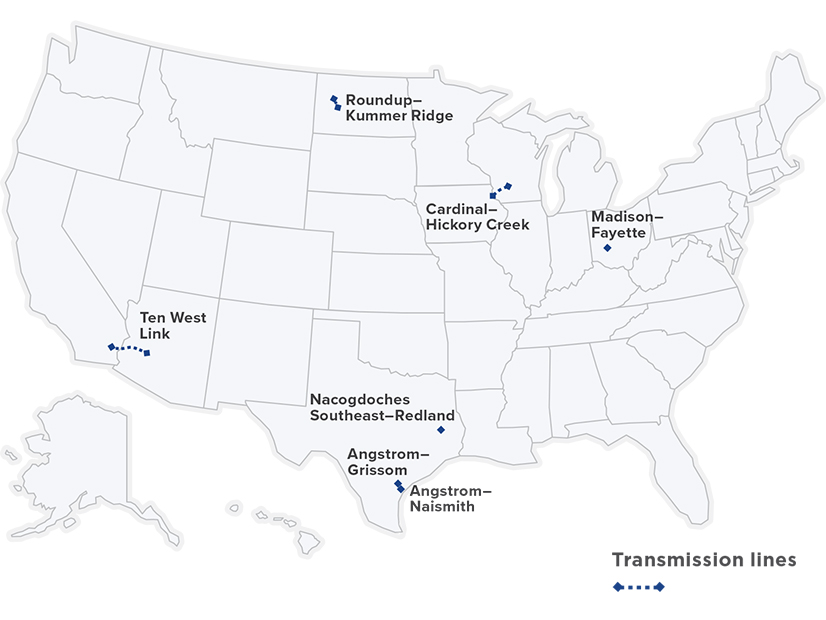
Americans for a Clean Energy Grid and Grid Strategies said July 21 that just 322 miles of lines rated at 345 kV or greater were completed in 2024, the third-lowest total among the past 15 years.
This creates potential stress for critical sectors whose electricity needs are growing, they said, such as artificial intelligence, computer chip fabrication and advanced manufacturing.
“We’re seeing a serious mismatch between where we are and where we need to be,” Christina Hayes, executive director of Americans for a Clean Energy Grid, said in announcing the report.
The two organizations called for ambitious multi-regional transmission planning as well as permitting reform.
“We know that thousands of miles of transmission can be built each year because in 2013 we did it, with California, Texas, the Southwest Power Pool and Midcontinent Independent System Operator all building hundreds of miles,” Grid Strategies President Rob Gramlich said in a news release.
The U.S. Department of Energy in October 2024 addressed the issue with release of its National Transmission Planning Study. (See DOE Funding 4 Large Tx Projects, Releases National Tx Planning Study.) That study found that under various scenarios, the transmission network in the contiguous United States would need to be 2.1 to 3.5 times larger in 2050 than in 2020.
The 2.1x model would imply an addition of roughly 5,000 miles a year, the ACEG/GS report states. The only year in the study period that approached this was 2013, when approximately 4,000 miles of 345-kV and 500-kV lines were completed.
As an added benefit, the report noted, high-voltage lines are more cost-effective per megawatt and enhance resource adequacy by allowing capacity sharing across regional boundaries at times of grid stress.
The Interregional Transfer Capability Study that NERC filed in November 2024 recommended 35 GW of such capacity be added. (See NERC Releases Final ITCS Draft Installments.)
The ACEG/GS report notes that significantly more miles of natural gas pipelines than high-voltage transmission have been built in the past five years, and notes that no siting authority for power lines exists that is comparable to FERC’s authority to site interstate gas lines.
Looking ahead, the report cites NERC data indicating 7,098 miles of lines greater than 345 kV under construction or planned through 2032 nationwide. And multiple regions are beginning to plan new 765-kV lines as higher-capacity corridors that move energy efficiently over long distances.
The ACEG/GS report concludes with the assertion that federal leadership in adopting the requirements of FERC Order 1920 now must be matched, and strongly, by regional implementation.
“Planners should treat Order No. 1920 as a floor, not a ceiling, building on its foundation for ambitious, proactive and multi-value regional transmission planning and cost allocation,” the authors wrote. “In parallel, permitting reforms, targeted funding and state-federal collaboration can help ensure that projects move from planning phases to steel in the ground.”