Strong winter discounts on electricity delivery rates are needed to more fairly charge Massachusetts homes with heat pumps for their share of grid costs, according to a new report commissioned by a coalition of environmental groups.
Written by climate policy think tank Switchbox, the report estimates that heat pump owners are being overcharged by an average of 23% during the heating season and finds that seasonal discounts could make electrified heating cheaper than natural gas heating for most residential consumers. It also finds that heat pump rates could help address significant cost barriers to heat pump adoption in the state.
“Heat pump customers are subsidizing everybody else, and that’s why they’re being overcharged,” Juan-Pablo Velez, one of the authors of the report, said during a webinar July 22.
Because New England has a summer-peaking power system, incremental demand during the heating season generally does not add to the cost of the grid, he said. However, volumetric delivery charges incurred during the winter frequently cause heat pump owners to pay more than their fair share of system costs, Velez said. “There is plenty of capacity to go before we run out of room with the existing [winter] capacity,” he said.
ISO-NE forecasts the region transitioning from summer-peaking to a winter-peaking system by the mid-2030s, largely because of heating electrification. The timing of the shift likely will depend on the pace of heat pump adoption.
The Massachusetts Department of Public Utilities already has directed the state’s investor-owned utilities to adopt specific heat pump rates. However, advocates for heating electrification argue that these rates do not fully address the issue of overcharging heat pump owners and have urged the DPU to direct the utilities to roll out steeper discounts aimed at more closely calibrating delivery costs with the grid impacts of electrified heating.
In December, an interagency working group recommended that the DPU require the utilities to establish more aggressive winter heat pump discounts. (See Mass. Electricity Rates Working Group Issues Recommendations.)
Under this updated discount, houses with heat pumps would pay roughly the same delivery costs as those heated by gas during the heating season. Supply costs would not be affected by the discount, and heat pumps still would pay for their full supply costs throughout the year.
Kyle Murray, director of state program implementation at the Acadia Center, emphasized that heat pump rates do not represent a “handout to heat pump owners.”
“Even though heat pump owners are using more energy than their non-heat pump counterparts, they’re not actually causing more stress on the system,” Murray said. “Heat pump rates just simply represent fairness in ratemaking.”
The DPU in March opened an investigation into requiring new heat pump rates following the 2025/26 heating season (DPU 25-08). In comments in the proceeding, the Massachusetts Department of Energy Resources supported the working group’s proposed rate, writing that the lower, DPU-approved heat pump rate “would provide approximately one-third to one-half the savings each winter-heating season as compared to the [working group’s] proposed heat pump rates.”
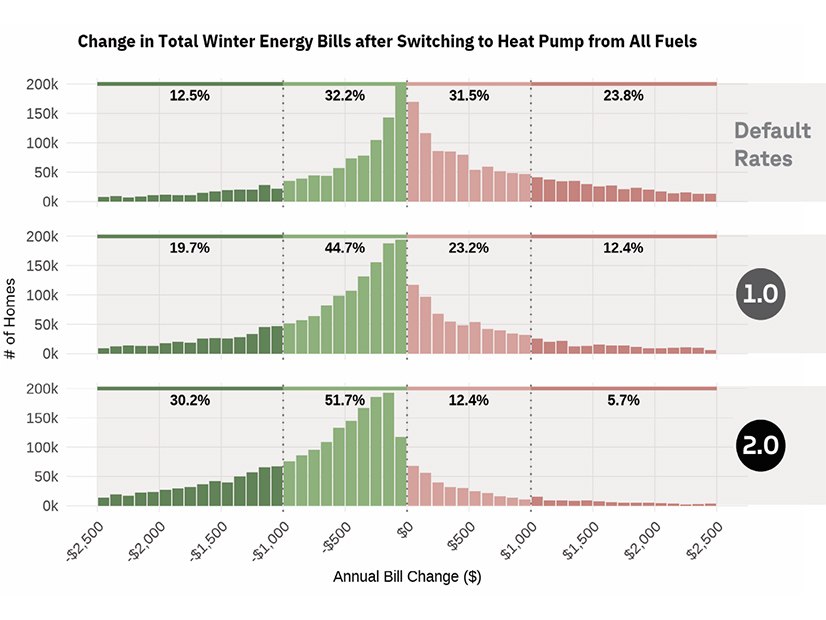
The Switchbox report found that “across all homes in Massachusetts, the median electric bill for heat pump customers would decrease by 12% under the DPU’s 1.0 rates and by 23% under DOER’s proposed 2.0 rates.”
Under default rates, about 55% of customers switching to a heat pump would see an increase in their annual energy costs, the report found. Adopting the DPU-approved heat pump rate would improve this cost comparison, reducing annual energy costs for about 64% of customers that make the switch, the report notes.
Unsurprisingly, the report found that the higher discount rate supported by the DOER would bring the greatest savings for heat pump owners and estimated that 82% of Massachusetts households converting to heat pumps would save money under the rate.
Massachusetts has set aggressive targets for heat pump deployment and will need to significantly accelerate adoption in the coming years to meet its climate targets. The state estimated in early 2025 it will need to double its rate of heat pump conversions between 2025 and 2030 to meet its deployment goals.
Seasonal heat pump rates likely will be a short-term solution for the state as its utilities work to deploy advanced metering infrastructure, speakers at the webinar noted.
“In about three or four years, everybody in Massachusetts should have an advanced meter,” which will require a new set of rate structures, said Larry Chretien of the Green Energy Consumers Alliance. He added that while seasonal heat pump rates may be a relatively short-term solution, they are an important tool for eliminating excessive cost burdens on heat pump owners over the next few years.