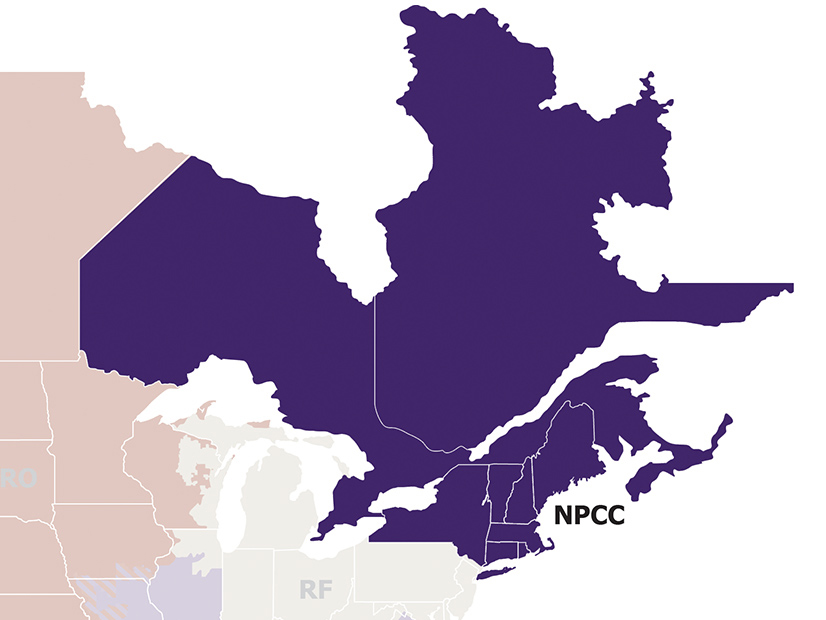
FERC has approved a set of amendments to the Northeast Power Coordinating Council’s bylaws that aim to broaden the regional entity’s purpose, modify membership eligibility and voting rights of members and the Board of Directors, and update its organizational structure.
NERC and NPCC filed the amendments in February, asserting they raised no reliability issues and “continue to satisfy the five governance criteria” for NPCC’s bylaws in the RE’s delegation agreement. Those criteria are that the RE:
-
- be governed by an independent or hybrid board;
- assure independence in its rules from power system owners and operators;
- let its membership be open with no more than a nominal fee;
- ensure no sector exercises dominance over its actions; and
- provide the public with reasonable notice and opportunity for comment.
FERC approved the changes in a July 21 filing (RR25-2).
The amendments apply throughout the RE’s bylaws, starting with Article II, where the requirement that NPCC’s principal office be located in Manhattan has been removed; now the office may be located anywhere within the NPCC geographic region. Additional language will allow the principal office to remain in its established location if that area is removed from the NPCC footprint.
In Article III, the language detailing NPCC’s purpose has been updated to widen the type of agreements the RE can enter with Canadian provincial authorities. Previously it included only memoranda of understanding. The article now also says NPCC may use any “lawful activity necessary or appropriate to achieve” its electric reliability mission.
Article IV has been updated to remove “the ability of a natural person to be an NPCC member” and require member applicants to “have a material interest in the reliable operation of the Northeastern” electric grid. NERC and NPCC said these changes would improve the handling of sensitive information discussed at member meetings by ensuring that anyone present at such meetings is a member of an organization with its own governance and accountability policies.
In addition, single end use customers no longer can be members of NPCC, in line with the requirement that a member not be a natural person, and other REs also cannot be members because “it is not necessary.” NERC said none of these changes will affect any existing members “because there are no natural persons, single end use customers or [REs] that are currently members of NPCC.”
The organizational changes in Article V specify that NPCC’s president also is the CEO and clarify the duties of the office. Language also has been modified in Article V to allow board vacancies to be filled by a simple majority vote of directors present at a meeting. This change ties into the modifications in Article VI that permit up to five independent directors, including the board chair; previously, two of the 16 directors were required to be independent, in addition to the chair. The chair’s term also has been lengthened from two to five years, with a maximum of two terms.
NPCC simplified the board’s quorum requirements to allow a quorum to exist with at least 50% of the directors present, including at least two independent directors. Previously, attaining quorum required at least one independent director and at least half of stakeholder directors in each of at least 60% of the sectors, meaning that quorum could be reached with as few as six directors present or denied with up to 10 directors present, depending on their sectors. The change will eliminate this ambiguity.
Voting requirements also have been changed to allow motions to pass based on a majority vote of directors present at a meeting, rather than the previous two-thirds sector-weighted majority. This update also is meant to simplify voting, particularly in light of the planned expansion of independent directors.
Similarly, members’ voting rights have been updated to allow a quorum with at least 50% of members present instead of half of members in at least 60% of stakeholder voting sectors. Motions also may pass based on a majority vote of members present, rather than a two-thirds sector-weighted majority.
The amendments also will change the names of three board committees. The Corporate Governance and Nominating Committee will become the Governance and Nominating Committee, the Management Development and Compensation Committee will become the Compensation Committee, and the Pension Committee will become the Retirement Plan Investment Committee.
Finally, NPCC added new provisions to Article XVIII, which covers dissolution of the RE, to state that a two-thirds affirmative majority vote of members is required to terminate NPCC as a corporation. The distribution of assets upon dissolution has been modified to reflect NPCC’s new status as a 501(c)(3) organization.