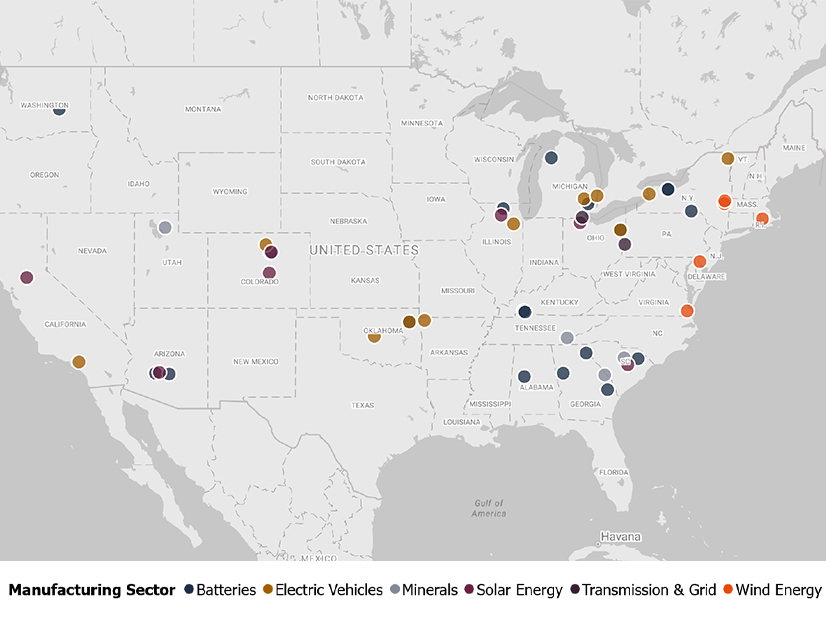
An effort to quantify growth of the clean energy sector has evolved into a tally of its contraction during the second term of President Donald Trump.
Announced cancellations, closures and cutbacks in new manufacturing and clean energy projects in the first half of 2025 were valued at $22.1 billion by the business policy group E2.
This was more than triple the $7.2 billion in new investments announced in the same time frame.
E2 based its analysis on projects recorded by it and the Clean Economy Tracker. It said $6.7 billion worth of pullbacks were reported in June alone, as Congress was finalizing a reconciliation bill containing many of Trump’s priorities, including cancellation of subsidies for clean energy and emissions-free transportation.
Major automakers’ moves to cut back investments in electric vehicle production accounted for much of the June total, E2 said. In one of the most glaringly literal shifts, GM announced June 10 it would build gas-powered SUVs and pickup trucks at the Orion, Mich., plant where it had planned to invest $4 billion in EV production.
E2 noted these numbers are not sterile statistics but jobs and economic activity that are being lost or never will be created.
“By effectively ending clean energy incentives, Congress is turning its back on thousands of American workers and dozens of communities that were ready to build our energy future and strengthen America’s competitiveness,” E2 Communications Director Michael Timberlake said in a July 24 news release.
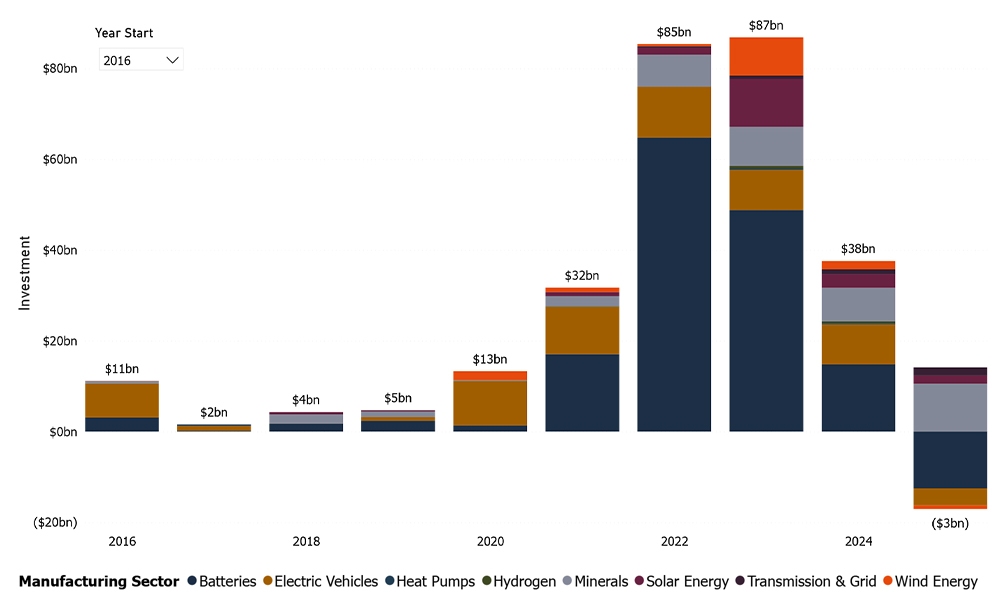
The investment announcements tallied by E2 and the Clean Economy Tracker show a correlation to 2022 passage of the Inflation Reduction Act, with its slew of promised tax credits, and the federal elections of 2024, which handed federal policymaking power to a Republican trifecta opposed to such credits.
Announced investment totals (minus later cancellations) were $43.5 billion in 2022, $64.3 billion in 2023 and $18.3 billion in 2024.
From Jan. 1, 2022, to June 30, 2025, this totaled $133.3 billion invested in 402 projects with 122,952 jobs expected to be created.
The value of announced project cutbacks was $744 million in 2023, $2 billion in 2024 and $22.1 billion so far in 2025. That consists of 58 projects with 26,187 jobs eliminated or not created.
Clean energy advocates had hoped that hometown interests would cause defections in the Republican ranks and derail the efforts to revoke the tax credits — Republican-controlled congressional districts are home to 62% of projects announced, 72% of expected job creation and 81% of planned investments.
But the Republican majority held firm, though apparently with some moderation to the most severe cutbacks proposed during intra-party negotiations. President Trump signed the reconciliation bill into law on July 4.
What’s Next?
Looking ahead, analysts see continued project cancellations amid the wholesale federal policy shift to fossil fuels, particularly for wind and solar power, which have been singled out for rapid loss of tax credits.
FTI Consulting predicted the impact will be significant.
“We conservatively estimate that more than 320 proposed wind and solar projects with a total capacity of over 100 GW would no longer be economically viable, making it significantly harder, if not impossible, to attract capital and meet key development milestones,” the Washington, D.C., consulting firm wrote July 16.
This sets up ripple effects in the grid, FTI wrote, as it removes planned capacity additions at a time of growing demand. Wholesale power prices and renewable energy certificate prices are likely to rise as a result, it said.
FTI’s update also notes that the reconciliation bill is likely to have a chilling effect on green hydrogen development.
But more broadly, beyond the wording of the bill, there is the concerning prospect that the Trump administration may use an all-of-the-above approach — including permitting reforms, restrictions on ownership and operational guidelines — to maximize disruption to the clean energy transition.
In mid-2025, momentum remains from the Biden administration.
Wood Mackenzie and the American Clean Power Association on July 28 released their U.S. Wind Energy Monitor report, which shows rising construction activity in the wind power sector.
The first quarter of 2025 saw 2.1 GW of installations, more than double the year-ago pace. Full-year construction is projected to be 8.1 GW, compared with 5.2 GW in 2024 and 7.0 GW in 2023.
But this still would be down from 17.5 GW, 13.9 GW and 11.6 GW in 2020-2022.
Further, a barometer of future activity is trending downward: wind turbine orders were 50% lower in the first half of 2025 than year-ago levels, reaching their lowest level since 2020 — a decline ACP attributed to tariffs and policy uncertainty.
“Market volatility will prompt a short-term decrease in onshore additions,” Leila Garcia da Fonseca, director of research at Wood Mackenzie, said in a news release. “A quarter-over-quarter net reduction of roughly 430 MW in the U.S. onshore wind outlook from 2025-2029 reflects growing uncertainty for currently under-development projects, mainly driven by ongoing permitting challenges, tariff risk and now a sunset of tax credits.”