Real-time Co-optimization Project Sailing Through Market Trials
ERCOT says all systems are go — or more specifically, green — and early market trials have been successful as the Real-time Co-optimization plus Batteries (RTC+B) project barrels to its Dec. 5 go-live date.
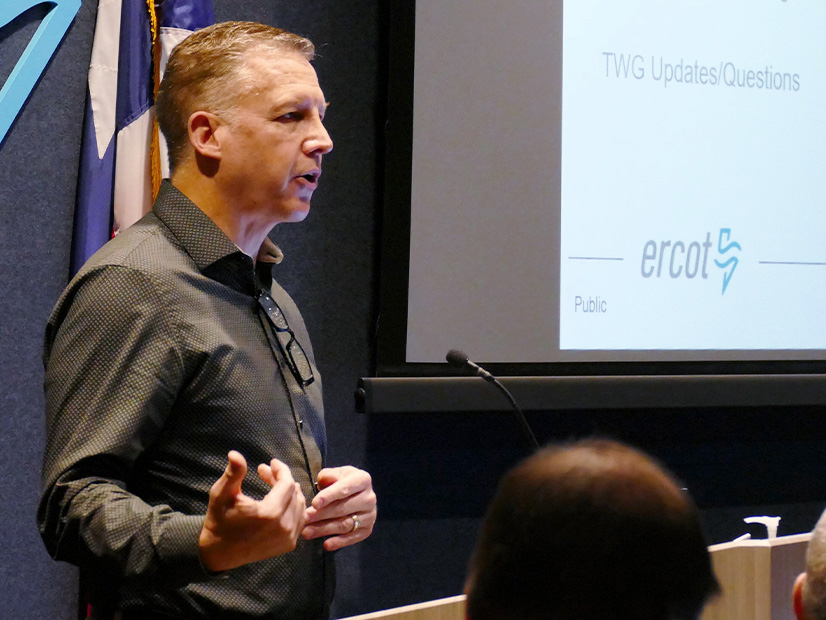
Matt Mereness, RTC+B’s project manager, told the Technical Advisory Committee on July 30 that market trials conducted in May and June were successful. Every resource was able to establish connectivity with ERCOT systems and submit at least one bid, and qualified scheduling entities added 99.5% of about 26,000 telemetry points to the current model.
“Thank you for helping get everything green,” Mereness said as he shared data from the trials.
The market trials are continuing in July and August, where the focus is on initial real-time market execution and verifying QSEs’ ability to follow ERCOT frequency signals. In September, the optional day-ahead market begins along with a required live-production test to ensure effective frequency dispatch and control.
“Not perfect, but hey, this was Week 1,” Mereness said. “This is what we expected. ERCOT wasn’t perfect either.”
The RTC+B initiative began last decade but was delayed by 2021’s Winter Storm Uri. The program will allow the market to optimize ancillary services and energy simultaneously in real time, with the goals of reducing overall costs and making it easier to dispatch energy resources more efficiently.
NPRRs to be Categorized
The committee’s leadership has scheduled an Aug. 25 workshop to prioritize existing protocol changes and those still being developed. ERCOT’s Keith Collins, vice president of commercial operations, asked for the workshop to balance delivering RTC on time while also addressing legislative directives from the most recent session and the existing backlog.
Collins suggested dividing Nodal Protocol revision requests (NPRRs) into tiers, with the top tier classified as those that are critical. Other NPRRs would be designated as “what’s that next batch?”
“When you have these really complicated processes, whether it’s RTC or maybe it’s [fuel] firming … if we keep kind of piling stuff on, we’re going to end up right back where we are,” Collins said. “What we’ve got to do is solve the current problem, and then we’ll work on the other things.”
Members discussed whether to hold the workshop annually or quarterly. Collins said the pace of workshops has yet to be determined.
“We’ve got to manage what’s coming into the reservoir and what’s going out of the reservoir,” he said. “If we do an effective job in an orderly way, we’ll sort of move through the backlog and then the stream just flows normally and we don’t have to worry about this anymore. It’s just the backlog is, as noted, large, and it could be years.”
Garza, Reid Join TAC
TAC welcomed two new members to its consumer segment: former Independent Market Monitor Beth Garza and Air Liquide’s Mike Reid, who will represent the residential consumer and industrial segments, respectively. Garza replaces Eric Goff, who runs Goff Policy, while Reid replaces LyondellBasell’s Eric Schubert.
Garza led the IMM for more than five years before leaving the position in 2019. She has been a senior fellow with the R Street Institute since 2020.
‘Penny’ 0.01-MW Bids
Committee members agreed to place all four NPRRs up for consideration on the combination ballot, which is essentially a consent agenda. The NPRRs were all unopposed at the Protocol Revision Subcommittee, responsible for reviewing and recommending protocol changes.
Members did discuss NPRR1289, which would provide an option pricing report that would be posted following each congestion revenue rights (CRR) auction. The report would contain shadow prices for all biddable source-sink paths for each month within each time-of-use for the auction period. It also establishes a minimum CRR bid of 1 MW.
“Today, people can use a 10th of a megawatt for price discovery or as a very small investment. So, that’s No. 1: getting rid of a lot of small noise on the quantities, and that is something that does take a system change,” Mereness said. “People have said one of the reasons for the 10th-of-a-megawatt penny bids is so they know the value of a path, and so this report that we need to develop is a source-sink pairing for all options.”
“At the end of the day, this is a moving target. I’ve said we’re going to be right back here,” said Seth Cochran, with energy trader Vitol. “We need a total state change with our computational power, or we need to figure out other things that we can do.”
Members agreed to have the Congestion Management Working Group continue to monitor the issue and discuss implementation details.
The combination ballot included three other NPRRs, three revisions to the Settlement Metering Operating Guide (SMOGRRs), and single changes to the Retail Market (RMGRR) and Planning (PGRR) guides and to the Verifiable Cost Manual (VCMRR) that, if approved by the Board of Directors, will:
-
- NPRR1277: revise the minimum current exposure and estimate aggregate liability (EAL) formulas, improving the efficacy of existing credit formulas that measure credit exposures in the ERCOT market. The EAL formula revisions include applying the real-time forward adjustment factor against the respective days’ real-time liability estimated (RTLE) and then taking the max over the lookback period; and introducing seasonal variability in the lookback period as it is applied for RTLE.
- NPRR1281: strengthen the relationship between the settlement of firm fuel supply service (FFSS) and operations by clarifying its hourly rolling equivalent availability factor language to ensure the accurate calculation of the FFSS standby fee.
- NPRR1288: simplify the CRR auction by removing the ability to transact in multiple month strips that create optimization issues for ERCOT.
- RMGRR183: incorporate various updates that have been implemented as part of previous project improvements to transmission and/or distribution service providers’ Competitive Retailer Information Portal self-service tool. TDSPs will be able to assign weather moratoriums by county name instead of service territory.
- PGRR120: prevent generators from interconnecting to the ERCOT grid if they would be radial to a series capacitor under N-1 conditions.
- SMOGRR032: incorporate the Other Binding Document “TDSP Access to EPS Metering Facility Notification Form” to standardize the approval process.
- SMOGRR033: incorporate the Other Binding Document “TDSP Cutover Form for EPS Metering Points” to standardize the approval process.
- SMOGRR034: remove obsolete gray-box language associated with NPRR1020 (Allow Some Integrated Energy Storage Designs to Calculate Internal Loads).
- VCMRR044: set the variable O&M in the mitigated offer cap for hydro generation resources to the real-time systemwide offer cap and the incremental heat rate value to zero.