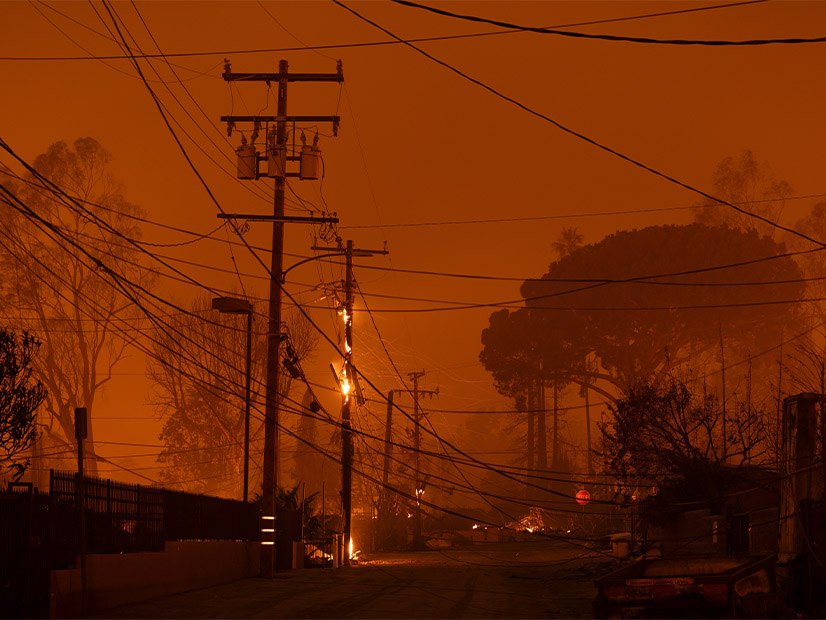
California Gov. Gavin Newsom is promoting legislation that would add billions of dollars to California’s utility wildfire fund after deadly fires destroyed more than 18,000 homes in the Los Angeles area in January.
Of the proposed $18 billion, $9 billion would be paid for by utility customers and the other $9 billion by shareholders of each participating utility in the fund. Customer contributions would come from a 10-year extension of an existing non-bypassable charge on customer electric bills that currently expires in 2035, the governor’s office told RTO Insider.
“This is an existing charge, so customers will not experience an increase in their bills from this proposal, while shareholders will be required to immediately commit to collectively contribute an additional $9 billion,” Newsom’s office said.
“We continue to work with the Legislature on policy that will stabilize California’s Wildfire Fund to support the recovery of wildfire survivors and to protect California utility consumers — even as wildfires become bigger and more destructive due to climate change,” Newsom’s office added in a separate statement.
The L.A. wildfires created significant uncertainty regarding the adequacy of the wildfire fund “to protect against electrical corporation bankruptcy risks and undermined confidence in the financial stability of the state’s electrical corporations,” the draft legislation says.
“The prospect that electrical corporations and their customers could be required to bear, on an ongoing basis, losses of the magnitude of those wildfires is unsustainable,” the draft says.
Financial markets are demanding higher costs for capital to account for the increased risk of investing in or lending to California’s electric companies, which increase electricity rates, the draft says. The wildfire fund’s durability is “being further compromised by hedge funds and other speculators seeking to profit from the fund,” the draft says.
After the January 2025 wildfires, some insurance companies sold their subrogation rights to private equity and hedge funds, which “profit by demanding even higher recovery than the insurance companies, draining the wildfire fund’s resources and capacity to pay fire victim claims,” the draft legislation says.
The draft legislation is supposed to stop hedge fund speculation by capping insurance subrogation claims at 40%, the governor’s office said.
The state’s wildfire fund began in 2019 after years of deadly fires ignited by Pacific Gas and Electric’s equipment sent the utility into bankruptcy court. The wildfire fund is financed by PG&E, Southern California Edison (SCE), San Diego Gas & Electric and California electricity ratepayers.
Of the L.A. fires, the Eaton Fire and the Palisades fire were the two most destructive. The L.A. County Fire Department and the California Department of Forestry and Fire Protection (Cal Fire) are still investigating the cause of the Eaton fire, but videos of the fire’s early stages suggest a possible link to SCE’s equipment, SCE representatives said in February. (See SCE Probes Link Between Equipment and Eaton Fire.)
On July 23, SCE announced a new wildfire recovery compensation program for victims of the Eaton Fire. The program is expected to operate through 2026, a company press release said.
Separately, the California Public Utilities Commission (CPUC) on July 28 issued a proposed decision that approves SCE’s 2025 general rate case to increase customer bills by $16.15 per month on average. A significant portion of the rate case is for capital expenditures for wildfire reduction risk purposes — about $5.1 billion for wildfire mitigation work from 2025-2028, the proposed decision says.
The CPUC decision approved about $3.1 billion of the request, “reflecting our judgment that the long-term benefits of these investments justify the costs,” said CPUC administrative law judges Colin Rizzo and Ehren Seybert, who co-wrote the proposed decision.