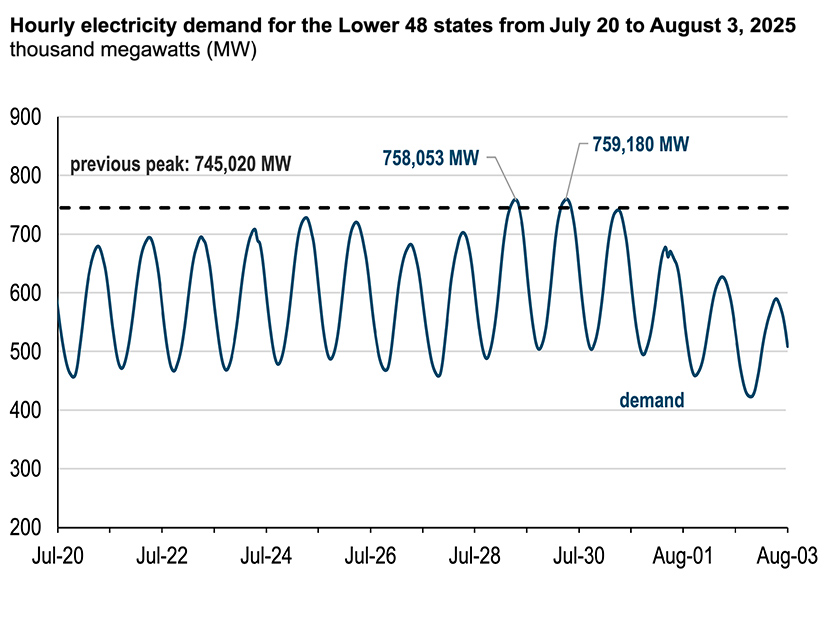
Peak electricity demand in the 48 contiguous states set records twice in the last week of July, reaching 758,053 MW and 759,180 MW over one-hour periods July 28 and 29.
The U.S. Energy Information Administration announced the developments Aug. 5 and attributed it to a heat wave coming amid the continuing growth of power demand.
The previous record was 745,020 MW, recorded July 15, 2024.
There is disagreement about how much and how quickly U.S. electric demand will increase, but there is wide consensus that growth will occur, due to transportation and building electrification, reshoring of manufacturing and rise of energy-intensive artificial intelligence data centers.
The EIA’s forecast calls for electricity demand to grow by an annual rate of just over 2% in 2025 and 2026.
This is a marked change from much of the century so far, EIA said, noting that average annual increase in demand was only 0.1% from 2005 to 2020 and just 0.8% between 2020 and 2024.
The back-to-back demand records at the end of July 2025 came as much of the nation was within a heat dome, subjecting tens of millions of Americans to very high temperatures and causing their air conditioners to consume more electricity.
Preliminary data from EIA’s Hourly Grid Monitor indicates the new all-time peak, 759,180 MW, was reached about 6 p.m. Eastern time July 29.
The Grid Monitor indicates that in the 60-minute period:
-
- The highest demand was in the Mid-Atlantic (154,380 MWh), Midwest (129,574 MWh) and Texas (81,572 MWh).
- The major energy sources meeting this demand were natural gas (348,891 MWh), coal (133,711 MWh), nuclear (95,287 MWh) and solar (88,389 MWh).
- Two other renewables were far behind — hydropower was near its peak output for the day at 39,392 MWh, while wind turbines produced only 25,772 MWh, down 57% from their peak output for the day, reached 16 hours earlier.
- The U.S. imported 5,883 MWh from Canada and exported 230 MWh to Mexico.
Daily demand peaks began to subside after July 29, preliminary data shows, dropping to 631,287 MWh from 6-7 p.m. Aug. 1.
Over the weekend, the peaks dipped further to 588,925 and 600,233 MWh. They bounced back to 645,449 MWh as the work week began Aug. 4.