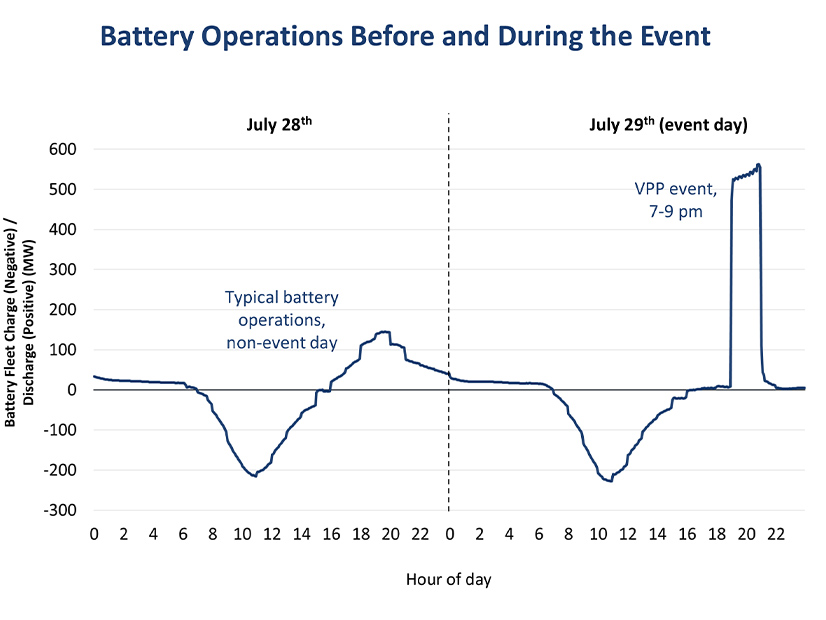
An aggregation of more than 100,000 residential batteries provided an average 535 MW of support to California’s electricity grid during a July 29 test to prepare for the hot summer period ahead.
The sea of home batteries formed a virtual power plant, comprising a group of customer-owned battery storage systems that are typically paired with solar panels. Local utilities, CAISO, the California Energy Commission and other energy companies, such as Sunrun, released charge from the fleet of batteries onto the grid for two hours, from 7 p.m. to 9 p.m.
The VPP visibly reduced CAISO’s net load during those peak demand hours, said representatives of The Brattle Group, which studied the results of the test.
“Performance was consistent across the event, without major fluctuations or any attrition,” said Ryan Hledik, a Brattle principal. “Residential batteries — and other sources of distributed flexibility — can serve CAISO’s net peak, reduce the need to invest in new generation capacity, and relieve strain on the system associated with the evening load ramp.”
Most of the 535 MW would not have been available had the test not been initiated, according to Brattle.
“On peak days, using VPPs to serve CAISO’s net peak could reduce the need to invest in new generation capacity and/or relieve strain on the system associated with the evening load ramp,” Brattle said, adding that would help address challenges with California’s “duck curve.”
“Optimized VPP program design and coordination with the system operator could further maximize the value of the battery output to the system,” Brattle noted.
Pacific Gas and Electric customers made up about 50% of test participants, Southern California Edison about 38%, and San Diego Gas & Electric about 12%.
Most of the batteries in the test are part of the CEC’s Demand Side Grid Support (DSGS) program, which rewards customers who support the electric grid during extreme events. Rewards include payment for demonstrated capacity at varying monthly rates based on VPP capacity and duration, according to the CEC.
As of October 2024, the DSGS program had 515 MW of capacity and more than 265,000 participants. The program, which began in 2022, operates from May to October and is intended to help reduce the risk of rotating power outages during peak demand months. In 2024, the DSGS program turned on its VPP system 16 times.
The test on July 29 was not the first of its kind this summer: On June 24, Sunrun participated in a similar event in which its power resources provided 325 MW to the grid from 7 to 9 p.m, according to Sunrun. Participating Sunrun customers can receive up to $150 per battery per dispatching season, while Sunrun is paid for dispatching the batteries, the company said.
The CEC on Aug. 14 is holding a workshop on the performance of the DSGS program in 2024, specifically on VPP performance.