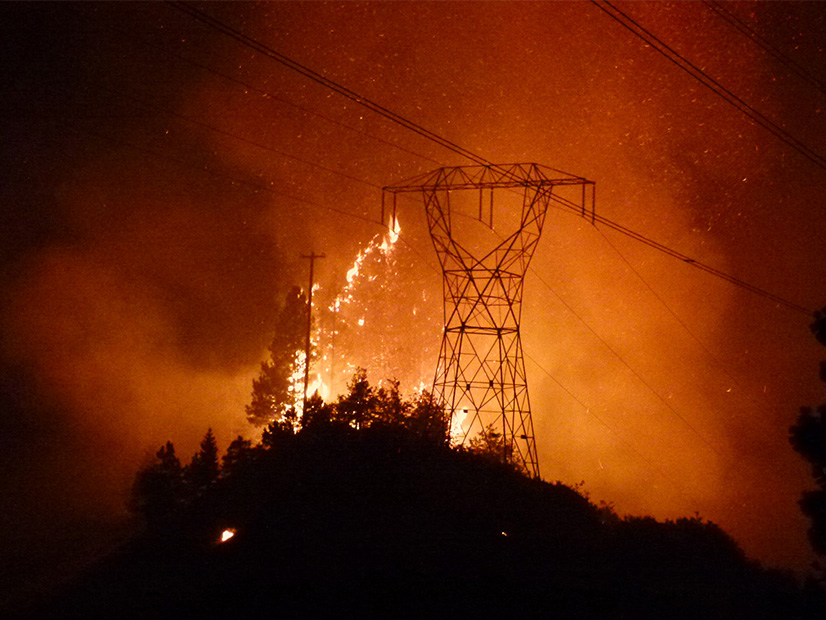
As large swaths of the West continue to explore ways to mitigate wildfire risk, utilities say information sharing and new technologies allow them to implement targeted public safety power shutoffs (PSPS).
Representatives from three utilities discussed PSPS during a webinar hosted by WECC on Aug. 6. A PSPS is when an electric utility temporarily shuts off power to reduce the risk of wildfire caused by the company’s equipment.
Southern California Edison, which serves about 15 million customers, has approximately 1,800 weather stations that are deployed across high-risk wildfire areas and provide real-time updates on conditions, said Kevin Alirez, a senior adviser with the utility.
But in an effort to avoid PSPS, SCE has “aggressively pursued grid-hardening efforts” around areas that are most prone to PSPS, including undergrounding of transmission lines and covering conductors, Alirez said.
“We’re installing more isolating devices as well across our distribution circuits so that we can be more surgical and more precise on those specific areas across our grid to do those de-energizations,” he added.
SCE also is looking at microgrids as a strategy for PSPS “where it makes sense,” according to Alirez.
“Battery energy is a big thing coming out too,” Alirez said. “So where can we potentially add battery energy storage units across our grid that would make most sense from a PSPS de-energization perspective?”
Carrie Laird, managing director of emergency management and meteorology at PacifiCorp, said PSPS is a last resort in wildfire mitigation.
In order to reduce the impact of PSPS, PacifiCorp focuses on sectionalizing its system “so that we can impact smaller subsets of customers with the introduction of … smart protective devices, early fault detecting devices,” Laird said.
The utility uses cameras powered by artificial intelligence, among other technologies, to detect wildfires faster, according to Laird.
Laird also noted that because of the challenging geography of PacifiCorp’s service area, the utility’s communications connections to its transmission and distribution system have been “pretty far behind the big California utilities … so that’s a huge area of focus.”
For the Public Service Company of New Mexico, PSPS is a great tool, but the goal is “to never have to do a PSPS,” according to Thad Petzold, associate director of wildfire risk and vegetation management.
“The first thing you do when you decide you’re going to have a PSPS policy is try to minimize the impact to your customers,” Petzold said. “And so you’re using sectionalizers, and you’re figuring out ways to really make those areas more granular … this isn’t something that we necessarily want to do, but it’s something that we will do for safety.”
An important part of ensuring that a PSPS has limited impact is collaborating with other utilities and states, he noted.
“Because … otherwise you’re stuck doing a lot of different trials and projects where you’re trying … that out and the data takes such a long time to really incorporate,” Petzold said. “So you look at what successful people do, you copy them, and you do it in, in our case, the most frugal way that we possibly can.”
Similarly, coordination and communication between utilities is important to avoid customer confusion, especially when the counterpart does not have the same type of PSPS planning, according to Laird.
Still, with the threat of wildfires growing and high fire-risk areas constantly changing and expanding, Laird said a PSPS “can happen anywhere if the combination of … the fuels and weather conditions are right.”
“It’s not just [a] California problem anymore, and it’s not just a … wild-urban land interface or rural problem either,” she added. “The topic of urban conflagration is a hot one right now. So the preparedness piece of this could happen anywhere, and helping our customers get to a space where they’re prepared should they be impacted is kind of an important area of focus.”