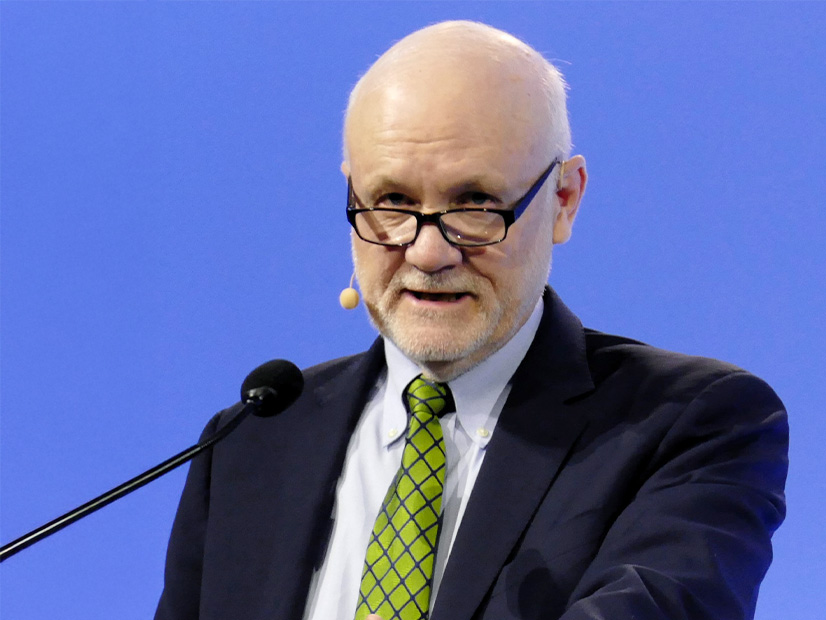
FERC Chair Mark Christie officially stepped down at the close of business Aug. 8, leaving the commission with a quorum of three until the Senate considers two pending nominees from President Donald Trump.
Christie already presided over his last meeting in July, which offered his colleagues a chance for a public send-off, and he took questions on his tenure. (See Christie Says Farewell to FERC at Final Meeting as Chair.)
He posted his last letter outlining FERC’s work over the previous week, which he started writing after Elon Musk emailed all federal employees asking them to send emails doing the same in February.
On Aug. 7, Christie posted on Musk’s social media site X that he had filed his last dissent as a FERC commissioner, in which he sided against the majority who partially granted a complaint Savion filed against PJM (EL25-63).
In the order, the majority sided with Savion, which argued it should have gotten an extension on an interconnection construction service agreement (ICSA) for a 66-MW solar development it was building at the same site, with the same point of interconnection, as an existing 111-MW solar plant it previously built. The project was built on a former surface coal mine in Martin County, Ky.
Savion argued PJM violated its rights under the ICSA, saying the RTO should have let it suspend work on the second part of the Martin project for 18 months after a construction firm building withdrew from the project unexpectedly and tariffs on solar panels were changed in 2024.
PJM said it was not eligible for suspension of the ICSA because the transmission infrastructure had been fully constructed.
FERC sided with Savion, finding that PJM improperly denied the suspension and saying that the 18-month suspension should be effective on Dec. 14, 2024, when Savion first requested it. Some work is left to be done on the interconnection facilities, which means the suspension still can go into effect, the majority reasoned.
Christie dissented, saying the order would let interconnection capacity go unused and further disrupt and delay PJM’s queue. AEP had finished building the transmission, and 111 MW of the Martin solar facility already was connected to the grid.
“The ICSA permits a project developer to suspend work ‘associated with the construction and installation’ of the transmission owner interconnection facilities,” Christie said. “Here, the record demonstrates that ‘construction and installation’ is complete.”
AEP has a couple of tasks to do, but the project is injecting power over the interconnection point. So just because some adjustments might be made, that does not mean there is remaining work that can be “suspended,” he said.
“The majority’s expansive reading of Section 3.4 would allow a customer to ‘suspend’ work through and including the time at which the project is operational and injecting power to the system and any time in the future,” Christie said. “This reading is illogical. It is plainly at odds with the purpose of suspension, which is to stop work on interconnection facilities when the generating facility is delayed (not when the generating facility is operational).”
Christie said PJM “hits the nail on the head” in its argument that the complaint is seeking to delay completion of the project and in the process “hoard the interconnection capacity” in a way that is unfair to other projects that use the capacity.
“The resulting delays and uncertainty hinder development of new generation and stifles competition, which harms PJM at a time when it desperately needs that new generation; instead, today’s order benefits a single developer to the ultimate detriment of consumers,” Christie said.