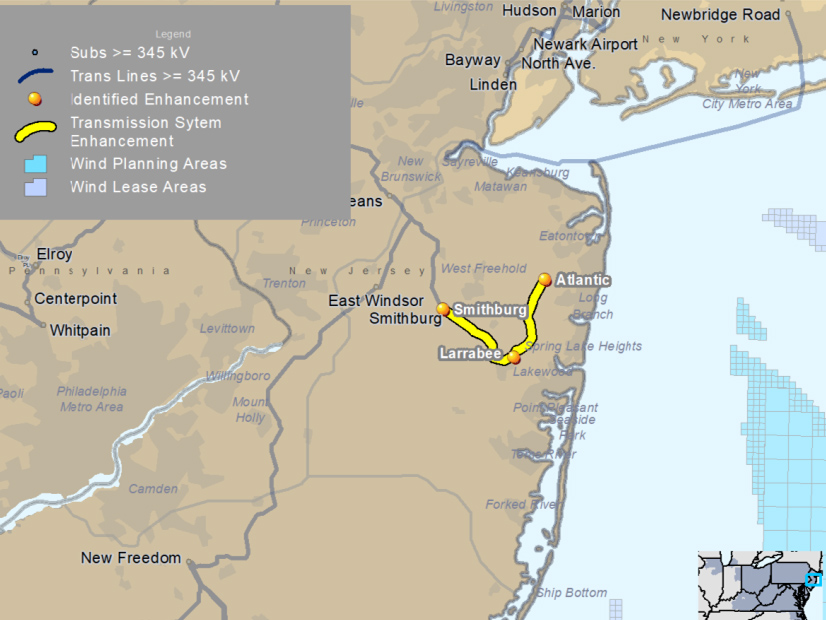
Bringing to a halt two major outstanding elements of New Jersey’s once-aggressive offshore wind plans, the state Board of Public Utilities postponed by 30 months all activities on onshore infrastructure intended to connect the wind farms to the grid.
The three BPU board members voted unanimously to delay all possible expenditures on the $1.07B project, which was approved in October 2022 and would deliver 6,400 MW of offshore wind generation. (See NJ BPU OKs $1.07B OSW Transmission Expansion.) Two seats on the five-member board are vacant after Commissioner Marian Abdou stepped down in July.
The project, at its outset, was widely seen as groundbreaking because it was conceived under FERC Order 1000’s State Agreement Approach, which enabled the BPU and PJM to work together to shape the plan. The project included three points of interconnection on Jersey Central Power and Light’s transmission system and included a new substation adjacent to the company’s Larrabee substation. BPU officials said at the time the project would save $900 million over a baseline scenario in which the projects were not coordinated.
Genevieve DiGiulio, project manager of offshore wind for the BPU, said that once the 30-month hold is over, there is a specific schedule for the projects to move forward. The BPU board at that time, however, will decide what happens next, she said.
The three commissioners also voted unanimously Aug. 13 to accept a request by Atlantic Shores, the state’s only remaining active wind project, to terminate its Wind Renewable Energy Agreement with the BPU. The project developer in June said it would put the 1.5-GW project on hold because of opposition from the Trump administration. (See Developer Shelves Atlantic Shores, Seeks to Cancel ORECs.)
“Obviously some federal uncertainty has created a situation where we need to make sure that we’re acting in a way that we always do what’s in the best interest of ratepayers,” said BPU President Christine Guhl-Sadovy. “And so this, along with some of the other actions today, are in response to some of those federal decisions around clean energy.”
The New Jersey League of Conservation Voters, saying the decision was a result of “President Trump’s clean energy ban,” called it a setback that nevertheless will “not stop our fight for a clean energy future in New Jersey.”
“Offshore wind is critical to our clean energy portfolio and to protecting our health, environment and economy. Every delay forces our residents — especially low-income families and communities of color — to breathe dirty air and bear the brunt of climate change,” said Ed Potosnak, executive director of New Jersey LCV. “Solar and wind are the cheapest forms of energy, and New Jersey deserves clean, affordable, renewable energy, and we will not stop until we achieve it.”
Solar Project Delays
The board also agreed to extend the development deadline for a series of solar projects in the Community Solar and Competitive Solar Incentive (CSI) programs that have been delayed by difficulties with the interconnection process with utilities. The CSI program is a part of the state’s Successor Solar Incentive (SuSI) program that sets incentive levels through a bid process for grid-scale projects.
Sawyer Morgan, a project manager in the BPU’s clean energy division, said that out of 451 projects in the community solar pipeline and five others in the CSI pipeline, about 160 submitted a request to the BPU for an administrative extension to project completion deadlines.
“The large number of projects entering the program simultaneously resulted in lengthy wait times for completion of facilities or engineering studies,” he said. “Stakeholders have reported concerns about the progress of interconnection with EDCs [electric distribution companies] and the opacity and unpredictability of the process.”
Most of the delays were created by the slowness in developing engineering studies, Morgan said.
The board agreed to extend the operation deadline for all projects in the two programs by nine months and allowed projects to request an additional six-month extension. The board also agreed to require developers to include a “completed facility study or equivalent feasibility or engineering study” to register a project.
In a bid to move projects forward more quickly, the board also required EDCs to publish a monthly interconnection queue inventory with data including the locations of projects applying for interconnection progress through the process and other requirements.
Commissioner Zenon Christodoulou suggested the BPU needs to orient developers to better handle delays.
“When we talk about unexpected delays, I mean, we’ve known about interconnection issues for years and years and years,” he said. “So these still remain to be issues … but it’s still unexpected? I think the developers should understand and should expect this.”