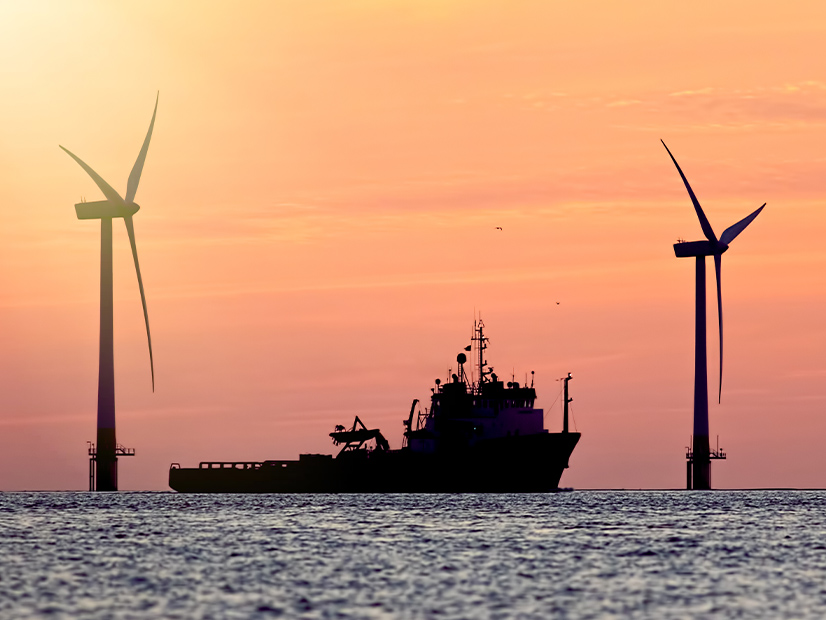
The Massachusetts Department of Energy Resources will delay its next offshore wind solicitation until “at least 2026” due to uncertainty around federal permitting, tax credits and tariffs.
The Massachusetts Department of Energy Resources (DOER) will delay its next offshore wind solicitation until “at least 2026” due to uncertainty around federal permitting, tax credits, tariffs and other investment risks that threaten to derail the state’s ambitions for offshore development.
The fate of Massachusetts’ previous procurement, which selected 2,678 MW from three project bids, remains unclear. (See Multistate Offshore Wind Solicitation Lands 2,878 MW for Mass., RI.) The state repeatedly has pushed back the timeline for finalizing contracts for these projects, with negotiations now slated to wrap up by the end of 2025. New England Wind 2, one of the selected projects, already has backed out of the negotiations.
“Massachusetts remains committed to an all-of-the-above approach to energy, including offshore wind,” said DOER spokesperson Lauren Diggin in a statement following the announcement. She added that the state plans to “develop a more flexible offshore wind procurement schedule so ratepayers can secure the best deals.”
The state began preparations for its next offshore wind solicitation in late 2024 and requested public comments on the procurement in May 2025. The DOER noted in an Aug. 7 memo that “commenters overwhelmingly recommended” waiting until at least 2026 to issue the next request for proposals (RFP) because of the uncertainty around federal policy and the ongoing negotiations for the previous solicitation.
The Trump administration has undertaken a multipronged assault on the U.S. offshore wind industry, halting leasing and permitting, rescinding designated wind energy areas, signing into law the expedited phase-out of federal tax credits, and recently launching an effort to overhaul all regulations related to wind generation. (See Dept. of Interior Launches Overhaul of OSW Regs.)
Offshore wind companies have reported significant financing challenges stemming from the Trump administration’s actions; Ørsted recently said it has been unable to reach a financing deal for up to $9.33 billion needed to finish construction on its Sunrise Wind project. (See Ørsted to Raise $9.3B, Self-finance Sunrise Wind.)
The company said potential investors were spooked by the Trump administration’s stop-work order on Equinor’s Empire Wind project. While Ørsted plans to raise money from existing shareholders to complete Sunrise Wind, the company and its investors remain in the dark as to whether the Trump administration will move to halt construction on Sunrise Wind or other in-progress projects.
In comments submitted to Massachusetts for its next procurement, Ørsted urged state regulators to focus on reducing risks to developers associated with changing federal regulations and macroeconomic conditions. It advocated for increased flexibility around commercial operation dates, longer price indexation timelines, inflation and interest rate adjustment mechanisms, and “provisions around force majeure for events beyond developer and state-level control.”
“These measures would help to counter complexities in the political and regulatory climate and macroeconomic conditions that have significant impacts on the long development timelines and high capital intensity unique to offshore wind projects,” Ørsted wrote.
Ocean Winds, the developer of SouthCoast Wind, one of the projects selected in the previous solicitation, wrote that the state should “focus on reducing the uncontrollable risks that would otherwise be assumed by developers,” and said these risks will translate into higher power purchase agreement prices if not addressed in the RFP.
The company also recommended that the state “wait for greater macroeconomic and political stability before releasing its next RFP,” and said uncertainty around interest rates, material and labor costs, and federal tax credits “[creates] significant financial risk and [undermines] confidence in long-term project viability, making it difficult for OW to proceed with a bid into the next Massachusetts auction.”
Vineyard Offshore wrote it “strongly recommends that Massachusetts consider material modifications to its form PPA contracts to address significant federal permitting, tariff and tax credit policy risks.”
The offshore wind developer also recommended “moving away from pre-published contracts to high-level term sheets that provide the necessary contractual information to inform bid price level but otherwise provide flexibility to negotiate durable contracts aligned with current market risks.”
Offshore wind development risks are not limited to the actions of the Trump administration. SouthCoast Wind and Commonwealth Wind (now New England Wind) both backed out of contracts during the Biden administration, part of an industry-wide wave of cancellations caused by rising costs from inflation, high interest rates and supply chain constraints.
‘Crucial’ for GHG Targets
The significant issues experienced in back-to-back offshore wind procurements underscores the significant challenges Massachusetts faces in scaling up the industry.
The state is counting on offshore wind to be a key component of its decarbonization strategy, and in 2022 set a goal of procuring 5,600 MW of offshore wind by mid-2027. The state has only the 804-MW Vineyard Wind project under contract, which is slated to come online around the end of 2025.
Meanwhile, ISO-NE has said repeatedly the reliability benefits of offshore wind resources, and continued long-term struggles of the offshore wind industry could create significant resource adequacy challenges for New England by the mid-2030s if power demand increases at the rate ISO-NE anticipates.
The Conservation Law Foundation said the DOER should seek to procure enough power to meet the state’s 5,600-MW goal in the next RFP and that offshore wind development “is crucial for keeping Massachusetts on track to meet its binding greenhouse gas emissions reduction targets.”